How are plastic bottles made?
A small, thick tube of plastic is warmed, stretched and blown up inside a bottle-shaped mold.
The big idea: Warm plastic stretches like a balloon. Compressed air pushes it out against a cold mold, and it sets in the mold's shape.
It's like blowing up a balloon inside a jar: it stretches until it presses on the glass everywhere, and takes the shape of the jar.
The interactive parts didn't load. The explanations below still work; try reloading the page.
From tiny tube to bottle
- A plastic bottle is light, clear and strong. It did not start out this big. It began as a small, thick tube. Let's see how the tube grows into a bottle.
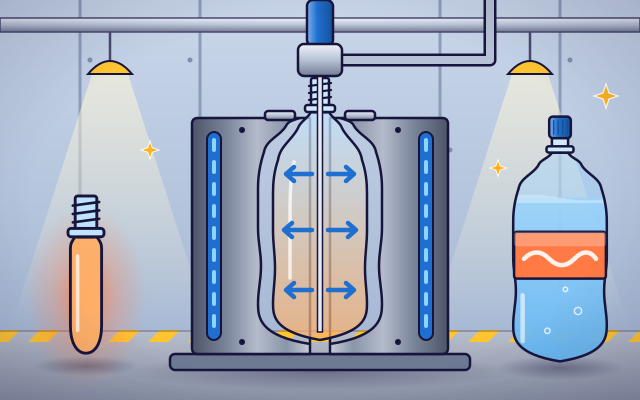
- Small plastic pellets are melted and pushed into a mold. Out comes a preform: a thick little tube. Its neck, with the screw threads for the cap, is already finished.
- Glowing lamps warm the preform as it turns, until it is soft and stretchy but not melted. The neck is shielded, so it stays cool and keeps its shape.
- The warm preform moves into a metal mold, and the two halves close around it. The hollow space inside is the exact shape of the bottle.
- A thin rod pushes down and stretches the soft tube longer. Then compressed air blasts in and blows the plastic out against the mold walls, like a balloon filling a jar.
- Cold water runs through the mold and keeps it chilly. The plastic touches the cold metal and sets in a second or two. The mold opens, and there is a finished bottle.
Look inside the blow mold
The mold is cut open so you can see inside. Tap each part.
- Preform. The preform is the starter piece: a small tube with thick walls. All the plastic for the bottle is in it, waiting to be stretched thin.
- Neck and threads. The neck with its screw threads is finished before the bottle is blown. It stays cool and hard, so it does not change shape.
- Stretch rod. The stretch rod pushes down through the neck and stretches the soft tube to the bottom of the mold, right down the middle.
- Compressed air. Air that has been squeezed into a tank rushes in through the neck. It pushes the soft plastic outward in every direction until it touches the mold.
- Mold halves. The mold is two metal halves with a bottle-shaped hollow between them. The plastic is blown against its walls and copies every curve and bump.
- Cooling water. Cold water flows through small tunnels in the mold. It carries the heat away, so the plastic sets firm the moment it touches the metal.
Warm it, then blow
Set the heater, then tap the air valve to blow. Try a cold tube, a warm one and a very hot one. What comes out of the mold?
Experiment: What happens if the tube is not warm enough when the air blows in?
- Slide the heater to cold and tap the air valve.
- Now warm the tube to the middle and blow again.
- Last, make it very hot. Look closely at the bottle.
What we found: A cold tube is stiff, so the air cannot stretch it and the bottle stays small. A warm tube is soft and stretchy and fills the whole mold. A tube that is far too hot turns cloudy and saggy. Bottle makers keep it in the warm middle.
Turn on JavaScript to try it yourself.
Three good bottles
The heater is warming the tube. Press Blow while the pointer is in the green band. Make 3 good bottles and waste as few tubes as you can.
How a tube becomes a bottle
Most drink bottles are made of a plastic called PET. The work starts with small pellets of PET. They are melted and pushed into a mold to make a preform, which looks like a thick test tube with a screw top. That screw top is already the neck of the finished bottle.
Next the preform is warmed by glowing lamps until it is soft and stretchy, but not runny. It has to be just right. Too cold and it is too stiff to stretch. Too hot and it turns cloudy and floppy.
The warm preform goes into a metal mold with a bottle-shaped hollow inside. A rod pushes it longer, and then compressed air blows it up, the way you blow up a balloon. The plastic stretches until it presses against the cold mold all over. It cools in a second or two and keeps that shape.
The balloon comparison works well, with one difference. A balloon shrinks back when the air comes out. The bottle does not, because the cold mold sets the plastic firm while it is still stretched. Stretching also makes the thin wall stronger, a bit like pulling a tangle of threads straight.
Key words
- Preform
- The small, thick plastic tube that is blown up into a bottle.
- Mold
- A hollow shape. Soft material pressed into it comes out in that shape.
- Compressed air
- Air squeezed into a small space, so it pushes hard when let out.
- PET
- The clear, strong plastic used for most drink bottles.
- Glass transition
- The temperature where a hard plastic turns soft and stretchy.
Check your thinking
-
What pushes the soft plastic out against the mold?
Show the answer
Compressed air. Compressed air pushes outward in every direction until the plastic touches the mold.
-
Why is the preform warmed before it is blown?
Show the answer
Warm plastic is soft and stretchy. Cold plastic is too stiff to stretch. Warm plastic stretches like a balloon.
-
A preform is blown while it is still too cold. What comes out?
Show the answer
A small, stubby shape that did not fill the mold. Stiff plastic cannot stretch far, so it never reaches the mold walls.
-
Why does the neck of the bottle keep its shape?
Show the answer
It is kept cool, so it never goes soft. The neck is shielded from the lamps. It stays hard, so the cap will still fit.
-
Why does the blown bottle not shrink back like a balloon?
Show the answer
The cold mold sets the plastic while it is stretched. The plastic cools against the cold metal and goes firm before the air is let out.
You're a Making everyday things expert!
You watched, looked inside, tried it, solved the challenge and went deeper. Pick another question below, or switch the age at the top to see this topic another way.
More about making everyday things
 #308
Making everyday things
How are balloons made?
Dip molds into liquid latex, dry the coating, and remove finished balloons.
#308
Making everyday things
How are balloons made?
Dip molds into liquid latex, dry the coating, and remove finished balloons.
 #309
Making everyday things
How is concrete made?
Mix cement, water, sand, and gravel and explore filling molds and curing.
#309
Making everyday things
How is concrete made?
Mix cement, water, sand, and gravel and explore filling molds and curing.
 #310
Making everyday things
How is plywood made?
Alternate thin wood sheets' grain directions and press the glued layers together.
#310
Making everyday things
How is plywood made?
Alternate thin wood sheets' grain directions and press the glued layers together.
 #311
Making everyday things
How is lumber prepared for building?
Follow logs through sawing, drying, grading, and planing into construction boards.
#311
Making everyday things
How is lumber prepared for building?
Follow logs through sawing, drying, grading, and planing into construction boards.
Keep exploring
Games to play next
- Machine RepairFix levers, pulleys, gears and ramps so every contraption works.
- Geometry Architect 3DCount, build and fold solids like a real architect.
- Sorting FactoryTurn a work order into if/else rules and watch the conveyor sort every item.
Guide for grown-ups
- How to start homeschooling: a step-by-step guide for familiesA guide for parents · 7 min read
Science games by grade
Science worksheets by grade
- Preschool Science Worksheets
- Pre-K Science Worksheets
- Kindergarten Science Worksheets
- 1st Grade Science Worksheets
- 2nd Grade Science Worksheets
- 3rd Grade Science Worksheets
- 4th Grade Science Worksheets
- 5th Grade Science Worksheets
- 6th Grade Science Worksheets
- 7th Grade Science Worksheets
- 8th Grade Science Worksheets