How is sea salt produced?
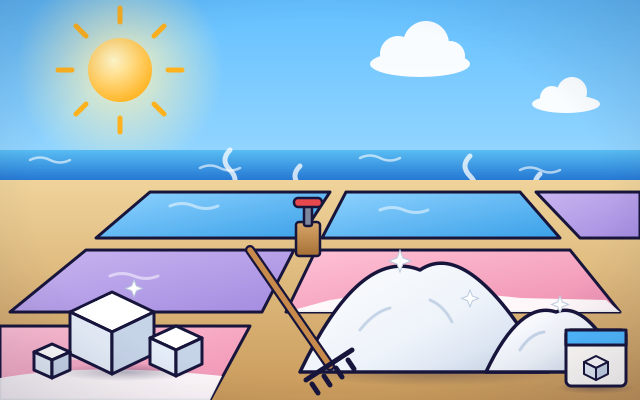
Seawater is let into shallow ponds. The sun and wind take the water away, and the salt stays behind as crystals.
The big idea: Salt is dissolved in seawater. When the sun evaporates the water, the salt cannot leave with it. The brine gets saltier and saltier until salt crystals form.
It's like the white marks left on your skin when seawater dries after a swim. That is sea salt the water left behind.
The interactive parts didn't load. The explanations below still work; try reloading the page.
From seawater to salt
- Seawater tastes salty because salt is dissolved in it: broken into bits too small to see. Every liter of seawater holds about two big spoonfuls of salt.
- At a salt works, wide shallow ponds lie right beside the sea. A gate is opened, often at high tide, and seawater flows in. Then the gate is shut.
- Sun and wind make the water evaporate: it turns into vapor and drifts away. The salt cannot go with it. So the water that is left, called brine, gets saltier every day.
- The strong brine is moved to the last pond. When the water can hold no more salt, the salt has to come out. It forms little white cubes on the bottom: salt crystals.
- Workers rake the salt into heaps before the pond is completely dry. Then the salt is rinsed with very salty water, which washes off the mud without dissolving the salt.
- The clean salt dries in the sun. Then it is sieved, and sometimes crushed, and packed into boxes. From sea to table, it can take many weeks.
Step by step through the salt works
Follow the seawater from the gate to the box, one step at a time.
- Let the sea in. The sea gate opens and seawater floods the first shallow pond. Then the gate is closed again.
- Evaporation pond. Sun and wind carry the water away as vapor. The salt stays, so the brine gets stronger, and it often turns pink.
- Crystallizer. The strong brine flows into the last pond. Here the water is so full of salt that crystals form on the bottom.
- Raking. The salt is raked into heaps by hand or scooped up by machines. A little bitter water is left behind in the pond.
- Washing. The salt is rinsed with very salty water. It washes away mud, but it is too full of salt to dissolve any more.
- Drying. The washed salt is left in heaps so the last water can drain off and dry in the sun.
- Packing. The dry salt is sieved into coarse or fine grains and packed into boxes and bags.
Shallow pan or deep pan?
Push the cloud away from the sun and watch both pans. Try a windy day too. Which pan makes salt first?
Experiment: Two pans hold seawater from the same sea. One is shallow and one is deep. Which makes salt crystals first?
- Push the cloud away so the sun shines on both pans.
- Watch the water levels and the colors. Where do crystals appear first?
- Let in new seawater and try a windy day.
What we found: The shallow pan makes salt first, because it has less water to lose. That is why salt ponds are wide and shallow. Sun and wind speed things up; clouds slow them down.
Turn on JavaScript to try it yourself.
Run the salt works
Run the salt works and pack as much salt as you can. Move the brine on when it is strong enough, and choose the right rinse.
Why the salt stays behind
If you stir salt into water, it seems to vanish. It has dissolved: it has broken up into bits far too small to see, mixed in among the water. The sea has been collecting salt this way for a very long time. Rain and rivers wash tiny amounts of salt out of rocks and carry it down to the sea.
To get the salt back, you have to take the water away. That is what the sun does. Warm water turns slowly into water vapor, a gas that floats off into the air. This is called evaporation. But salt cannot evaporate. Every bit of salt stays in the water that is left, so that water, called brine, gets saltier and saltier.
Water can only hold a certain amount of salt. When the brine is completely full, any more evaporation squeezes the salt out, and it forms solid crystals. Salt crystals are little cubes. Salt makers help this along by using very wide, shallow ponds, because shallow water warms up quickly and has less water to lose.
Then comes the work. The salt is raked into heaps and rinsed with very salty water. Fresh water would dissolve it again, but water that is already full of salt cannot. The clean salt dries in the sun and is packed. People have made salt this way for thousands of years, and the sun still does most of the work for free.
Key words
- Dissolve
- To break up into bits too small to see and mix evenly into a liquid.
- Evaporation
- Liquid water slowly turning into water vapor and drifting into the air.
- Brine
- Very salty water.
- Saturated
- So full of salt that the water cannot hold any more.
- Crystal
- A solid whose particles are stacked in a regular pattern. Salt crystals are cubes.
- Bittern
- The bitter liquid left when most of the table salt has crystallized. It is rich in magnesium salts.
Check your thinking
-
What happens to the water in a salt pond?
Show the answer
It evaporates into the air. The sun warms the water and it turns into vapor that drifts away.
-
Why are salt ponds made wide and shallow instead of deep?
Show the answer
Shallow water warms quickly and has less water to lose. A shallow pond reaches the crystal stage much sooner than a deep one of the same size.
-
Why is harvested salt rinsed with very salty water and not with fresh water?
Show the answer
Fresh water would dissolve the salt, but very salty water cannot. Water that is already full of salt has no room for more, so the crystals stay solid.
-
Which weather makes salt fastest?
Show the answer
Sunny, dry and windy. Sunshine warms the water and wind carries the damp air away. Rain would add water back.
-
Why is the salt harvested before the crystallizer pond dries out completely?
Show the answer
The last liquid holds bitter magnesium salts that would crystallize into the salt. Magnesium and potassium salts are very soluble and stay in the bittern until nearly all the water is gone.
-
At what moment do salt crystals start to form?
Show the answer
When the water holds as much salt as it possibly can. Water can hold only so much salt. Once it is full, more evaporation pushes the salt out as crystals.
You're a Food & farming expert!
You watched, looked inside, tried it, solved the challenge and went deeper. Pick another question below, or switch the age at the top to see this topic another way.
More about food & farming
 #21
Food & farming
How is bread made, and why does dough rise?
Mix ingredients, zoom into dough as gas bubbles develop, and watch a loaf change during baking. Compare different rising times in a simulation.
#21
Food & farming
How is bread made, and why does dough rise?
Mix ingredients, zoom into dough as gas bubbles develop, and watch a loaf change during baking. Compare different rising times in a simulation.
 #22
Food & farming
How is ice cream made?
Follow mixing, chilling, and churning inside a transparent machine. Experiment with simulated churning conditions and explore how air and ice crystals affect texture.
#22
Food & farming
How is ice cream made?
Follow mixing, chilling, and churning inside a transparent machine. Experiment with simulated churning conditions and explore how air and ice crystals affect texture.
 #23
Food & farming
How is chocolate made?
Follow cacao from pods through fermentation, drying, roasting, grinding, mixing, and molding. Run a miniature chocolate factory and design a finished shape.
#23
Food & farming
How is chocolate made?
Follow cacao from pods through fermentation, drying, roasting, grinding, mixing, and molding. Run a miniature chocolate factory and design a finished shape.
 #24
Food & farming
Why does popcorn pop?
Look inside a kernel as it heats. Watch pressure build and the kernel expand, then compare what happens under different simulated heating conditions.
#24
Food & farming
Why does popcorn pop?
Look inside a kernel as it heats. Watch pressure build and the kernel expand, then compare what happens under different simulated heating conditions.
Keep exploring
Games to play next
- Ratio KitchenScale recipes, fill ratio tables and find the better buy.
- Garden AutomationProgram a garden robot with sensor rules — then watch a whole day play out.
- Label LabPut the right labels on beautiful science diagrams, from bean plants to heart chambers.
Guide for grown-ups
- How to start homeschooling: a step-by-step guide for familiesA guide for parents · 7 min read
Science games by grade
Science worksheets by grade
- Preschool Science Worksheets
- Pre-K Science Worksheets
- Kindergarten Science Worksheets
- 1st Grade Science Worksheets
- 2nd Grade Science Worksheets
- 3rd Grade Science Worksheets
- 4th Grade Science Worksheets
- 5th Grade Science Worksheets
- 6th Grade Science Worksheets
- 7th Grade Science Worksheets
- 8th Grade Science Worksheets