How do submarines dive and surface?
Look inside the ballast tanks, follow the water and air, and steer a submarine on an underwater mission.
The big idea: A submarine has ballast tanks. Letting seawater in makes it heavier than the water it pushes aside, so it dives. Blowing air in pushes the water out, making it lighter, so it rises. With just the right amount, it hovers.
It's like
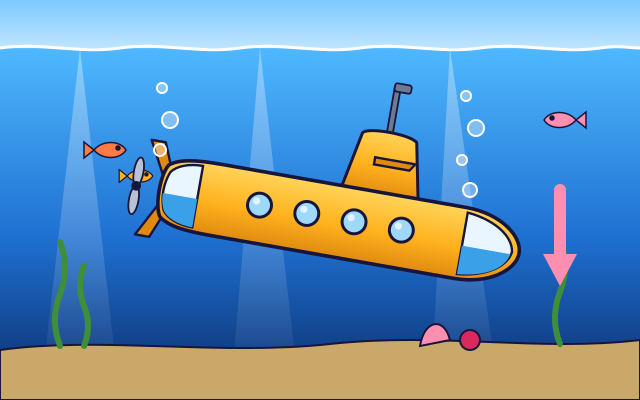
The interactive parts didn't load. The explanations below still work; try reloading the page.
How a submarine dives and surfaces
- At the surface, the submarine's ballast tanks are full of air. That makes it lighter than the water it pushes aside, so it floats like a ship.
- To dive, the crew opens vents on top of the tanks. Air bubbles out, and seawater flows in through holes underneath. The submarine gets heavier and sinks.
- With just the right amount of water, the submarine is as heavy as the water it pushes aside. It hovers at one depth. Small trim tanks move water forward or back to keep it level.
- The deeper you go, the harder the water squeezes, because more water presses down from above. A thick, round pressure hull keeps the crew safe and dry.
- To surface, the crew blows compressed air from strong bottles into the ballast tanks. The air pushes the water out through the holes, the submarine gets lighter, and it rises.
- A propeller pushes the submarine forward, and the rudder steers. Deep down it's dark, so the submarine uses sonar: it listens for sounds and echoes to find its way.
Inside a submarine
Tap each part to see how the submarine dives, rises, balances and moves.
- Ballast tanks. Ballast tanks sit between the outer hull and the inner hull. Filling them with seawater makes the submarine dive; filling them with air makes it rise.
- Vents and flood holes. Valves on top of each tank let the air out. Open holes underneath let seawater rush in to take its place, or push it back out.
- Compressed air bottles. Strong bottles store air squeezed to very high pressure. To surface, this air is blown into the ballast tanks to push the water out.
- Trim tanks. Small trim tanks inside the hull pump water forward or backward. That keeps the submarine balanced, like a seesaw.
- Pressure hull. The pressure hull is a thick, round steel tube. Its round shape is strong against the squeezing water, so the air inside stays at normal pressure.
- Diving planes. Diving planes are small wings. When the submarine moves, tilting them steers the bow up or down, like an airplane's elevator.
- Propeller and rudder. The propeller pushes water backward, so the submarine moves forward. The rudder behind it swings to turn left or right.
- Sail and periscope. The tall sail on top holds the periscope. Just below the surface, the periscope can poke up to look around.
- Sonar. Sound travels well in water. Sonar listens for sounds, or sends out a ping and times the echo, to find the seabed, fish and other ships.
Ballast lab: dive, hover and rise
Move the ballast slider and watch water and air move in the tanks. Can you make the submarine dive, rise and hover? Then use trim to level it.
Experiment: What happens to the submarine when you fill its ballast tanks with water?
- Start with the tanks full of air. Where does the submarine float?
- Slowly add water. Watch the bubbles and the depth.
- Blow some water out until the submarine hovers.
What we found: Filling the tanks with water makes the submarine heavier than the water it pushes aside, so it sinks. Blowing air in pushes the water out, so it gets lighter and rises. With just the right amount, it hovers.
Turn on JavaScript to try it yourself.
Photograph the shipwreck
Dive under the iceberg, then hover level next to the shipwreck long enough to take its photo.
Sinking and floating on purpose
Every object in water gets an upward push, called buoyancy, equal to the weight of the water it pushes aside. A ship floats because it is lighter than that water. A rock sinks because it is heavier. A submarine is special: it can switch between the two.
It does this with ballast tanks. When they are full of air, the submarine is light and floats. When the crew lets seawater in, the submarine becomes heavier than the water it pushes aside and dives. To come up, compressed air pushes the water back out.
Hovering in the middle is tricky. The crew uses small trim tanks to add or remove a little water and to move it forward or backward, keeping the submarine level. Diving planes, like little wings, steer it up or down as it moves.
The deeper a submarine goes, the harder the water squeezes, because there is more water above pressing down. That's why submarines have a thick, round pressure hull. Deep in the ocean it is completely dark, so submarines use sound, called sonar, to find their way.
Key words
- Ballast tank
- A tank that is filled with water to dive or with air to rise.
- Neutral buoyancy
- When something is exactly as heavy as the water it pushes aside, so it neither sinks nor floats up.
- Trim
- Balancing a submarine front to back so it stays level.
- Pressure hull
- The strong inner hull that keeps the crew at normal air pressure.
- Sonar
- Using sound and echoes to find things underwater.
- Density
- How much mass is packed into a certain volume.
Check your thinking
-
How does a submarine dive?
Show the answer
It lets seawater into its ballast tanks. The extra water makes it heavier than the water it pushes aside, so it sinks.
-
What pushes the water out of the ballast tanks?
Show the answer
Compressed air from strong bottles. High-pressure air expands into the tanks and forces the water out of the holes.
-
Why do submarines need very strong hulls?
Show the answer
Deep water squeezes very hard. All the water above presses down, so the deeper you go, the harder it squeezes.
-
How does a submarine 'see' in the deep, dark sea?
Show the answer
With sonar, using sound and echoes. Sound travels far underwater, and echoes show where things are.
-
A submerged submarine displaces 2,050 tonnes of seawater and has a mass of 2,100 tonnes. What happens?
Show the answer
It sinks, because weight is greater than buoyancy. Buoyancy equals the weight of 2,050 t of water, less than the weight of 2,100 t, so the net force is downward.
-
What do trim tanks do?
Show the answer
Move water front or back to keep the submarine level. Like a seesaw, moving water forward or back balances the submarine.
You're a Flight & transportation expert!
You watched, looked inside, tried it, solved the challenge and went deeper. Pick another question below, or switch the age at the top to see this topic another way.
More about flight & transportation
 #7
Flight & transportation
How do trains work?
Explore wheels, motors, brakes, and track switches. Build a small railway, move passengers or cargo, and guide trains through stations and junctions.
#7
Flight & transportation
How do trains work?
Explore wheels, motors, brakes, and track switches. Build a small railway, move passengers or cargo, and guide trains through stations and junctions.
 #8
Flight & transportation
How do bicycles work?
Follow motion from the pedals through the chain to the rear wheel. Change gears on hills and explore steering, balance, and brakes.
#8
Flight & transportation
How do bicycles work?
Follow motion from the pedals through the chain to the rear wheel. Change gears on hills and explore steering, balance, and brakes.
 #9
Flight & transportation
How does a car engine work?
Watch a transparent engine in slow motion. Follow air and fuel entering, compression, combustion, and exhaust, then trace the motion toward the wheels.
#9
Flight & transportation
How does a car engine work?
Watch a transparent engine in slow motion. Follow air and fuel entering, compression, combustion, and exhaust, then trace the motion toward the wheels.
 #10
Flight & transportation
How do electric cars work?
Follow energy from the battery to the motor and wheels. Drive a short course, recharge the battery, and explore how regenerative braking recovers energy.
#10
Flight & transportation
How do electric cars work?
Follow energy from the battery to the motor and wheels. Drive a short course, recharge the battery, and explore how regenerative braking recovers energy.
Keep exploring
Games to play next
- Deep Sea ExplorationLight the blue, meet ocean wildlife and discover hidden treasures.
- Plane Flight SimulatorTake off from the runway and thread numbered sky hoops in order. Every clean flight is a new personal best.
- Machine RepairFix levers, pulleys, gears and ramps so every contraption works.
Guide for grown-ups
- How to start homeschooling: a step-by-step guide for familiesA guide for parents · 7 min read
Science games by grade
Science worksheets by grade
- Preschool Science Worksheets
- Pre-K Science Worksheets
- Kindergarten Science Worksheets
- 1st Grade Science Worksheets
- 2nd Grade Science Worksheets
- 3rd Grade Science Worksheets
- 4th Grade Science Worksheets
- 5th Grade Science Worksheets
- 6th Grade Science Worksheets
- 7th Grade Science Worksheets
- 8th Grade Science Worksheets