How do trains work?
Motors turn steel wheels on steel rails, and switches guide trains from one track to another.
The big idea: A train can't steer. Its wheels have lips that keep them on the rails, so the track does the steering. To change tracks, short moving rails called points slide over at a switch.
It's like
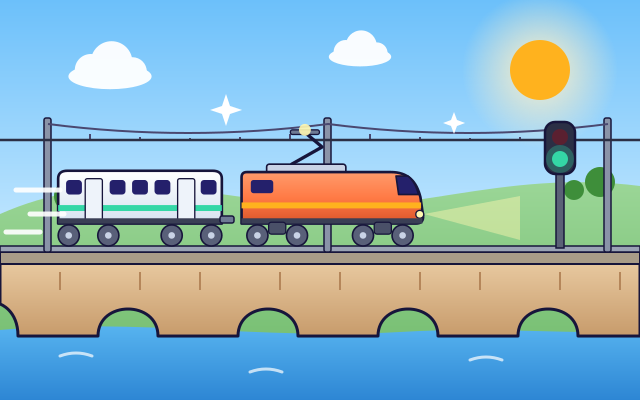
The interactive parts didn't load. The explanations below still work; try reloading the page.
A trip on an electric train
- At the station, passengers climb aboard. When the doors close and the signal turns green, the driver knows the track ahead is clear.
- This train is electric. A springy arm on the roof, called a pantograph, touches a wire above the track. Electricity flows down into motors that turn the wheels.
- Train wheels are steel, and so are the rails, so they roll very easily. A lip called a flange on the inside of each wheel stops the train from slipping off the track.
- Trains can't steer, so how do they turn? At a switch, two short rails called points slide sideways and guide the wheels onto the other track.
- The track is split into sections called blocks. Only one train may be in a block. A red signal says the block ahead is busy, so the next train waits.
- To stop, brake pads squeeze the wheels. A heavy, fast train needs a long way to stop, so the driver starts braking far from the station.
Inside an electric locomotive
Tap each part of the locomotive and the track. Many of them move when you find them!
- Driver's cab. The driver sits in the cab at the front. A handle sets the power, another sets the brakes, and screens show the speed and signals.
- Pantograph. The pantograph is a folding arm on the roof. Springs press it up against the overhead wire so electricity can flow into the train, even at high speed.
- Transformer and controls. The electricity in the wire is very strong. The transformer and control box turn it into the right kind for the motors, giving more or less power when the driver asks.
- Traction motors. Electric motors sit right next to the axles. Gears connect each motor to a wheel axle, so when the motor spins, the wheels turn.
- Bogie. The wheels are held in frames called bogies, or trucks. Each bogie can swivel, so the long train can follow curves, and springs soak up the bumps.
- Wheels and axle. Two steel wheels are fixed to one axle, so they always turn together. A lip called a flange on each wheel keeps it on the rail.
- Brakes. Brake pads squeeze against the wheels or against metal discs on the axle. Air pressure pushes them, and every car has its own brakes.
- Coupler. Couplers join the cars together. Many work like two hands gripping each other, and they lock shut when the cars are pushed together.
- Rails and ties. The two steel rails are held the same distance apart by ties, also called sleepers. Crushed stones underneath let rain drain away and hold the ties in place.
Railway control: set the switches
Tap a switch to slide its points, then send a train. Watch which way the wheels go at each junction.
Experiment: A train has no steering wheel. When you flip a switch, what makes the train change tracks?
- Send a train with the first switch pointing straight.
- Flip the first switch and send another train.
- Watch the points slide and see where each train goes.
What we found: Flipping a switch slides two short rails, called points, from one side to the other. The lips on the wheels follow the rails, so the points guide the whole train onto the new track. The track does the steering!
Turn on JavaScript to try it yourself.
Junction control
Route every train to the station that matches its load. Set the switches before you press Go.
How trains stay on track
A train's wheels are made of steel, and so are the rails. Hard steel rolling on hard steel squashes very little, so the wheels roll easily. That's why one locomotive can pull a whole line of heavy cars, using much less energy than the same number of trucks on a road.
Trains can't steer. Each wheel has a lip, called a flange, on the inside of the rail. The wheels are also slightly cone-shaped. When the track curves, the wheels shift a little and the train follows the rails around the bend.
To move a train from one track to another, railways use switches. Two short rails called points slide sideways and guide the wheels onto the new track. People in control centers set the switches and signals for every train.
Rolling easily has a downside: it's hard to stop. Steel on steel isn't very grippy, so a fast train needs a long distance to brake. Signals warn drivers far ahead, and the track is split into blocks so only one train can be in each block.
Key words
- Flange
- The lip on the inside edge of a train wheel that keeps it on the rail.
- Switch (points)
- A place where moving rails guide a train onto a different track.
- Pantograph
- The springy arm on an electric train's roof that collects electricity from the overhead wire.
- Bogie
- A swiveling frame under a rail vehicle that holds the wheelsets and springs. Also called a truck.
- Block signaling
- Splitting the track into sections so only one train is in each section at a time.
- Braking distance
- How far a train travels from when the brakes go on until it stops.
Check your thinking
-
What keeps a train's wheels from slipping off the rails?
Show the answer
A lip on each wheel called a flange. The flanges sit inside the rails, so the wheels can't slide off sideways.
-
Why does a red signal tell a train to wait?
Show the answer
Another train is in the block of track ahead. Only one train may be in each block, so the next train waits until the block is clear.
-
What moves at a switch to send a train onto a different track?
Show the answer
Two short rails called points. The points slide sideways and guide the wheel flanges onto the new route.
-
A train doubles its speed from 60 to 120 km/h. About how does its braking distance change?
Show the answer
It becomes about four times as long. Braking distance is v² ÷ (2a). Twice the speed gives 2² = 4 times the distance.
-
How does an electric train get electricity while it moves?
Show the answer
A pantograph on the roof touches a wire above the track. The pantograph slides along the overhead wire and carries electricity to the motors.
-
Why can one locomotive pull so many heavy cars?
Show the answer
Steel wheels roll very easily on steel rails. Hard steel on hard steel barely squashes, so very little energy is lost to rolling.
You're a Flight & transportation expert!
You watched, looked inside, tried it, solved the challenge and went deeper. Pick another question below, or switch the age at the top to see this topic another way.
More about flight & transportation
 #8
Flight & transportation
How do bicycles work?
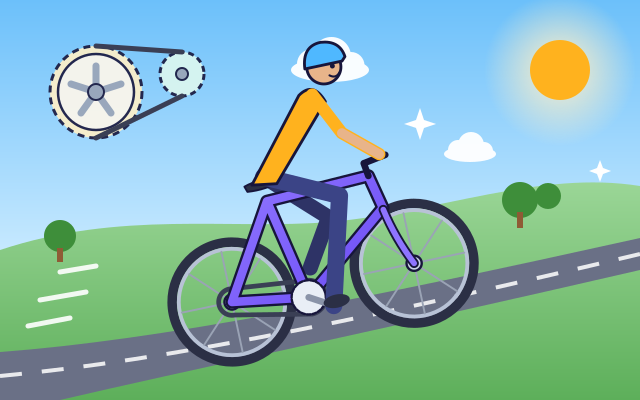
Follow motion from the pedals through the chain to the rear wheel. Change gears on hills and explore steering, balance, and brakes.
#8
Flight & transportation
How do bicycles work?
Follow motion from the pedals through the chain to the rear wheel. Change gears on hills and explore steering, balance, and brakes.
 #9
Flight & transportation
How does a car engine work?
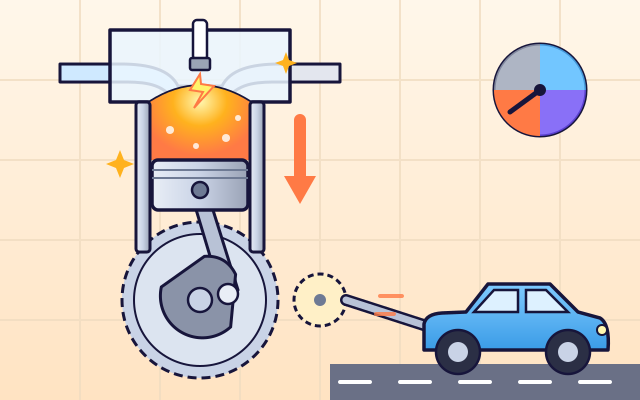
Watch a transparent engine in slow motion. Follow air and fuel entering, compression, combustion, and exhaust, then trace the motion toward the wheels.
#9
Flight & transportation
How does a car engine work?
Watch a transparent engine in slow motion. Follow air and fuel entering, compression, combustion, and exhaust, then trace the motion toward the wheels.
 #10
Flight & transportation
How do electric cars work?
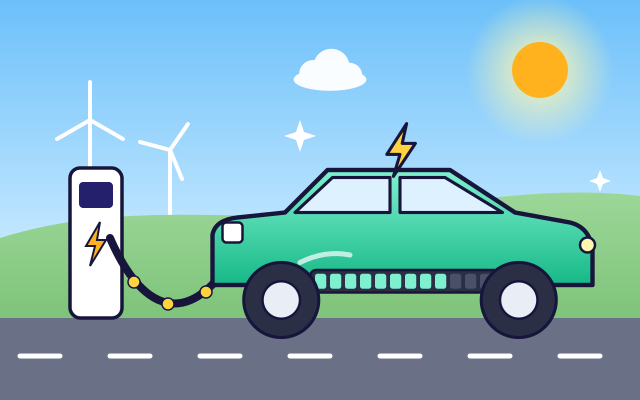
Follow energy from the battery to the motor and wheels. Drive a short course, recharge the battery, and explore how regenerative braking recovers energy.
#10
Flight & transportation
How do electric cars work?
Follow energy from the battery to the motor and wheels. Drive a short course, recharge the battery, and explore how regenerative braking recovers energy.
 #123
Flight & transportation
How do parachutes slow a fall?
Change canopy size and cargo mass, then compare descent and landing in a simulation.
#123
Flight & transportation
How do parachutes slow a fall?
Change canopy size and cargo mass, then compare descent and landing in a simulation.
Keep exploring
Games to play next
- Timetable TerminalRead the departure board, count the minutes and catch your connection on time.
- Plane Flight SimulatorTake off from the runway and thread numbered sky hoops in order. Every clean flight is a new personal best.
- Machine RepairFix levers, pulleys, gears and ramps so every contraption works.
Draw it or make it
- How to draw a steam trainDrawing lesson
Guide for grown-ups
- How to start homeschooling: a step-by-step guide for familiesA guide for parents · 7 min read
Science games by grade
Science worksheets by grade
- Preschool Science Worksheets
- Pre-K Science Worksheets
- Kindergarten Science Worksheets
- 1st Grade Science Worksheets
- 2nd Grade Science Worksheets
- 3rd Grade Science Worksheets
- 4th Grade Science Worksheets
- 5th Grade Science Worksheets
- 6th Grade Science Worksheets
- 7th Grade Science Worksheets
- 8th Grade Science Worksheets