
What If? Lab
What if sound traveled through water?
Whales sing and call under the sea. Can sound move through water? Let's send a sound through water in Olly's lab!
Sound does travel through water, and it goes more than four times faster than through air. Send the same sound 1,000 meters through air and then through water in our model, then find out how whale songs carry so far in the real ocean.
Sound is a pressure wave, and water's stiffness carries it at about 1,481 m/s in our model (fresh water, 20 °C) against 343 m/s in air: 4.3 times faster. Speed is only half the story: NOAA explains that a deep sound channel lets low sounds cross whole ocean basins.
The big question
When you clap, the sound goes through the air to your ears.
But whales call to each other under the sea. Can sound go through water too?
Most sounds you hear have traveled through air: a voice, a dog's bark, a clap of thunder. But the ocean is full of sounds too. Whales sing, dolphins click, and waves crash.
So what happens when a sound travels through water instead of air? Does it go slower, faster, or not at all? In this lab you can send the same sound the same distance through air and through water, and time it.
Sound is a mechanical wave: a compression passed from particle to particle. It needs a medium, and the medium sets its speed. Air, water and steel all carry it, at very different speeds.
This lab asks a simple question with real consequences for ocean life and ocean science: how does the trip change when the medium is water? The model sends a single sound pulse 1,000 meters, first through air at 20 °C and then through fresh water.
Try the experiment
Make a prediction
One sound goes through air. One goes through water. Which gets there first?
The same sound travels 1,000 meters, once through air and once through water. Which one arrives first?
A sound pulse crosses 1,000 m of air at 20 °C, and another crosses 1,000 m of fresh water. Which arrives first?
- The one in water
- The one in air
- They arrive together
| Control | In our world | What if… | Range |
|---|---|---|---|
| What the sound travels through · Air, water or steel can carry sound. Try water: it is what whales call through. | 0 | 1 | 0–3 |
| Distance to the listener · How far the sound has to go. The model goes up to 2,000 meters. | 1000 m | — | 1–2000 m |
| Air temperature · Sound moves a little faster in warm air. It only changes the air setting; the water setting is fixed at 20 °C. | 20 °C | — | -40–60 °C |
| Pitch (frequency) · Pitch does not change the speed, only the wavelength. Compare the wavelength in air and in water. | 440 Hz | — | 20–20000 Hz |
-
Established fact
Sound goes much faster in water than in air.
Sound travels about 1,500 meters per second in seawater and about 340 meters per second in air.
Sound travels about 1,500 m/s in seawater, varying by a few percent with temperature, pressure and salinity, against about 340 m/s in air (DOSITS).
-
What the model shows
In the model, sound crosses 1,000 meters of water in less than one second.
In the model, a sound crosses 1,000 meters of water in 0.675 seconds and the same distance of air in 2.91 seconds.
Model: 1,481 m/s in fresh water at 20 °C against 343 m/s in air, a ratio of 4.3; 1,000 m takes 0.675 s versus 2.91 s.
-
Established fact
Deep in the sea, sound can travel very far.
Deep in the ocean, a sound channel bends sound waves so they can travel hundreds or even thousands of miles.
The SOFAR channel, a sound-speed minimum near 1,000 m depth, refracts low-frequency sound back toward its axis so it can travel thousands of miles with little loss (NOAA).
-
An idea scientists discuss
Whales may use the deep sound channel to call far away.
NOAA says whales rely on the sound channel to communicate over very long distances, and that ship noise can get in the way.
NOAA describes whales using the SOFAR channel to communicate over hundreds or thousands of miles; how much each species relies on it, and how much noise masks it, are active research questions beyond this model.
Sound in air
In air, sound is fast. But it still takes a little time.
In Olly's lab, a sound takes about 3 seconds to go 1,000 meters through air.
In air, sound moves at about 343 meters every second on a warm day. That is fast, but you can still notice the wait over long distances. It is why you see lightning before you hear the thunder.
In our model, a sound sent 1,000 meters through air at 20 °C takes 2.91 seconds to reach the listener. Count it out: one, two, almost three.
In dry air the model uses c = 331.3 √(1 + T/273.15) m/s, which gives 343 m/s at 20 °C. A pulse covering 1,000 meters therefore arrives after 2.91 seconds, and 2,000 meters takes 5.83 seconds.
Pitch does not change the speed. A 440 Hz note (the A that orchestras tune to) has a wavelength of 0.78 m in air, because λ = c/f. OpenStax lists 331 m/s at 0 °C and 343 m/s at 20 °C, matching the model.
Send it through water
Now Olly sends the sound through water.
Whoosh! It gets there much faster. Sound zooms through water.
Now switch the medium to water and send the same sound the same 1,000 meters. This time it arrives in just 0.675 seconds, less than a quarter of the time it took in air.
The model's speed readout jumps from 343 to 1,481 meters per second: 4.3 times faster than in air. In one second, sound in water can cover 1,481 meters, almost one and a half kilometers.
With the medium set to water, the model uses a fixed 1,481 m/s, the speed in fresh water at 20 °C. The 1,000 m trip shrinks from 2.91 s to 0.675 s, and the speed ratio readout shows 4.3×. Over the slider's full 2,000 m the times are 5.83 s in air and 1.35 s in water.
The wavelength grows in the same proportion: a 440 Hz note stretches from 0.78 m in air to 3.37 m in water. For comparison, the model's steel setting carries sound at 5,960 m/s, 17.4 times faster than air.
Why water is faster
Sound is a push that goes from one tiny bit to the next.
Water is very hard to squash. So it passes the push along quickly.
Sound is a push passed along from one tiny particle to the next. How fast the push travels depends on how hard the material is to squash. Air squashes easily. Water is much harder to squash, so it pushes back quickly and passes the sound along faster.
Our model is simple. It uses fresh water at one temperature and sends the sound in a straight line. It does not show how loud the sound is, how it fades or how it bends in the real sea.
The speed of a sound wave is c = √(K/ρ), where K is the medium's bulk modulus (its resistance to compression) and ρ its density. Water is far denser than air, but it is so much less compressible that c is larger. OpenStax puts it simply: the more rigid, or less compressible, the medium, the faster the sound.
Model limits: a single fixed speed for fresh water at 20 °C, a straight path, no echoes, no bending, and no loudness or fading. Seawater is faster (OpenStax lists 1,540 m/s at 20 °C), and its speed changes with depth, which the model cannot show.
Sound in the real ocean
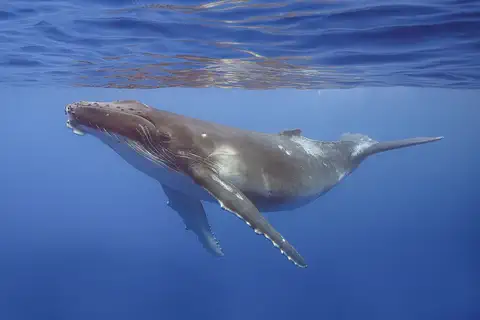
Humpback whales sing long songs in the sea.
Their songs can travel for miles. Scientists listen with underwater microphones.
In the real ocean, the University of Rhode Island's DOSITS project says sound moves at about 1,500 meters per second, a little faster than in our fresh-water model. Its speed changes slightly with temperature and depth.
NOAA explains that how far a sound goes depends mostly on temperature and pressure. Deep down, a layer called the sound channel bends sound waves up and down so they can travel hundreds of miles. In Hawaii, NOAA says male humpback whale songs can carry over several miles, and scientists record them with underwater microphones called hydrophones.
DOSITS gives about 1,500 m/s for seawater, varying by a few percent with temperature, pressure and, less often, salinity. Near the surface, cooling with depth slows sound; deeper, rising pressure speeds it up. The resulting speed minimum, at roughly 1,000 m in mid-latitudes, forms the SOFAR channel: sound bends back toward it from above and below and can travel thousands of miles without losing much energy (NOAA).
NOAA notes that whales use this channel to communicate over hundreds and even thousands of miles, and that ship noise can interfere. Speed matters for timing; distance depends on the channel and on how little energy low sounds lose.
Amazing facts
-
Long ago, scientists timed a bell ringing under a lake.
In 1826, on Lake Geneva in Switzerland, two scientists rang a bell underwater and timed how long its sound took to reach a boat 10 miles away.
In 1826 Jean-Daniel Colladon and Charles-François Sturm struck an underwater bell on Lake Geneva at the same moment as a flash of gunpowder, and timed the sound over 10 miles: the first recorded measurement of sound speed in water (DOSITS).
-
Some humpback whales sing for a very long time.
A male humpback whale can sing for anything from five minutes to more than 24 hours, repeating the same song.
NOAA reports humpback singing sessions lasting from five minutes to over 24 hours, with all males in a breeding area singing the same current version of the song.
-
Sound goes faster in steel than in water.
Sound zooms through steel at about 5,960 meters per second, four times faster than through water.
Longitudinal sound waves in bulk steel travel at about 5,960 m/s (OpenStax), about four times the speed in water and 17 times that in air.
-
In winter, whale songs fill the sea near Hawaii.
From December to April, humpback songs are the main underwater sound in many parts of Hawaii.
Between December and April, male humpback song becomes the dominant source of underwater ambient noise in many parts of Hawai‘i (NOAA).
Words to know
- medium
- the material a sound travels through, such as air, water or steel
- speed of sound
- how far a sound travels each second
- wavelength
- the distance from one sound wave to the next
- hydrophone
- a microphone that listens under water
- sound channel
- a deep ocean layer that bends sound so it can travel very far
- compress
- to squash something into a smaller space
Discovery challenge
-
Where does sound go faster?
Does sound travel faster in air or in water?
In which medium does a sound pulse travel faster?
- In water
- In air
- The same in both
Show the answer
In water
In water! It is much faster.
In water: about 1,481 meters per second in the model, against 343 in air.
Water: its low compressibility gives 1,481 m/s in the model, 4.3 times the speed in air.
-
How long does the sound take to go 1,000 meters through water?
In the model, about how long does a sound take to cross 1,000 meters of water?
In the model, what is the arrival time for a pulse crossing 1,000 m of fresh water?
- Less than 1 second
- About 3 seconds
- About 10 seconds
Show the answer
Less than 1 second
Less than 1 second. That is fast!
0.675 seconds. Through air it would take 2.91 seconds.
0.675 s (1,000 ÷ 1,481), against 2.91 s in air at 20 °C.
-
What helps whale sounds go very far in the sea?
What lets some ocean sounds travel hundreds of miles?
What mainly allows low-frequency sound to travel thousands of miles in the ocean?
- A deep sound channel that bends sound back
- Salt that makes sound louder
- Waves on the surface pushing it along
Show the answer
A deep sound channel that bends sound back
A special deep layer of the sea keeps the sound going.
A deep layer called the sound channel bends sound waves back into it, so they can travel very far.
The SOFAR channel: a sound-speed minimum that refracts sound back toward its axis, so it loses little energy (NOAA).
-
Which humpback whales sing?
Which humpback whales do scientists believe sing?
According to NOAA, which humpback whales are believed to sing?
- The males
- Only the calves
- Only the mothers
Show the answer
The males
The males sing.
Scientists believe only males sing; all humpbacks can make other calls.
Scientists believe only males sing; all humpbacks make shorter non-song calls.
Experiments to try
- Watch Try it What If? Lab What if sound couldn’t travel through air? Sound is a push passed from particle to particle. In air it travels about 343 meters every second. Take the air away, as in empty space, and there is nothing to pass the push along, so a clap makes no sound at all. Water and steel still carry it, and much faster.
- Watch Try it What If? Lab What if you counted the seconds after lightning? You see lightning almost at once, but its thunder travels at the speed of sound, about 343 meters per second. The National Weather Service says thunder takes about 5 seconds to travel a mile, so counting the seconds tells you how far away the lightning was. In our model, thunder from 1,700 meters away arrives after about 5 seconds.
- Watch Try it What If? Lab What if elephants talked with very low sounds? Elephants really do talk with very low rumbles, some too low for people to hear. Turn the pitch down in our sound model and see what changes about the wave, then find out how far real elephant calls can carry.
Explore next
-
 Watch
3D
Animal
Humpback whale
The humpback whale is a baleen whale famous for leaping out of the water, slapping its giant flippers and singing long, complex songs. It lives in every ocean and makes one of the longest journeys of any mammal, between cold feeding waters and warm waters where calves are born. Once hunted almost to extinction, it is now recovering.
- Watch Try it What If? Lab What if sound couldn’t travel through air? Sound is a push passed from particle to particle. In air it travels about 343 meters every second. Take the air away, as in empty space, and there is nothing to pass the push along, so a clap makes no sound at all. Water and steel still carry it, and much faster.
- Watch Try it What If? Lab What if you counted the seconds after lightning? You see lightning almost at once, but its thunder travels at the speed of sound, about 343 meters per second. The National Weather Service says thunder takes about 5 seconds to travel a mile, so counting the seconds tells you how far away the lightning was. In our model, thunder from 1,700 meters away arrives after about 5 seconds.
- Watch Try it What If? Lab What if elephants talked with very low sounds? Elephants really do talk with very low rumbles, some too low for people to hear. Turn the pitch down in our sound model and see what changes about the wave, then find out how far real elephant calls can carry.
- Watch Try it What If? Lab What if a coast were made of hard rock? Waves wear coasts away, but not every coast wears at the same speed. In our model, a bare sandy island facing ordinary waves keeps about 72 percent of its land after 50 model years. Make the same island of hard rock and it keeps about 99 percent. That is why hard rock is often left sticking out to sea as headlands.
- Watch Try it What If? Lab What if all the sea ice melted? Sea ice floats, so it is already pushing aside about as much water as it will make when it melts, like an ice cube in a glass. In our model, melting all the Arctic's springtime sea ice raises the sea by only about 2 millimeters. The same ice melting on land would raise it about 7 centimeters.
- Watch Try it What If? Lab What if an ocean food web changed? Antarctic krill are small shrimp-like animals, but they feed a huge number of bigger ones. Take krill out of our model's Southern Ocean food web and all seven other species are affected: every animal in it loses all its food, from silverfish to orcas.
- Watch What If? Lab What if coral reefs could be regrown? Scientists grow broken pieces of coral in underwater nurseries, then plant them back on damaged reefs. Follow how coral gardens work, how scientists search for corals that cope with heat, and what happens when fish come back to a restored reef.
For parents & teachers
What children will learn
- Sound is a wave that needs a material, such as air or water, to travel through.
- Sound travels more than four times faster in water than in air, because water is much harder to compress.
- How far a sound travels in the ocean depends on temperature, pressure and depth, not just speed.
- A model fixes some things (one water temperature, a straight path) to make one idea clear.
Recommended ages: 7 to 17 · About 15 minutes
Talk about it
- Why might sound be especially useful to whales, when light does not reach far into the deep sea?
- Sound is faster in water. Does that mean it is always easier to hear under water? What else might matter?
- What does our model leave out about real ocean sound?
Try at home or in class
- Put your ear against one end of a table while a helper gently taps the other end with a pencil. Then listen to the same tap through the air. Which sounds clearer?
- Hold a sealed zip-top bag of water against your ear and gently tap the bag. Compare it with tapping an empty bag full of air.
Key vocabulary: medium, speed of sound, wavelength, hydrophone, sound channel, compress
Where these facts come from
- How fast does sound travel? , Discovery of Sound in the Sea (University of Rhode Island)
- College Physics 2e, §17.2 Speed of Sound, Frequency, and Wavelength , OpenStax
- How far does sound travel in the ocean? , NOAA National Ocean Service
- What is SOFAR? , NOAA National Ocean Service
- Acoustic Monitoring of Humpback Whale Chorusing , NOAA Hawaiian Islands Humpback Whale National Marine Sanctuary
- Unraveling Mysteries of Humpback Whale Song , NOAA Office of National Marine Sanctuaries
Checked, not yet human-reviewed. Last updated October 26, 2026. Spotted a mistake? Tell us.