Animal
Humpback whale
The humpback whale is a big whale with very long flippers. It jumps out of the water, sings songs and swims very far every year.
The humpback whale is a baleen whale famous for leaping out of the water, slapping its giant flippers and singing long, complex songs. It lives in every ocean and makes one of the longest journeys of any mammal, between cold feeding waters and warm waters where calves are born. Once hunted almost to extinction, it is now recovering.
Megaptera novaeangliae, the 'big-winged New Englander', is a rorqual with pectoral fins up to a third of its body length, the most complex songs of any whale and some of the longest migrations of any mammal. Whaling reduced most populations by more than 95 percent; since protection, numbers have risen and the IUCN lists the species as Least Concern.
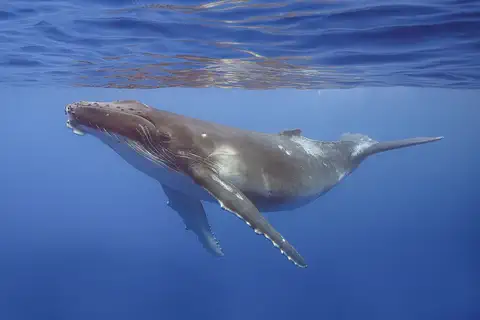
Photo: Charles J. Sharp, CC BY-SA 4.0, via Wikimedia Commons
Meet the humpback whale
The humpback whale is a huge whale with long flippers.
It is mostly black, with white on its flippers and tummy. It has bumps on its head. It loves to jump and splash!
The humpback whale can grow up to about 18 meters long, longer than a school bus, and weigh up to about 36,000 kilograms. It gets its name from the hump in front of the small fin on its back.
Its scientific name, Megaptera novaeangliae, means 'big-winged New Englander'. The 'wings' are its flippers, which can be up to 4.6 meters long, about a third of its body. Humpbacks are mostly black with white on their flippers, belly and the underside of the tail, and they have knobby bumps on their heads.
Megaptera novaeangliae is a large rorqual: adults reach about 18 meters and 36 tonnes, and females are larger than males. Megaptera means 'big-winged', after pectoral fins up to about 4.6 meters, a third of body length; novaeangliae, 'of New England', recalls where European whalers first encountered the species.
The body is mainly black with variable white on the pectorals, belly and fluke undersides; Southern Hemisphere whales tend to have more white. Flukes up to about 5.5 meters wide have a serrated trailing edge, and their pigment pattern, shape and scars are unique to each whale, allowing photo-identification and tracking of individuals over their lives.
Quick facts
- Group
- Mammal
- Length
- up to 18 m
- Weight
- up to 36,000 kg
- Lifespan in the wild
- 80 to 90 years
Where it lives
Humpback whales live in all the oceans.
In summer they eat in cold water. In winter they swim far to warm water. That is where babies are born.
Humpback whales live in every ocean on Earth. Most spend summer in cold, food-rich waters, then migrate to warm, shallow tropical waters in winter to mate and give birth, often near reefs or shores.
Their journeys are some of the longest of any mammal: some swim about 8,000 kilometers each way. In the North Pacific, some humpbacks travel from Alaska to Hawaiʻi, about 4,800 kilometers, in as little as 28 days. In the North Atlantic, whales that feed from the Gulf of Maine to Norway spend winter in the West Indies or near Cape Verde.
Humpbacks occur in all major oceans, migrating between high-latitude summer feeding grounds in cold, productive waters and low-latitude winter mating and calving areas, where they favor shallow, warm water near reefs and coasts. Some migrations cover about 5,000 miles (8,000 kilometers).
NOAA Fisheries recognizes 14 distinct population segments. In the North Pacific, the Hawaiʻi population feeds from the Aleutians and Bering Sea to northern British Columbia, and the Mexico and Central America populations feed off the U.S. West Coast; some Alaska whales reach Hawaiʻi, about 3,000 miles, in as few as 28 days. Seven Southern Hemisphere populations feed in Antarctic or sub-Antarctic waters. The migration line on the map shows the Alaska to Hawaiʻi journey only.
Its habitat

Where can you find this animal?
- Migration route · Countries and seas named by a scientific source
- Lives here naturally · Countries and seas named by a scientific source
- Sightings recorded · Records of wild sightings (GBIF)
Migration route · Countries and seas named by a scientific source
One well-known route: some North Pacific humpbacks swim between feeding grounds in Alaska and breeding grounds in Hawaiʻi, about 4,800 km, in as few as 28 days. The line joins the two areas; it is not the exact path of any whale.
Places: Pacific Ocean.
Source: https://www.fisheries.noaa.gov/species/humpback-whale · checked October 2026
Lives here naturally · Countries and seas named by a scientific source
All the world's oceans. Most humpbacks feed in cold, food-rich waters toward the poles in summer and travel to warm tropical waters near coasts and reefs in winter to give birth.
Places: Pacific Ocean, Atlantic Ocean, Indian Ocean, Southern Ocean and Arctic Ocean.
Source: https://www.fisheries.noaa.gov/species/humpback-whale · checked October 2026
Sightings recorded · Records of wild sightings (GBIF)
Counts of GBIF records of wild observations (human and machine) and preserved specimens. Records include introduced populations, vagrants, escaped or released animals and misidentifications, so a country with records is not necessarily part of the native range.
Wild sightings have been recorded in United States, Antarctica, Australia, Canada, Mexico, Iceland, South Africa, Brazil and 82 more places.
Source: gbif · checked October 2026
Range maps show where scientists say an animal lives, often country by country. An animal may live in only part of a country shown, and sightings records can include animals that wandered far from home.
Bubble nets and big gulps
Humpbacks eat krill and small fish.
Some humpbacks blow bubbles in a circle to trap fish. Then they swim up with their mouths open. Gulp!
Humpbacks are baleen whales. They gulp huge mouthfuls of water full of krill and small fish such as anchovies and herring, then push the water out through their baleen, which works like a sieve.
They have clever ways to catch food. In 'bubble net feeding', whales swim in a circle under a school of fish, blowing a ring of bubbles that traps the fish like a net. Then they lunge up through the middle with their mouths wide open, catching thousands of fish in one gulp. Some groups work as a team.
Humpbacks filter-feed on krill and small schooling fish such as anchovies, herring and sand lance, engulfing prey-laden water and straining it through baleen. During the feeding season they build up fat stores (blubber) to sustain them through the winter.
They use a range of techniques to herd and concentrate prey, using bubbles, sound, the seafloor and even their pectoral fins. In group-coordinated bubble-net feeding, whales release curtains of bubbles that confine a school, then lunge upward through it. NOAA Fisheries notes regional specializations in bubble-feeding among populations, and some humpbacks suction-feed on sediment, which may expose them to plastic debris.

Flippers, bumps and flukes
A humpback has very, very long flippers.
Its head has round bumps. Its tail has a pattern that is different on every whale.
A humpback whale's flippers can be up to 4.6 meters long, about a third of its body. Humpbacks slap them on the water and sometimes use them to herd fish. Round knobs on its head and along the front edge of its flippers make it look different from other whales.
The tail, called the flukes, can be up to about 5.5 meters wide, wider than a car is long. The black and white pattern under the flukes is different on every humpback, like a fingerprint. Scientists photograph tails to recognize whales and follow them for years.
The long pectoral fins, up to a third of body length, have knobbed leading edges and are used in displays such as flipper-slapping and sometimes to herd prey. The head is covered in knobs, and the throat has long ventral pleats that expand during engulfment feeding.
Flukes up to about 18 feet (5.5 meters) wide are serrated along the trailing edge and pointed at the tips. Fluke pigmentation, shape and scars are distinctive enough to act as fingerprints: photo-identification catalogs let scientists record where individual whales appear and track them over time, revealing migration links between feeding and breeding areas.
Growing up
A humpback mother has one calf at a time.
The calf is born in warm water. It is already as long as a car! It stays close to its mother for about a year.
A humpback mother carries her calf for about 11 months. The calf is born in warm tropical water and is already about 4 to 5 meters long, as long as a car, and can weigh about 680 kilograms.
The calf swims close to its mother, and she often touches it with her flipper. It stays near her for up to a year before it stops drinking milk. Humpbacks are grown up at 4 to 10 years old, and a mother usually has a calf every 2 to 3 years.
Gestation lasts about 11 months, and a single calf about 4 to 4.9 meters long (13 to 16 feet) is born in warm wintering waters. Mothers are protective, swimming close and often touching calves with their flippers. Calves stay near their mothers for up to a year before weaning.
Females calve on average every 2 to 3 years, though annual calving has been documented. Sexual maturity comes at 4 to 10 years, and lifespan is estimated at about 80 to 90 years. Long-term associations between mother and calf are not thought to persist, but calves tend to use the same feeding and breeding areas as their mothers.
Songs and splashes
Humpback whales sing long songs under the sea.
They jump out of the water and land with a big splash. They slap the water with their flippers and tails.
Humpbacks have the most complex and varied songs of any whale. Their long, haunting songs carry for miles under the sea.
They are also the acrobats of the ocean. A humpback can launch its school-bus-sized body right out of the water and crash back down. This is called breaching. Humpbacks also slap the water with their flippers and tails. These displays make them a favorite of whale watchers.
Humpback song is the most complex and varied of any whale's, and the sounds carry for miles underwater. Researchers have recorded songs across many humpback habitats.
Humpbacks are known for surface activity: breaching, in which the whale launches most or all of its body clear of the water, and slapping the surface with pectoral fins and flukes. Groups of whales may cooperate in bubble-net feeding. Killer whales, false killer whales and large sharks are known predators, though few attacks on humpbacks have been documented.
Did you know?
A baby humpback is as long as a car.
A newborn humpback calf is about 4 to 5 meters long, as long as a car.
Calves measure about 4 to 4.9 meters at birth and stay near their mothers for up to a year.
A whale comeback
Long ago, people hunted humpback whales.
Now they are protected. There are many more humpbacks than before. People still work to keep them safe from ships and nets.
Before whaling was stopped, most humpback populations had been cut by more than 95 percent. Since people agreed to stop commercial whaling, humpbacks have been coming back in much of the world. They are now listed as Least Concern worldwide.
They still face dangers: getting tangled in fishing gear, being hit by ships, being disturbed by boats, ocean noise, plastic pollution and a changing climate. Scientists help free tangled whales and work to make shipping lanes safer.
Commercial whaling reduced most humpback populations by more than 95 percent. Protection, including the final moratorium on commercial whaling in 1985, drove widespread recovery. The IUCN's 2018 global assessment lists the species as Least Concern with an increasing trend; in the United States, 4 of the 14 distinct population segments remain endangered and 1 threatened.
Current threats include entanglement in fishing gear and marine debris, vessel strikes, vessel-based harassment, ocean noise and changing climate conditions. A 2022 study cited by the Monterey Bay Aquarium estimated that a fish-feeding humpback may ingest about 200,000 pieces of microplastic a day.
IUCN Red List
How is the humpback whale doing in the wild?
- Least Concern (this animal)
- Near Threatened
- Vulnerable
- Endangered
- Critically Endangered
- Extinct in the Wild
- Extinct
Least Concern
Not at risk of disappearing from the wild right now.
See the IUCN Red List assessment · The IUCN Red List of Threatened Species 2022.2
Amazing facts
-
A humpback's name means 'big-winged'.
Megaptera, the humpback's scientific name, means 'big-winged', because its flippers can be a third as long as its body.
Megaptera ('big-winged') refers to the pectoral fins, and novaeangliae ('of New England') to where European whalers first met the species.
-
Every humpback has its own tail pattern.
The black and white pattern under a humpback's tail is different on every whale, like a fingerprint.
Fluke pigmentation, shape and scars are unique enough for photo-identification across a whale's lifetime.
-
Some humpbacks swim from Alaska to Hawaii in about a month.
Some humpbacks swim from Alaska to Hawaiʻi, about 4,800 kilometers, in as little as 28 days.
NOAA Fisheries reports Alaska to Hawaiʻi migrations of about 3,000 miles completed in as few as 28 days.
-
A baby humpback is as long as a car.
A newborn humpback calf is about 4 to 5 meters long, as long as a car.
Calves measure about 4 to 4.9 meters at birth and stay near their mothers for up to a year.
Words to know
- baleen
- comb-like plates in some whales' mouths that strain food from water
- breach
- to leap out of the water and splash back down
- migration
- a long journey animals make at the same time every year
- flukes
- the two wide halves of a whale's tail
- bubble net
- a ring of bubbles humpbacks blow to trap fish
- calf
- a baby whale
Discovery challenge
-
What is special about a humpback's flippers?
What does 'Megaptera' mean?
What proportion of a humpback's body length can its pectoral fins reach?
- They are very long
- They are very tiny
- They are fluffy
Show the answer
They are very long
Its flippers are super long!
'Big-winged', for its very long flippers.
About a third, up to about 4.6 meters.
-
What do humpbacks blow to catch fish?
What is bubble-net feeding?
How does group-coordinated bubble-net feeding work?
- Bubbles
- Sand
- Leaves
Show the answer
Bubbles
They blow rings of bubbles to trap fish.
Whales blow a ring of bubbles around fish, then lunge up through the middle.
Curtains of bubbles confine a school, and the whales lunge upward through the net to engulf it.
-
Why do humpbacks swim to warm water in winter?
Why do humpbacks migrate to warm waters?
What separates humpback feeding grounds from breeding grounds?
- To have their babies
- To eat ice cream
- To find snow
Show the answer
To have their babies
Babies are born in warm water.
They mate and give birth in warm tropical waters, then return to cold waters to feed.
Feeding grounds are cold, productive high-latitude waters; mating and calving areas are warm, shallow tropical waters.
-
Are there more humpbacks now than long ago?
What helped humpback whales recover?
What is the humpback's IUCN status today?
- Stopping commercial whaling
- Feeding them bread
- Moving them to lakes
Show the answer
Stopping commercial whaling
Yes! People stopped hunting them.
Protection and the end of commercial whaling let many populations grow.
Least Concern with an increasing trend (2018), though some populations remain endangered.
Places where you might see it

Experiments to try
- Watch What If? Lab What if we could understand animal sounds? Animals pass messages with sounds, smells, movements and touch. Scientists have already worked out what a honey bee's dance means, and they are listening hard to whales. Imagine understanding three animals, a bee, a whale and a dog, and find out how much we really know.
- Watch Try it What If? Lab What if sound traveled through water? Sound does travel through water, and it goes more than four times faster than through air. Send the same sound 1,000 meters through air and then through water in our model, then find out how whale songs carry so far in the real ocean.
- Watch What If? Lab What if whales returned to every ocean? Hunting in the last century took away most of the world's great whales, and since a 1985 ban on commercial whaling many are growing in number again. Whale poop feeds the tiny drifting plants at the base of the ocean food web, and whale bodies carry carbon to the deep sea. Imagine whales back in every ocean and follow what they might do.
Explore next
-
 Watch
Animal
Blue whale
The blue whale is the largest animal ever to live on Earth, bigger than any dinosaur. It is a baleen whale: instead of teeth it has bristly plates that strain huge mouthfuls of seawater to catch krill. Blue whales live in every ocean except the Arctic, and their deep calls are among the loudest sounds made by any animal.
-
 Watch
Animal
Gray whale
The gray whale is a baleen whale of the North Pacific Ocean. It sucks up mud from the seafloor to catch tiny animals, and it makes one of the longest yearly journeys of any mammal: about 16,000 kilometers there and back between Arctic feeding seas and shallow lagoons in Mexico.
-
 Watch
3D
Animal
Antarctic krill
Antarctic krill are small, shrimp-like crustaceans about 6 centimeters long that live in the icy Southern Ocean around Antarctica. They gather in enormous swarms, and almost all the bigger animals of the Antarctic, from penguins to blue whales, depend on them for food.
-
 Watch
3D
Animal
Atlantic herring
The Atlantic herring is a small, silvery fish of the cold North Atlantic. Herring swim in enormous schools, eat tiny floating plankton, and lay their sticky eggs on the sea floor. Whales, seabirds and many fish depend on them for food, and people have fished for them for hundreds of years.
-
 Watch
3D
Animal
Orca
The orca, also called the killer whale, is the largest member of the dolphin family and the ocean's top predator. Orcas live in every ocean, in close family groups called pods, made up of orcas related through their mothers. Each group has its own favorite foods, hunting tricks and even its own calls, which young orcas learn from their families.
- Watch What If? Lab What if we could understand animal sounds? Animals pass messages with sounds, smells, movements and touch. Scientists have already worked out what a honey bee's dance means, and they are listening hard to whales. Imagine understanding three animals, a bee, a whale and a dog, and find out how much we really know.
- Watch Try it What If? Lab What if sound traveled through water? Sound does travel through water, and it goes more than four times faster than through air. Send the same sound 1,000 meters through air and then through water in our model, then find out how whale songs carry so far in the real ocean.
-
 Watch
Animal
North Atlantic right whale
The North Atlantic right whale is a large black baleen whale that lives along the east coast of North America. It filters tiny animals called copepods from the water and has rough white patches on its head that are different on every whale. It is one of the most endangered large whales, with about 384 left (2024), and many people are working to protect it.
For parents & teachers
What children will learn
- Describe the humpback whale's body features, especially its long flippers and unique tail.
- Explain how humpbacks feed, including bubble-net feeding.
- Explain why humpbacks migrate between feeding and breeding waters.
- Describe how humpbacks recovered after whaling and what threatens them now.
Recommended ages: 3 to 17 · About 15 minutes
Talk about it
- Why might a whale travel thousands of kilometers instead of staying in one place?
- Why do you think humpbacks work together to catch fish?
- How can photos of whale tails help scientists protect whales?
Try at home or in class
- Blow bubbles through a straw in a bowl of water with floating cereal pieces and watch how a ring of bubbles can push things together.
- Draw your own humpback tail pattern, then mix up everyone's drawings and try to match each to its artist, like photo-identification.
Key vocabulary: baleen, breach, migration, flukes, bubble net, calf
Where these facts come from
- The IUCN Red List of Threatened Species , International Union for Conservation of Nature (IUCN terms of use (no redistribution of Red List data or range maps))
- GBIF Backbone Taxonomy and GBIF Occurrence Search , Global Biodiversity Information Facility (CC0 1.0 (backbone); occurrence counts are facts derived from records under CC0, CC BY and CC BY-NC)
- Humpback Whale , NOAA Fisheries
- Humpback whale , Monterey Bay Aquarium
- Humpback Whale Species Profile , Alaska Department of Fish and Game
- Megaptera novaeangliae (Humpback Whale), 2018 global assessment , IUCN Red List of Threatened Species
- Wikidata , Wikimedia Foundation (CC0 1.0)
- Wikimedia Commons , Wikimedia Foundation (Per file: Public domain, CC0, CC BY or CC BY-SA only (credited on each page))
Checked, not yet human-reviewed. Last updated October 28, 2026. Spotted a mistake? Tell us.