How does sound travel?
A sound is a shake that travels. Follow it as tiny particles bump it along through air, water and metal.
The big idea: Sound starts when something shakes back and forth. The shake pushes the tiny particles next to it, they push their neighbors, and the push travels on as a wave. The particles stay close to where they started.
It's like a push sent along a stretched toy spring. Each coil squeezes the next and springs back. The squeeze travels to the far end, but the coils stay where they are.
The interactive parts didn't load. The explanations below still work; try reloading the page.
The journey of a sound
- Sam hits the drum, and a moment later Lena hears it on the other side of the room. Nothing flew through the air from the drum to her ears. So how did the sound get across?
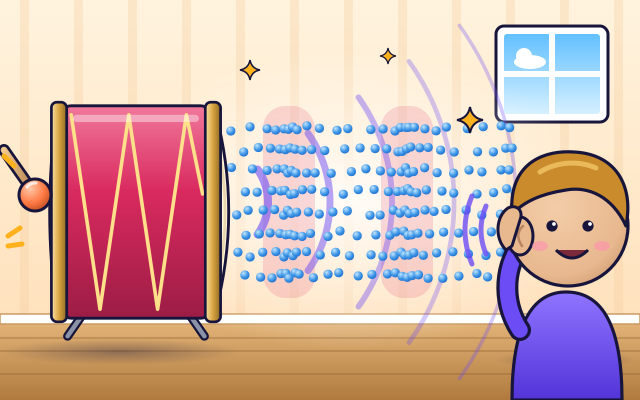
- Here is the drum in slow motion. Its skin shakes back and forth very fast. That shaking is called vibration. Each time the skin moves out, it pushes the air right next to it.
- Air is made of tiny particles, far too small to see. A pushed particle bumps its neighbor, and that one bumps the next. Watch the yellow one: it only wiggles and goes back. The push is what travels.
- As the drum keeps shaking, it sends out one push after another. The air becomes a moving pattern of squeezed bands and stretched bands. That traveling pattern is a sound wave.
- Sound travels through liquids and solids too, and it travels faster. In water it goes about four times as fast as in air. In a steel bar it goes about fifteen times as fast, because the particles of steel are held tightly together.
- In space there is almost nothing between things: no air to pass the push along. A ringing bell there is silent. But join the bell to a helmet with a metal rod, and the shake has something to travel through.
Look inside a sound wave
This is the air between a drum and an ear, drawn with giant particles. Tap each part of the wave.
- Drum skin. Every sound starts with something shaking. The drum skin moves back and forth and pushes on the air next to it, again and again.
- One air particle. Watch one particle. It moves forward a tiny bit, bumps its neighbors and moves back. It never travels across the room. Only the push does.
- Squeezed air. In these bands the particles are crowded together, because they have just been pushed. The crowded band moves along, like a squeeze passing down a toy spring.
- Stretched air. Between the squeezed bands the particles are spread out. The drum skin moved back and left more room, so the air here is thinner for a moment.
- One whole wave. From one squeezed band to the next is one whole wave. A drum that shakes faster sends out waves that are closer together, and you hear a higher sound.
- Eardrum. At the end of the ear tunnel is a thin skin called the eardrum. The squeezes and stretches of the air push and pull it, so it shakes in just the same way as the drum did.
The sound race: air, water and steel
Tap the mallet. One bang goes into a tube of air, a tank of water and a steel bar at the same time. Watch the particles pass it along. Then pump the air out of the top tube and try again.
Experiment: One bang goes into air, water and a steel bar. Which path gets the sound to the listener first?
- Tap the mallet and watch the three glowing pushes.
- See which animal hops first, second and last.
- Now switch on the pump to take the air out of the top tube. Bang again. What does the bird hear?
What we found: The steel bar wins easily, the water is second and the air is last. The particles in a solid are held tightly together, so each one passes the push to the next very quickly. With the air pumped out there are no particles in the tube, so no sound arrives at all.
Turn on JavaScript to try it yourself.
Pick the first listener
The listeners sit at different distances. Use what you know about air, water and steel to pick who hears the bang first, three times.
How sound really travels
Every sound starts with a vibration, which means something shaking back and forth. It could be a drum skin, a guitar string, a buzzing bee's wings or the vocal folds in your throat. The shaking thing pushes on the air beside it.
Air is made of tiny particles. When they are pushed, they crowd together and bump the particles next to them. Those bump the next ones, and so on. Then each particle moves back to where it was. The air itself does not fly across the room. Only the push travels, as a wave of squeezed and stretched air.
When that wave reaches your ear, it pushes and pulls on your eardrum and makes it shake in the same way. Your brain turns the shaking into the sound you hear. Fast shaking gives a high sound, like a whistle. Slow shaking gives a low sound, like a big drum. Bigger shakes sound louder.
Sound can travel through liquids and solids too, and it goes faster there. That is why you can hear a train coming through the rails before you hear it through the air. But sound cannot travel through empty space. With no particles to pass the push along, there is only silence. Our toy spring comparison is a little too simple in one way: a real sound spreads out in every direction and gets quieter as it goes.
Key words
- Vibration
- A fast shaking back and forth.
- Sound wave
- A pattern of squeezed and stretched air that travels away from something that shakes.
- Compression
- A band where the particles are squeezed closer together and the pressure is a little higher.
- Rarefaction
- A band where the particles are spread farther apart and the pressure is a little lower.
- Medium
- The material a wave travels through, such as air, water or steel.
- Vacuum
- A space with no particles in it. Sound cannot travel through a vacuum.
- Frequency
- How many times something shakes each second. Fast shaking makes a high sound.
Check your thinking
-
What does every sound start with?
Show the answer
Something vibrating (shaking back and forth). A vibrating thing pushes the air beside it, again and again. Those pushes travel away as sound.
-
When a sound crosses a room, what do the air particles do?
Show the answer
They bump their neighbors and go back to where they were. Only the push travels. If the air itself flew across, you would feel a wind with every sound.
-
Which of these does sound travel through fastest?
Show the answer
A steel bar. Sound is about 15 times faster in steel than in air. Water is in between, about 4 times faster than air.
-
Why is space silent?
Show the answer
There are almost no particles to pass the push along. Sound needs something to travel through. With nothing to bump, the push cannot go anywhere.
-
You see a flash of lightning, and the thunder comes 6 seconds later. Why the wait?
Show the answer
Light arrives almost at once, but sound takes time to travel. Sound moves through air at about 340 meters each second, so thunder from far away arrives well after the flash.
-
A note has a frequency of 686 hertz. The speed of sound in the air is 343 meters per second. What is its wavelength?
Show the answer
0.5 meters. Speed equals frequency times wavelength, so wavelength is 343 divided by 686, which is 0.5 meters.
You're a Light & sound expert!
You watched, looked inside, tried it, solved the challenge and went deeper. Pick another question below, or switch the age at the top to see this topic another way.
More about light & sound
 #437
Light & sound
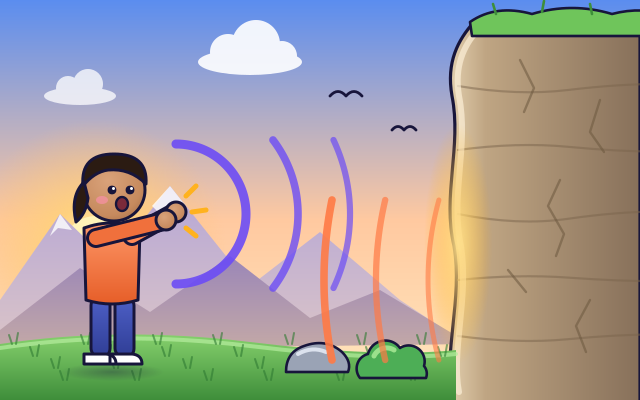
How do echoes happen?
Send sound toward different surfaces and compare the returning sound and delay.
#437
Light & sound
How do echoes happen?
Send sound toward different surfaces and compare the returning sound and delay.
 #438
Light & sound
How do guitar strings create different notes?
Change string length, tension, and thickness and compare vibrations and pitch.
#438
Light & sound
How do guitar strings create different notes?
Change string length, tension, and thickness and compare vibrations and pitch.
 #439
Light & sound
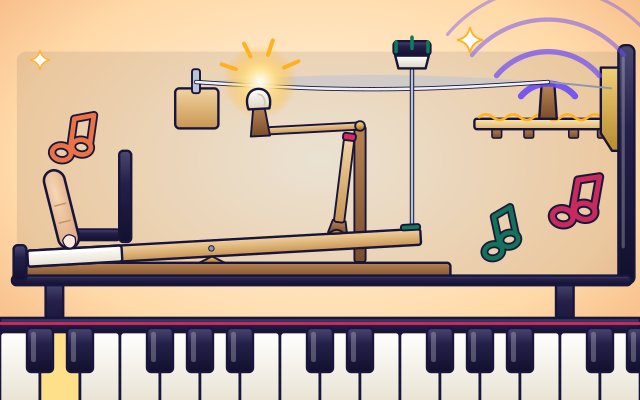
How does a piano make music?
Follow a key press through a hammer, string, damper, and soundboard.
#439
Light & sound
How does a piano make music?
Follow a key press through a hammer, string, damper, and soundboard.
 #440
Light & sound
How do flutes produce different notes?
Open and close holes and explore changing vibrations in an air column.
#440
Light & sound
How do flutes produce different notes?
Open and close holes and explore changing vibrations in an air column.
Keep exploring
Games to play next
- Listen and FindOlly whispers a clue or plays a sound. Can you find it in the picture?
- Mirror MazeBend a beam of light with mirrors to light up every crystal — in the right order.
- Shadow SculptorStack cubes under three lamps until every shadow matches the outline.
Guide for grown-ups
- How to start homeschooling: a step-by-step guide for familiesA guide for parents · 7 min read
Science games by grade
Science worksheets by grade
- Preschool Science Worksheets
- Pre-K Science Worksheets
- Kindergarten Science Worksheets
- 1st Grade Science Worksheets
- 2nd Grade Science Worksheets
- 3rd Grade Science Worksheets
- 4th Grade Science Worksheets
- 5th Grade Science Worksheets
- 6th Grade Science Worksheets
- 7th Grade Science Worksheets
- 8th Grade Science Worksheets