
City Europe
Bordeaux
Bordeaux is a city in France beside a big river. It has long rows of pale stone buildings.
Bordeaux is a port city in southwestern France on the Garonne River, about 100 kilometers from the Atlantic Ocean. Its 18th-century streets and squares are a UNESCO World Heritage Site called the Port of the Moon. France's 2023 census counted 267,991 people in the city.
Bordeaux grew from the Roman town of Burdigala into a great trading port, first for wine shipped to the British Isles and later for goods from overseas. UNESCO listed its historic center in 2007 as an outstanding ensemble of the Age of Enlightenment. The 2023 census counted 267,991 people in the commune.
Photo: Patrick Despoix, CC BY-SA 4.0, via Wikimedia Commons
Discover Bordeaux
Bordeaux is a city in France. It sits beside a wide river called the Garonne.
Ships have come up the river to Bordeaux for a very long time.
Bordeaux lies on the Garonne River in southwestern France, about 100 kilometers from the Atlantic Ocean. It is the capital of the region of Nouvelle-Aquitaine and the center of a group of 28 towns called Bordeaux Métropole.
France's statistics office, INSEE, counted 267,991 people in the city in its 2023 census, almost the same as the 266,662 of 1968.
INSEE's historical table for the commune shows 266,662 people in 1968, a low of 208,159 in 1982 and steady growth since: 235,178 in 2007, 254,436 in 2017 and 267,991 in 2023, on about 49 km² (5,429 people per km²).
Universalis notes that Bordeaux has headed an urban community of 28 communes since 1968, which became Bordeaux Métropole in 2015, with 843,700 inhabitants, and that the city, long tied to the wine trade, has become a leading regional metropolis.
- Country and region
- France; capital of Nouvelle-Aquitaine
- People in the city (2023 census)
- 267,991
- People in 1968 (census)
- 266,662
- Distance to the Atlantic Ocean
- about 100 km
The Port of the Moon
Bordeaux has a big square with grand old buildings.
In front of it is a flat, shallow pool of water. It shines like a mirror!
UNESCO calls the historic port city 'the Port of the Moon'. Its streets and squares, planned from the early 1700s onward, have more protected buildings than any French city except Paris.
The Place de la Bourse is a square of grand stone buildings, opened in 1749. In front of it lies the water mirror, a reflecting pool from 2006; in the photo, the buildings are reflected in a thin layer of water on the paving.
UNESCO inscribed 'Bordeaux, Port of the Moon' in 2007 (criteria ii and iv, 1,731 ha) as an inhabited historic city and an outstanding urban and architectural ensemble of the Age of Enlightenment, with more protected buildings than any other French city except Paris. It praises the 'exceptional urban and architectural unity and coherence' of its classical and neoclassical plans from the early 18th century.
Universalis lists the monuments of that golden age: the place Royale, the facade of the quays, the avenues and the Grand-Théâtre. Wikidata dates the square to 1749, the theater's opening to 7 April 1780 and the water mirror to 2006.
- Bordeaux, Port of the Moon
- UNESCO World Heritage Site since 2007
- Place de la Bourse
- square opened in 1749
- Water mirror (miroir d'eau)
- reflecting pool from 2006
Wine, ships and trade
Long ago, the Romans built a town here. Its name was Burdigala.
Later, ships carried things from Bordeaux to faraway places, and the town grew rich.
Bordeaux began as a trading town of a people called the Bituriges, and grew into the Roman city of Burdigala. Its first wealth came from vineyards planted in the 1st century.
From 1154 to 1443 the Duchy of Aquitaine was joined to the kingdom of England, and Bordeaux shipped great amounts of wine to the British Isles. The 18th century was its 'golden age': the port became a great center of the colonial trade, handling sugar and coffee from the islands, and the city built its grand squares and quays.
Universalis (Charles Higounet) describes Burdigala as first a trading post of the Bituriges, where British tin passed through, then a cultured Gallo-Roman city, a 'little Rome', whose first fortune came from an Atlantic vineyard created in the 1st century. A medieval revival came in the 12th century, and the union of Aquitaine with England (1154–1443) built a great export trade in wine; by the early 14th century a third wall enclosed about 30,000 people, a large number for the time.
In the 18th century the city became the great port of the colonial trade, redistributing sugar and coffee, and gave itself its classical streets and monuments. Its distance from Europe's great industrial centers slowed it in the 19th century; in 1914 it had 260,000 inhabitants.
- Roman name
- Burdigala
- Union with the kingdom of England
- 1154 to 1443
- People in 1914
- 260,000
Trams along the river
Trams glide through the streets of Bordeaux.
An old stone bridge crosses the river.
Bordeaux opened its tram network in 2003. By 2023 it had grown to about 80 kilometers, and that year the tram reached the airport at Mérignac.
The Pont de pierre, whose name means 'stone bridge', crosses the Garonne about 0.7 kilometers east-southeast of the Place de la Bourse. Wikidata dates its opening to 1822.
UrbanRail.Net lists Bordeaux's standard-gauge tram, opened in 2003, at about 80 km and 4 lines in May 2023, with Alstom Citadis trams. Line A reached Mérignac Airport on 29 April 2023 (4.7 km), and on 6 December 2025 lines E and F were created by splitting lines A and C.
Wikidata gives the Pont de pierre over the Garonne a construction start of 1810 and an opening on 30 April 1822; its point is about 0.66 km east-southeast of the Place de la Bourse.
- Tram opened
- 2003
- Tram network
- about 80 km (May 2023)
- Pont de pierre
- stone bridge over the Garonne, opened 1822
Mild and often wet
Bordeaux has mild winters and warm summers.
It is wet in every month, but late autumn and winter are the wettest.
The World Meteorological Organization's averages for Bordeaux (1971–2000) show daytime highs of about 27 °C in July and August and about 10 °C in January. Even January nights average just above freezing, about 3 °C.
About 984 millimeters of precipitation fall in an average year. Summer is the driest season: July brings the least, about 55 millimeters, while November and December bring the most, about 107 each.
The WMO table for Bordeaux, 1971–2000, gives average highs from 10.0 °C in January to 26.6 °C in August (26.4 °C in July) and average lows from 2.8 °C in January to 15.2 °C in August; no month's average low is below freezing.
The monthly precipitation averages add up to about 984.0 mm a year, on about 128 days with 1 mm or more. November (106.8 mm) and December (106.7 mm) are wettest and July (54.5 mm) is driest; June to August together bring 177.8 mm, less than a fifth of the year.
- August, average high (WMO, 1971–2000)
- 26.6 °C
- January, average low (same period)
- 2.8 °C
- Precipitation in a year (sum of the monthly averages)
- about 984 mm
A port city of trade
For hundreds of years, Bordeaux has traded with other countries.
It also has a grand old theater from 1780.
UNESCO says Bordeaux has been a place where cultures met and exchanged ideas for more than 2,000 years, especially through its trade with Britain and the Low Countries since the 1100s. Universalis says its history is tied above all to the wine trade, and that it has become a leading regional city.
The Grand-Théâtre, one of the monuments of the 18th-century golden age, opened in 1780.
UNESCO recognizes Bordeaux's role 'as a place of exchange of cultural values over more than 2,000 years', particularly through commercial links with Britain and the Low Countries since the 12th century, and calls its plan the success of philosophers who wanted towns to be 'melting pots of humanism, universality and culture'.
Universalis notes that in the 18th century the city's merchants, magistrates and thinkers, the last symbolized by Montesquieu, gave it its classical monuments, and that in 1914 the first industrial plants were built to offset the port's decline.
- Trade with Britain and the Low Countries
- especially since the 12th century (UNESCO)
- Grand-Théâtre
- opened 7 April 1780
- Bordeaux Métropole
- 28 communes, 843,700 inhabitants
Bordeaux on the map
Find France on the globe. Look at its southwest corner, near the Atlantic Ocean. Bordeaux is there, beside a river!
The river carries ships out to the sea.
Bordeaux lies in southwestern France at about 45° north, on the Garonne River, about 100 kilometers from the Atlantic Ocean.
Measured from the Place de la Bourse, the water mirror is about 80 meters to the east-northeast, the Grand-Théâtre about 300 meters to the west-northwest, and the Pont de pierre about 660 meters to the east-southeast.
Bordeaux lies at about 44.9° N and 0.6° W. Measured from the Place de la Bourse (Wikidata points), the water mirror is about 0.08 km east-northeast, the Grand-Théâtre about 0.30 km west-northwest and the Pont de pierre about 0.66 km east-southeast.
The hero photo was taken on 5 September 2013 at 10:29 by the camera's clock, from the water mirror looking toward the Place de la Bourse (Commons gives no camera point).
- Latitude
- about 44.9° north
- Longitude
- about 0.6° west
- Place de la Bourse to the Grand-Théâtre
- about 0.3 km west-northwest
Amazing facts
-
Bordeaux has a pool of water that reflects buildings like a mirror!
The water mirror in front of the Place de la Bourse is a very shallow reflecting pool, made in 2006.
Wikidata records the miroir d'eau as a reflecting pool dating from 2006, in front of the Place de la Bourse.
-
Only Paris has more protected old buildings than Bordeaux in France.
UNESCO says Bordeaux has more protected buildings than any other French city except Paris.
UNESCO's description of 'Bordeaux, Port of the Moon' notes more protected buildings than any other French city except Paris.
-
Long ago, Bordeaux's land and England were joined under one ruler for almost 300 years.
From 1154 to 1443, the Duchy of Aquitaine, with Bordeaux, was joined to the kingdom of England.
Universalis dates the political union of the Duchy of Aquitaine with the kingdom of England to 1154–1443, which built Bordeaux's great wine export trade to the British Isles.
-
The Romans called Bordeaux Burdigala.
In Roman times Bordeaux was called Burdigala and was known as a 'little Rome'.
Universalis describes Gallo-Roman Burdigala as a cultured, aristocratic 'little Rome' whose grid of streets and monuments spread over a large area.
Words to know
- port
- a town or city where ships load and unload goods
- quay
- a stone platform along a river or harbor where ships tie up
- reflecting pool
- a shallow pool built so that buildings or the sky are reflected in it
- Enlightenment
- an 18th-century movement in Europe that valued reason, science and learning
- World Heritage Site
- a place UNESCO lists as so important that it should be protected for everyone
- tram
- an electric train that runs on rails along city streets
Discovery challenge
-
Bordeaux is a city in which country?
Bordeaux is a city in which country?
Bordeaux is the capital of Nouvelle-Aquitaine, a region of which country?
- Spain
- France
- Italy
Show the answer
France
France!
France, in the southwest.
France.
-
Which river flows through Bordeaux?
Bordeaux stands on which river?
On which river does Bordeaux stand, about 100 km from the Atlantic?
- The Seine
- The Garonne
- The Rhine
Show the answer
The Garonne
The Garonne!
The Garonne.
The Garonne.
-
What does the big pool in Bordeaux look like?
What is the water mirror in front of the Place de la Bourse?
What kind of feature is Bordeaux's miroir d'eau, dating from 2006?
- A deep swimming pool
- A shallow reflecting pool
- A harbor for boats
Show the answer
A shallow reflecting pool
A shiny mirror of water!
A very shallow reflecting pool.
A reflecting pool, according to Wikidata.
-
What does UNESCO call Bordeaux?
What name does UNESCO give to Bordeaux's World Heritage Site?
Under which name did UNESCO inscribe Bordeaux in 2007?
- City of Light
- Port of the Moon
- Gate of the Sun
Show the answer
Port of the Moon
The Port of the Moon!
The Port of the Moon.
'Bordeaux, Port of the Moon'.
-
Which month is the driest in Bordeaux?
Which month brings Bordeaux the least precipitation, on average?
In the WMO's 1971–2000 averages, which month is Bordeaux's driest (54.5 mm)?
- July
- November
- January
Show the answer
July
In July, in summer!
July. November and December are the wettest.
July (54.5 mm); November is the wettest (106.8 mm).
Nearby places
-
 Watch
Landmark
Cordouan Lighthouse
Cordouan Lighthouse stands on a rocky plateau in the sea where the Atlantic Ocean meets the Gironde estuary in France. Building began in 1584 and finished in 1611, and in 1788-1789 the tower was made taller. It still guides ships today and became a UNESCO World Heritage Site in 2021.
-
 Watch
Landmark
Guggenheim Museum Bilbao
The Guggenheim Museum Bilbao is an art museum in Bilbao, Spain, designed by the architect Frank Gehry and built from 1993 to 1997. Its swirling shapes are covered with about 33,000 thin sheets of titanium, and it stands beside the Nervión River.
-
 Watch
Natural wonder
Pyrenees
The Pyrenees are a mountain range between France and Spain. They formed when the Iberian and European plates collided, and later glaciers carved their deep valleys. Today they shelter wildlife such as isards, marmots and bearded vultures, and two of Europe's largest canyons.
-
 Watch
Landmark
Château de Montsoreau
The Château de Montsoreau is a castle on the bank of the Loire River in western France. A powerful adviser to the king, Jean II de Chambes, had it built in the 1450s from a soft local stone called tufa. Today it is a museum of modern art.
-
 Watch
Landmark
Millau Viaduct
The Millau Viaduct is a motorway bridge in southern France that crosses the wide valley of the Tarn River. Its road is about 300 meters above the river, as high as the Eiffel Tower is tall. It was designed by the architect Norman Foster and the engineer Michel Virlogeux, and it opened in December 2004.
- Watch Natural wonder Cave of Altamira The Cave of Altamira, in northern Spain, holds some of the most famous prehistoric paintings in the world. People who hunted and gathered their food used the cave between about 36,000 and 13,000 years ago, and painted and engraved bison, horses, deer, hands and signs on its walls and ceiling. It was the first cave where prehistoric cave art was ever recognized.
-
 Watch
Landmark
Burgos Cathedral
Burgos Cathedral is a Gothic cathedral in the city of Burgos, in northern Spain. Builders laid its first stone in 1221 and finished the dome over its center in 1567. Its front has two lacy stone spires, and it has been a World Heritage Site since 1984.
-
 Watch
Landmark
Pont du Gard
The Pont du Gard is a Roman bridge in southern France that carried an aqueduct, a channel for water, across the Gardon River. Built about 2,000 years ago, it has three levels of arches and stands almost 49 meters high. Water once flowed along its top on its way to the city of Nîmes.
Explore next
-
 Watch
 Country
France
France is a country in northwestern Europe, between the Atlantic Ocean and the Mediterranean Sea. It has high mountains such as the Alps and the Pyrenees, long rivers such as the Loire and the Seine, and about 69.1 million people (2026). Its capital is Paris.
-
 Watch
City
Paris
Paris is the capital of France. It grew from an island in the Seine River into a city of about 2.1 million people (2023), with the Eiffel Tower, Notre-Dame, the Louvre and a subway that has run since 1900.
-
 Watch
City
Lyon
Lyon is a city in France where two rivers, the Rhône and the Saône, meet below two hills. The Romans founded it more than 2,000 years ago, and its old town is a UNESCO World Heritage Site. The Lumière brothers worked on their movie camera, the Cinematograph, in Lyon. About 519,000 people lived in the city in 2023.
-
 Watch
City
Marseille
Marseille is a port city on France's Mediterranean coast. Greeks from Phocaea founded it about 600 BC, around a sheltered inlet that is now the Old Port. White limestone hills rise along its coast, inside the Calanques National Park. INSEE's 2023 census counted 886,040 people in the city.
-
 Watch
City
Porto
Porto is a city in Portugal, built on hills above the Douro River, a few kilometers from the Atlantic Ocean. It is Portugal's second city, after Lisbon, and its old center is a UNESCO World Heritage site. Portugal's 2021 census counted 231,800 people in the municipality of Porto.
-
 Watch
City
Amsterdam
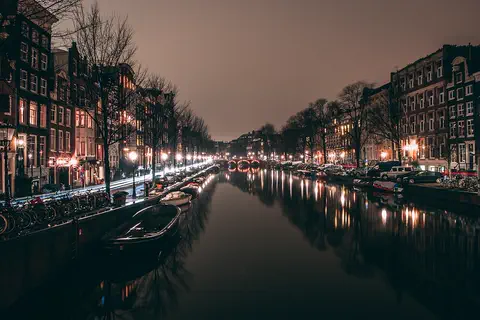
Amsterdam is the capital of the Netherlands. It began as a fishing village beside a dam on the Amstel River, which gave the city its name. Today about 942,000 people live among its rings of canals, hundreds of bridges, houseboats and bicycles.
-
 Watch
City
Antwerp
Antwerp is a city in Belgium on the Scheldt river, and Universalis calls it the second port of continental Europe, after Rotterdam. Belgium's statistics office estimated 565,615 people in the city on 1 January 2026. In the 1500s it was one of Europe's great trading cities.
-
 Watch
City
Athens
Athens is the capital of Greece and one of the oldest cities in the world. Above it rises the Acropolis, a rocky hill crowned by the marble Parthenon, built about 2,500 years ago. Ancient Athens was home to early democracy, great thinkers and theater.
For parents & teachers
What children will learn
- Locate Bordeaux on the Garonne in southwestern France.
- Describe how trade by river and sea shaped a city over 2,000 years.
- Explain why UNESCO protects a whole historic city, not just one building.
- Read monthly temperature and precipitation averages for a mild Atlantic climate.
Recommended ages: 3 to 17 · About 15 minutes
Talk about it
- Bordeaux is about 100 km from the sea, yet it became a great port. How can a river help a city trade?
- UNESCO praises the 'unity and coherence' of Bordeaux's streets. What makes a street look as if it belongs together?
- The water mirror turns a square into a reflection. Why might a city build something like that?
Try at home or in class
- Mirror pool: pour a thin layer of water on a dark tray outside and look at the reflections of buildings or trees.
- River port map: draw a river from the sea to a city and mark the quays where ships would tie up.
- Precipitation chart: plot Bordeaux's monthly precipitation and color the driest summer months.
Key vocabulary: port, quay, reflecting pool, Enlightenment, World Heritage Site, tram
Where these facts come from
- Wikidata , Wikimedia Foundation (CC0 1.0)
- Natural Earth vector data , Natural Earth (NACIS) (Public domain)
- Dossier complet: Commune de Bordeaux (33063), population 1968–2023 , INSEE
- Bordeaux, Port of the Moon , UNESCO World Heritage Centre
- Bordeaux , Encyclopaedia Universalis (Jean Dumas, Charles Higounet)
- Bordeaux Tram , UrbanRail.Net (Robert Schwandl)
- World Weather Information Service: Bordeaux climatological information , World Meteorological Organization
- File:138 - Place de la Bourse et le miroir d'eau - Bordeaux.jpg (Patrick Despoix, 5 September 2013) , Wikimedia Commons
- Wikimedia Commons , Wikimedia Foundation (Per file (public domain, CC0, CC BY or CC BY-SA); see each media record)
Checked, not yet human-reviewed. Last updated November 1, 2026. Spotted a mistake? Tell us.