
Landmark Africa
Saint Catherine's Monastery
Saint Catherine's Monastery is a home for monks in the mountains of Egypt. Thick stone walls go all the way around it. It is more than 1,400 years old.
Saint Catherine's Monastery stands at the foot of Mount Sinai, in the dry mountains of Egypt's Sinai Peninsula. It was founded in the 500s, and its granite walls and church date from that time. UNESCO says it is the oldest Christian monastery still used for its first purpose, and it holds famous collections of old books and paintings.
Founded under the Byzantine emperor Justinian I, with granite walls begun in 527 and a church built in the 560s, Saint Catherine's has been a working Greek Orthodox monastery without a break ever since. Its library and icon collection are among its treasures, a small Fatimid-era mosque stands inside its walls, and since 2002 it has been the heart of the Saint Catherine Area World Heritage Site.
Photo: Berthold Werner, CC BY-SA 3.0, via Wikimedia Commons
Discover Saint Catherine's Monastery
A monastery is a place where monks live, work and pray together.
This one is in Egypt, in a valley between rocky mountains. Monks have lived here for about 1,500 years.
Saint Catherine's Monastery is in the south of Egypt's Sinai Peninsula, at the foot of a mountain called Mount Sinai, or Jebel Musa in Arabic. The land around it is dry and rocky, with cool winters and hot summers.
A monastery is a place where monks live and pray together. Monks have lived here since the 500s, and UNESCO says it is the oldest Christian monastery still used for its original purpose. The mountain above it is important to Christians, Muslims and Jews, whose traditions link it with Moses. The monastery belongs to the Greek Orthodox Church.
The monastery lies in the rugged mountains of southern Sinai, in an area with about 60 mm of rain a year. It is the centerpiece of the Saint Catherine Area, a World Heritage Site inscribed in 2002 that covers 601 km² within the larger Saint Catherine Protectorate.
UNESCO describes it as the oldest Christian monastery that has kept its original function without a break since its foundation in the 6th century, and as one of the very early outstanding examples, in the Eastern tradition, of a Christian monastic settlement in a remote area. The area is, in UNESCO's words, of immense spiritual significance to Christianity, Islam and Judaism: the Old Testament places Moses receiving the Tablets of the Law on this mountain, which Muslims know as Jebel Musa. The monastery is the property of the Greek Orthodox Church and is self-governing, led by an abbot who holds the rank of archbishop.
- Where
- At the foot of Mount Sinai (Jebel Musa), South Sinai, Egypt
- Founded
- 6th century; walls begun in 527
- Walls
- granite, about 11 m high and 2.5 m thick
- World Heritage
- Saint Catherine Area, 2002
A fortress for monks
Long ago, monks lived alone in these mountains.
An emperor sent builders to make strong walls around them. The walls are still standing today!
Early Christian hermits, people who chose to live alone to pray, came to live in the wild mountains of Sinai. After the Romans left in the late 300s, life there became unsafe, so the monks asked for help.
The Byzantine emperor Justinian I sent architects and builders. They put up a fort below the mountain, both to protect the monks and to guard the road between Aqaba and Suez. The walls were begun in 527, and the main church was finished in the 560s. Later, from 1101 to 1106, a small mosque was built inside the walls, and in 1871 one of the monks built a bell tower.
ICOMOS relates that early Christian hermits settled in the Sinai wilderness and that, after the Romans withdrew in the later 4th century, the monastic communities sought protection. Justinian I sent teams of architects and masons to build a fort below the peak the monks identified as Mount Sinai, to protect the community and secure the road from Aqaba to Suez. The architect Stephanos began the walls in 527 and built the main church, which dates from the 560s. Its first dedication was to the Virgin Mary; it was later dedicated to Saint Catherine, whose name the monastery carries.
Under the Fatimid caliphate a mosque was built inside the walls, between 1101 and 1106, on the site of a small chapel; ICOMOS links it to the close relations the monastery has kept with Islam. Later, the upper parts of the walls were restored on Napoleon's orders, and in 1871 the monk Gregorius built the bell tower. UNESCO notes repairs going back to the Middle Ages, made by both the monks and the local Bedouin.
Granite walls and a granite church
The walls are made of big blocks of granite, a very hard rock.
They are 11 meters tall. The monks' rooms are built along the inside of the walls.
The monastery is closed in on every side by a massive wall of granite blocks, about 11 meters high and 2.5 meters thick. The upper parts were rebuilt later with smaller, rougher stones. The original main gate, on the west side, is blocked, and people go in through a smaller gate beside it.
Inside, the monks' rooms, called cells, line the inner face of the walls. The main church is also built of granite. It has a long central hall, called a nave, with a row of huge granite columns on each side, and its carved cedar wood doors are as old as the church itself.
ICOMOS describes an enclosing wall 2.5 m wide and averaging 11 m high, built of massive dressed granite blocks, with upper sections restored on Napoleon's orders in smaller undressed stone. Crosses and monograms are carved into it in places. The original west gate is blocked; entry is through a smaller, also original, gate beside it, and UNESCO's summary mentions a newer visitor entrance in a side wall.
The Church of the Transfiguration, or Katholikon, is a granite basilica by Stephanos: a broad nave flanked by two aisles with massive granite columns, an apse and a narthex, with three chapels off each aisle. Its carved cedar entrance doors are contemporary with the building, while those of the narthex were made in the 11th century; the ceiling, marble floor and iconostasis (the screen of icons before the altar) date from the 18th century. Its internal layout, UNESCO says, is still the same as at its foundation.
A church, a mosque and a famous library
Inside the walls is a church with a bell tower.
Right next to it is a small white tower, called a minaret. It belongs to a little mosque. The monks also keep very old books and paintings.
Look over the walls and you can see two towers side by side. One is the stone bell tower of the church, built in 1871, with nine bells given by the ruler of Russia. The other is the small white minaret of a mosque, built inside the monastery walls between 1101 and 1106.
The monastery is famous for its library. When experts studied it for its World Heritage listing, it held more than 3,000 handwritten books, called manuscripts, and more than 5,000 early books. It also has more than 2,000 icons, religious paintings, in styles from the 500s to the 1700s.
The Fatimid mosque, south-west of the basilica, is a rectangular building 7 by 11 m and 7 m high, with a small minaret at its northern corner and three mihrabs (prayer niches) in its qibla wall. ICOMOS records that it fell out of regular use in the later 13th century, was restored in the early 20th century, and was still used on special occasions by local Muslims. The neo-Classical bell tower beside the church was built in 1871 by the monk Gregorius and holds nine bells presented by the Tsar of Russia.
ICOMOS counted more than 3,000 manuscripts and more than 5,000 early books in the library, which it called the oldest in the Christian world, and more than 2,000 icons representing almost every school of Byzantine icon painting from the 6th to the 18th century. The Old Refectory, a dining hall with a Gothic vaulted roof, has wall paintings from the Crusader period and the 16th century.
- Main church
- Church of the Transfiguration, built in the 560s
- Mosque
- built 1101–1106, 7 × 11 m, 7 m high
- Bell tower
- 1871, nine bells
- Library (ICOMOS count)
- more than 3,000 manuscripts
Garden, mountains and visitors
Outside the walls, the monks grow a garden.
They carried soil here to grow olives, apricots and cherries. Tall mountains rise all around.
Outside the walls is the monastery garden. Over many years the monks brought in soil and built tanks to store water, so they could grow fruit trees such as olives, apricots, plums and cherries, and vegetables too.
Above the monastery rise two peaks. Mount Moses is 2,285 meters high, and Mount Catherine, at 2,642 meters, is the highest peak on the Sinai Peninsula. A path leads up Mount Moses past old stone arches and the ruins of small chapels. Many visitors come, and UNESCO warns that crowds, rock slides and rare flash floods are risks the monastery must manage.
The triangular garden outside the walls was created over many years by monks who brought in soil and built irrigation tanks; it holds olives, apricots, plums, cherries and vegetables. ICOMOS adds that a constant supply of fresh water comes from a fountain that taps an underground spring.
The World Heritage Site also covers the surrounding mountains: Mount Moses (2,285 m), with a mosque and a chapel on its summit and a path to the top lined with two stone arches and ruined chapels, and Mount Catherine (Jebel Katrin, 2,642 m), the highest peak of the Sinai Peninsula. UNESCO's summary names large numbers of well-intentioned tourists, rock slides and rare flash floods as risks, calls the modern town of Saint Catherine the only discordant feature, and describes conservation work against rock slides, repairs to the walls, a new visitor circuit entered through a new side-wall entrance, and an inner museum that was being built inside the monastery.
Amazing facts
-
A church and a little mosque are inside the same walls.
A small mosque, built between 1101 and 1106, stands inside the monastery's walls, next to the church.
The Fatimid mosque inside the enclosure, built 1101–1106, was restored in the early 20th century and, ICOMOS reported, was still used by local Muslims on special occasions.
-
The church doors are made of wood that is about 1,500 years old.
The carved cedar wood doors at the entrance of the main church are as old as the church itself, from the 500s.
The carved cedar doors at the church entrance are contemporary with the 6th-century building; the narthex doors were made in the 11th century.
-
The bell tower has nine bells, a gift from far away.
The bell tower, built in 1871 by one of the monks, holds nine bells given by the Tsar, the ruler of Russia.
The neo-Classical bell tower is the work of the monk Gregorius (1871); its nine bells were presented by the Tsar of Russia.
-
Monks and local Bedouin people have mended the walls together.
Some repairs to the monastery go back to the Middle Ages and were made by both the monks and the local Bedouin people.
UNESCO notes repairs dating back to the Middle Ages by both the monks and the local Bedouin, and credits the use of local materials with keeping the buildings authentic.
Words to know
- monastery
- a place where monks live, work and pray together
- granite
- a very hard rock made of large crystals
- Byzantine
- of the eastern Roman Empire, ruled from Constantinople
- manuscript
- a book or document written by hand
- icon
- a religious painting, often on wood, in the Orthodox tradition
- minaret
- a tall, slender tower built at or near a mosque
Discovery challenge
-
Who lives at Saint Catherine's Monastery?
Who has lived at Saint Catherine's since the 500s?
What community has used the site for its original function without a break since the 6th century?
- Monks
- Soldiers
- Kings and queens
Show the answer
Monks
Monks live there!
Monks; UNESCO says it is the oldest Christian monastery still used for its first purpose.
A Greek Orthodox monastic community, in continuous use since its foundation.
-
What are the big walls made of?
What hard rock were the monastery's walls and church built from?
Of what stone are the enclosure wall and the basilica built?
- Granite
- Ice
- Wood
Show the answer
Granite
Granite, a very hard rock!
Granite: massive blocks for the walls, and granite for the church and its columns.
Dressed granite blocks for the wall, and granite for the basilica and its columns.
-
What stands next to the church's bell tower?
What building with a minaret stands inside the monastery walls?
Which building was erected inside the enclosure between 1101 and 1106?
- A small mosque
- A castle
- A lighthouse
Show the answer
A small mosque
A little mosque, with a white minaret!
A small mosque, built between 1101 and 1106.
A Fatimid-era mosque, 7 × 11 m, with a small minaret.
-
What did the monks carry in to make their garden?
How did the monks make a garden in such a dry place?
What did the monks bring in, with irrigation tanks, to create the garden?
- Soil
- Snow
- Sand from the sea
Show the answer
Soil
Soil, so plants could grow!
They brought in soil and built tanks to store water.
Soil, together with tanks that stored water for irrigation.
Nearby places
-
 Watch
Natural wonder
Wadi Rum
Wadi Rum, in southern Jordan, is a desert of towering sandstone and granite mountains rising from valleys of red sand. Wind, water and salt have carved arches, gorges and honeycomb patterns into the rock. People have lived here for at least 12,000 years, leaving behind about 25,000 rock carvings and 20,000 inscriptions.
-
 Watch
Natural wonder
Negev
The Negev is a dry region in the Middle East, shaped like a triangle with its point at the Red Sea. Its name comes from a Hebrew word meaning to dry. It has huge craters called makhteshim, carved by erosion, ancient towns on an old incense trade route, and farms watered by pipelines.
-
 Watch
Landmark
Petra
Petra, in southern Jordan, was the capital of the Nabataeans, who grew rich from trade in incense and spices. Many of its tombs and monuments are carved straight into red sandstone cliffs, and a narrow gorge called the Siq leads to its most famous facade, the Treasury.
-
 Watch
Landmark
Memphis
Memphis was the capital of Egypt in the time of the first great pyramids, more than 4,000 years ago. It stood on the west side of the Nile, about 24 kilometers south of modern Cairo. Kings, priests, craftworkers and traders lived there, and its rulers were buried in pyramids and tombs along the desert edge, from Giza to Dahshur.
-
 Watch
Landmark
Bent Pyramid
The Bent Pyramid stands at Dahshur in Egypt. It was built for King Sneferu, who reigned about 2613 to 2589 BCE. Its builders started the sides at a steep angle of 55 degrees, then changed to 43 degrees because the pyramid was becoming unstable. That change gives it its bent shape.
-
 Watch
Landmark
Red Pyramid
The Red Pyramid stands at Dahshur in Egypt. It was built for King Sneferu, who reigned about 2613 to 2589 BCE. Egypt's antiquities ministry says it was Egypt's first true pyramid to be completed, and it is the highest pyramid at Dahshur. Its name comes from the reddish color of its stones.
-
 Watch
City
Cairo
Cairo, the capital of Egypt, has stood on the banks of the Nile for more than 1,000 years, where the river spreads out into its delta. Founded in 969, it has a medieval old city full of historic mosques and markets, the Egyptian Museum and, at its edge, the Pyramids of Giza. It is one of the largest cities in Africa.
-
 Watch
Landmark
The Great Sphinx
The Great Sphinx at Giza, Egypt, is a lion with a human head, carved out of the solid rock about 4,500 years ago. It is about 73 meters long and 20 meters high, one of the largest sculptures in the world. Most experts think it shows the face of King Khafre.
Explore next
-
 Watch
 Country
Egypt
Egypt is in the northeastern corner of Africa, and its Sinai Peninsula reaches into Asia. Almost all of it is desert, so most of its more than 100 million people live along the green banks of the Nile River, where one of the world's earliest civilizations grew.
-
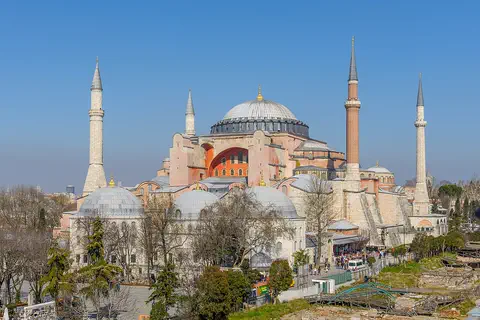 Watch
Landmark
Hagia Sophia
Hagia Sophia in Istanbul was built in under six years, from 532 to 537, for the emperor Justinian. Its enormous dome seems to float on a ring of 40 windows. Over almost 1,500 years it has been a church, a mosque and a museum, and since 2020 it has been a mosque.
-
Watch
City
Cairo
Cairo, the capital of Egypt, has stood on the banks of the Nile for more than 1,000 years, where the river spreads out into its delta. Founded in 969, it has a medieval old city full of historic mosques and markets, the Egyptian Museum and, at its edge, the Pyramids of Giza. It is one of the largest cities in Africa.
-
 Watch
Landmark
Abu Simbel
Abu Simbel is two temples cut into the rock by King Ramesses II of Egypt, around 1264 BCE. Four seated statues of the king, each 21 meters tall, guard the Great Temple. In the 1960s, a new dam was about to flood them, so workers cut them into more than a thousand blocks and rebuilt them higher up.
-
 Watch
Landmark
Aït Benhaddou
Aït Benhaddou is a ksar, a village of earthen buildings inside high walls, on the southern slopes of the High Atlas mountains in Morocco. Its oldest buildings probably date from no earlier than the 1600s. It was a stop on an old trade route to Marrakesh, and it became a UNESCO World Heritage Site in 1987.
-
 Watch
Landmark
Amphitheater of El Jem
The Amphitheater of El Jem is a Roman arena in Tunisia, built around the year 238. It stands on flat ground and is made entirely of stone blocks. UNESCO says it could hold about 35,000 spectators, which makes it one of the largest amphitheaters in the world.
-
 Watch
Landmark
Aswan High Dam
The Aswan High Dam crosses the Nile River in southern Egypt. Finished in 1970, it is 111 meters high and 3,830 meters long. It controls the Nile's yearly flood, stores water for farms, makes electricity and created a huge reservoir, Lake Nasser. Ancient temples had to be moved to save them from the rising water.
-
Watch
Landmark
Bent Pyramid
The Bent Pyramid stands at Dahshur in Egypt. It was built for King Sneferu, who reigned about 2613 to 2589 BCE. Its builders started the sides at a steep angle of 55 degrees, then changed to 43 degrees because the pyramid was becoming unstable. That change gives it its bent shape.
For parents & teachers
What children will learn
- Locate the Sinai Peninsula in Egypt and describe Saint Catherine's as a monastery founded in the 6th century.
- Explain how its walls, church and garden were built for life in a remote, dry place.
- Notice that one place can matter to people of several faiths, and that a mosque stands inside the monastery's walls.
Recommended ages: 4 to 17 · About 15 minutes
Talk about it
- Why might people have chosen to live in such a remote, dry place?
- What would you need to make a garden grow where there is very little rain?
- Why might a library of handwritten books be so valuable today?
Try at home or in class
- Plant a seed in a small pot of soil, water it a little each day, and talk about how the monks brought soil to the desert.
- Make a small book by folding paper and copying a short story by hand, as books were made before printing.
Key vocabulary: monastery, granite, Byzantine, manuscript, icon, minaret
Where these facts come from
- Wikidata , Wikimedia Foundation (CC0 1.0)
- Saint Catherine Area , UNESCO World Heritage Centre
- Advisory Body Evaluation: Saint Catherine Area (No 954) , ICOMOS, via UNESCO World Heritage Centre
- Wikimedia Commons , Wikimedia Foundation (Per file (public domain, CC0, CC BY or CC BY-SA); see each media record)
Checked, not yet human-reviewed. Last updated November 1, 2026. Spotted a mistake? Tell us.