Landmark Asia
Hagia Sophia
Hagia Sophia is a huge old building in Istanbul, Türkiye. It has a giant dome. It was a church, then a mosque, then a museum, and now it is a mosque again.
Hagia Sophia in Istanbul was built in under six years, from 532 to 537, for the emperor Justinian. Its enormous dome seems to float on a ring of 40 windows. Over almost 1,500 years it has been a church, a mosque and a museum, and since 2020 it has been a mosque.
Designed by Anthemius of Tralles and Isidorus of Miletus for Justinian I and completed in 537, Hagia Sophia set a dome on pendentives above a vast basilica. It served as a cathedral, then a mosque from 1453, a museum from 1935 and a mosque again since 2020; UNESCO lists it within the Historic Areas of Istanbul.
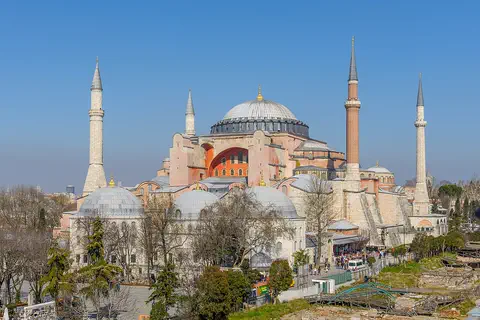
Photo: Arild Vågen, CC BY-SA 3.0, via Wikimedia Commons
Discover Hagia Sophia
Hagia Sophia is in Istanbul, a big city in Türkiye.
It has one giant round dome and many smaller domes. Four tall, thin towers stand around it. It is almost 1,500 years old. People still go inside to pray and to look.
Hagia Sophia stands in Istanbul, the city once called Constantinople, where Europe meets Asia beside the Bosphorus strait. Its name comes from Greek words meaning "Holy Wisdom."
The emperor Justinian had it built as a church between 532 and 537. The top of its great dome is about 55 meters above the ground. Over the centuries it has been a church, a mosque and a museum, and since 2020 it has been a mosque again. It remains open to visitors, and UNESCO protects it as part of the Historic Areas of Istanbul.
Hagia Sophia stands on the point of land where the Bosphorus meets the Golden Horn in Istanbul, Byzantine Constantinople. Britannica calls it one of the world's great monuments, built as an Eastern Orthodox church in 532 to 537 under Justinian I; the American Society of Civil Engineers, which lists it as a Historic Civil Engineering Landmark, describes a domed basilica 220 by 250 ft with a dome about 182.5 ft (about 55.6 m) above the ground.
Its uses trace the region's history: Eastern Orthodox church (537 to 1204), Roman Catholic cathedral (1204 to 1261), Orthodox again (1261 to 1453), mosque (1453 to 1935), museum (1935 to 2020) and, by President Erdoğan's decision in 2020, a mosque again, the Hagia Sophia Grand Mosque. UNESCO's Historic Areas of Istanbul (1985) name it a masterpiece that became a model for a whole family of churches and later mosques.
- Where
- Istanbul, Türkiye, near the Bosphorus
- Built
- 532 to 537
- Dome
- about 182.5 ft (about 55.6 m) above the ground
- World Heritage
- part of the Historic Areas of Istanbul (1985)
Church, mosque, museum, mosque
A long time ago, an emperor named Justinian built Hagia Sophia as a church.
About 900 years later, a sultan made it a mosque. Much later, it became a museum. Since 2020, it has been a mosque again.
Two earlier churches stood here before. Both were destroyed, the second during riots in 532. Emperor Justinian quickly ordered a much bigger church, finished in 537. For centuries it was the great cathedral of Constantinople.
In 1453, the Ottoman sultan Mehmed II took the city and made Hagia Sophia a mosque. Minarets were added over the next century. In 1934, Türkiye's first president, Kemal Atatürk, ended its use as a mosque, and in 1935 it opened as a museum. In 2020 it became a mosque again, still open to visitors.
Constantius II completed the first church, the Magna Ecclesia (Great Church), in 360; its roof burned in 404, and Theodosius II's rebuilt church was destroyed in the Nika riots of January 532. ASCE notes that work on Justinian's far larger church began only 39 days later. Earthquakes brought partial collapses: part of the dome fell in 558 and was rebuilt higher by Isidorus the Younger by 562, and the eastern arch fell again in 1347 and was restored in 1354. In 1204 the church was looted by the armies of the Fourth Crusade and became a Roman Catholic cathedral until 1261.
After the Ottoman conquest of 1453, Mehmed II added a wooden minaret, a mihrab (a niche showing the direction of Mecca), a minbar (pulpit), a madrasa and a great chandelier. Atatürk secularized the building in 1934 and opened it as a museum in 1935; in 2020 President Erdoğan made the controversial decision to reconvert it, and curtains now partly conceal its Christian images during prayers.
Who built it, and how
Two clever builders planned Hagia Sophia. They knew a lot of math.
Thousands of workers built it very fast. They used bricks and mortar for the dome. They brought shiny colored stone from far away for the inside.
The church was designed by two Greek architects from Asia Minor, Anthemius of Tralles and Isidorus of Miletus. Unusually for builders of their time, their names are well known, and so is their skill in mathematics and mechanics.
According to the author Richard Winston, Justinian employed about 10,000 workers, led by 100 foremen, each in charge of 100 workers. Half worked on one side of the church and half on the other, racing to finish. The dome was made of brick and mortar, lighter than solid stone. Inside, columns were covered in green marble and purple stone brought from as far as Egypt and Italy.
Anthemius, an architect and mathematician, and Isidorus, a professor of physics and stereometry, are unusually well documented for builders of their period. ASCE quotes the author Richard Winston: Justinian employed some 10,000 men, 100 foremen each overseeing 100 workers, split into two halves on the left and right of the church so that it rose quickly in rivalry. The work took less than six years.
The dome was built of a brick aggregate lighter than solid stone or concrete. It rests on two pairs of arches joined by pendentives, curved triangles of masonry that carry its load down to four massive piers. Half domes extend the space east and west, while the thicker north and south arches are filled with thin walls pierced by windows. Columns were clad in green marble and purple stone imported from Egypt, Italy and the Atlantic coast of France, and the interior was decorated with gold and silver.
The floating dome
Inside, the dome is very high above you.
A ring of 40 windows lets sunlight in at the bottom of the dome. The dome looks like it floats! Old pictures made of tiny colored pieces, called mosaics, decorate some walls.
The dome sits on four great arches. Between the arches, curved triangles of brick called pendentives carry its weight down to four huge pillars. Around the bottom of the dome, a ring of 40 windows fills the building with light, so the dome seems to float.
On the outside, heavy walls called buttresses help hold back the dome's outward push. The four minarets were added by the Ottomans. Inside are mosaics, pictures made of small pieces of glass and stone, from the Byzantine centuries, and eight giant round panels of Islamic calligraphy added in the 1840s.
After much of the first dome fell in 558, Isidorus the Younger rebuilt it with its crown about 20.5 ft higher to reduce its outward thrust and added 40 ribs; the 40 windows ringing its base make it seem almost to float. Because the dome is supported unevenly, by half domes on two sides and buttresses on the other two, its thrust has needed constant correction: Mimar Sinan added buttresses in the Ottoman period, and the Fossati brothers (1847 to 1849) straightened columns, added tie rods and bound the dome with iron chains.
Britannica attributes the red minaret at the southeast corner to Mehmed II or Bayezid II, the narrow white northeast minaret to Bayezid II, and the two identical western minarets to Sinan in the 1500s. Inside, Byzantine mosaics survive alongside the eight great calligraphic roundels by Kazasker Mustafa Izzet Efendi, commissioned in 1847.
- Windows around the dome
- 40
- Ribs in the dome
- 40 (added by 562)
- Building
- about 220 ft by 250 ft
- Minarets
- 4, added from 1453 to the 1500s
Hagia Sophia today
Today, Hagia Sophia is a mosque, and visitors are still welcome.
Many people come to see the great dome. Experts work to look after the old building.
Hagia Sophia is now a working mosque, where Muslims pray, and it is still open to visitors from around the world.
Earthquakes have damaged Hagia Sophia many times, and it has been repaired again and again. Engineers and art experts still study the building to protect its walls, its dome and its old mosaics.
Since 2020 the building has been the Hagia Sophia Grand Mosque, open to visitors; Britannica describes it as Türkiye's most popular tourist destination, and ASCE reported roughly 3 to 4 million visitors a year when it was a museum, before the COVID-19 pandemic.
ASCE describes its history as a cycle of earthquake damage and restoration, from the 6th century to the 19th, and quotes the architectural historian Robert Van Nice, who called it not a lifeless ruin but "a vast and living laboratory" for studying Byzantine building. In 1931 the Turkish government gave the Byzantine Institute of America permission to study and conserve the Byzantine mosaics.

Amazing facts
-
Workers were split into two teams that raced each other.
Half of the workers built one side of the church and half the other, racing to see who was faster.
Winston, quoted by ASCE, says Justinian split his 100 foremen into two groups of fifty, one for each half, so the church rose quickly in competition.
-
The dome is held together with iron chains.
In the 1840s, two Swiss brothers wrapped the dome with iron chains to help hold it together.
The Fossati brothers fitted two iron chains, one around the foot of the hemisphere and one hidden in a plaster cornice around the square base.
-
The church was rebuilt after its dome fell down.
An earthquake made part of the dome fall in 558. A new, taller dome was finished by 562.
After the 558 collapse, Isidorus the Younger raised the dome's crown by 20.5 ft to reduce lateral thrust and added 40 ribs.
-
The building's name means Holy Wisdom.
Hagia Sophia comes from Greek words meaning "Holy Wisdom." In Turkish it is called Ayasofya.
The first church on the site was the Magna Ecclesia, or Great Church; the name Hagia Sophia came into use around 430 CE.
Words to know
- dome
- a round roof shaped like half a ball
- pendentive
- a curved triangle of masonry that lets a round dome sit on a square base
- buttress
- a thick wall or support built against a building to hold it up
- mosaic
- a picture made of many small pieces of colored glass or stone
- minaret
- a tall, slim tower beside a mosque, used for the call to prayer
- basilica
- a long, large hall, a shape used for many early churches
Discovery challenge
-
Which city is Hagia Sophia in?
In which city does Hagia Sophia stand?
Which city, once called Constantinople, is home to Hagia Sophia?
- Istanbul
- Paris
- Cairo
Show the answer
Istanbul
Istanbul, a big city in Türkiye!
Hagia Sophia is in Istanbul, Türkiye, beside the Bosphorus strait.
Istanbul, Byzantine Constantinople, where the Bosphorus meets the Golden Horn.
-
What lets sunlight in around the bottom of the dome?
What rings the base of the great dome and makes it seem to float?
What ring of openings at the base of the dome makes it appear to hover?
- A ring of 40 windows
- A ring of lamps
- A ring of doors
Show the answer
A ring of 40 windows
Forty windows go all the way around the dome.
A ring of 40 windows at the base of the dome fills the building with light.
Forty windows ring the base of the dome rebuilt in 562, so it seems to float.
-
What was Hagia Sophia first built as?
What was Hagia Sophia built as in 537?
As what kind of building did Justinian I complete Hagia Sophia in 537?
- A church
- A train station
- A castle
Show the answer
A church
A church. Later it became a mosque.
It was built as a church. It became a mosque in 1453, a museum in 1935 and a mosque again in 2020.
An Eastern Orthodox church; it served as a Catholic cathedral (1204 to 1261), a mosque (1453 to 1935), a museum (1935 to 2020) and a mosque since 2020.
-
What holds up the big dome?
What are the curved triangles that carry the dome's weight down to the pillars called?
Which structural elements transfer the dome's load from the arches to the four piers?
- Pendentives
- Chimneys
- Balconies
Show the answer
Pendentives
Curved triangles called pendentives, on top of big arches.
Pendentives are curved triangles of brick between the arches. They carry the dome's weight down to four huge pillars.
Pendentives join two pairs of arches and carry the dome's load to four massive piers, with half domes and buttresses resisting its thrust.
Nearby places
-
 Watch
Landmark
Sultan Ahmed Mosque
The Sultan Ahmed Mosque in Istanbul was built between 1609 and about 1616 for the Ottoman ruler Sultan Ahmed I. Its central dome is ringed by half-domes and smaller domes, and six slender minarets rise around it. Many people call it the Blue Mosque because of the blue and green tiles and painted decoration inside. It is still a working mosque, where Muslims come to pray.
-
 Watch
Landmark
Topkapı Palace
Topkapı Palace sits on a point of land where the Bosphorus Strait meets the sea in Istanbul. Sultan Mehmed II built it between 1460 and 1478, and for nearly 400 years it was the home of the Ottoman sultans and the center of their government. In 1924 it became a museum.
-
Watch
City
Istanbul
Istanbul is the biggest city in Türkiye, built on both sides of the Bosporus, the narrow strait between Europe and Asia. Once called Byzantium and then Constantinople, it was the capital of two great empires. About 15.7 million people lived in Istanbul province in 2023.
-
 Watch
Natural wonder
Pamukkale
Pamukkale, in southwestern Türkiye, is a hillside of bright white terraces and pools built by warm spring water. The water is full of a dissolved mineral called calcium carbonate, and as it flows over the slope it leaves the mineral behind as a rock called travertine. Its name means "cotton castle". On top stand the ruins of Hierapolis, an ancient spa town.
-
 Watch
City
Ankara
Ankara is the capital of Türkiye, in the interior of Anatolia, about 200 kilometers from the Black Sea. People have lived here since the Stone Age, and Romans, Byzantines, Seljuks and Ottomans all left buildings behind. It became the capital in 1923, and today it is a city of government, universities and museums.
-
 Watch
Landmark
Temple of Artemis at Ephesus
The Temple of Artemis at Ephesus was one of the Seven Wonders of the ancient world. It was rebuilt several times, and its 6th-century BCE version was more than 300 feet long. After a fire in 356 BCE it was built again just as big. Today only scattered stones and one column remain.
-
 Watch
Landmark
Ephesus
Ephesus was a great Greek and Roman city on the west coast of what is now Türkiye. Its ruins include ancient streets, a theater for nearly 25,000 people and the Library of Celsus, whose two-story front has been rebuilt. Archaeologists have been digging there since 1895.
-
 Watch
City
Bucharest
Bucharest, the capital of Romania, lies on a wide plain beside the Dâmbovița River. First written about in 1459, it became the capital of Walachia in 1659 and of Romania in 1862. Today it is a city of broad boulevards, a huge parliament palace, the Romanian Athenaeum concert hall and an open-air Village Museum.
Experiments to try
Explore next
-
 Watch
 Country
Türkiye (Turkey)
Türkiye, also called Turkey, lies partly in Asia and partly in Europe. A narrow waterway called the Bosporus runs through its biggest city, Istanbul, and its land is mostly mountains and high plains. About 86 million people live there.
-
Watch
City
Istanbul
Istanbul is the biggest city in Türkiye, built on both sides of the Bosporus, the narrow strait between Europe and Asia. Once called Byzantium and then Constantinople, it was the capital of two great empires. About 15.7 million people lived in Istanbul province in 2023.
-
Watch
Landmark
Sultan Ahmed Mosque
The Sultan Ahmed Mosque in Istanbul was built between 1609 and about 1616 for the Ottoman ruler Sultan Ahmed I. Its central dome is ringed by half-domes and smaller domes, and six slender minarets rise around it. Many people call it the Blue Mosque because of the blue and green tiles and painted decoration inside. It is still a working mosque, where Muslims come to pray.
-
 Watch
Landmark
St. Peter's Basilica
St. Peter's Basilica, in Vatican City, is the church of the popes and a place of worship for Catholics. Building began in 1506 and took more than a century. Bramante, Michelangelo, Maderno and Bernini all helped design it, and 800 workers raised its great dome in just 22 months.
-
 Watch
Landmark
Pantheon
The Pantheon in Rome was rebuilt by the emperor Hadrian almost 1,900 years ago, as a temple of ancient Roman religion. Its concrete dome, about 43 meters across, was the largest ever built until modern times. Since 609 it has been a church, and it still stands almost exactly as it was built.
-
 Watch
Journey
The Silk Road
The Silk Road was not one road but a web of trade routes, about 6,400 kilometers long, linking China with Central Asia and the Mediterranean. For more than 1,500 years, caravans carried silk, tea, spices and glass, and travelers shared ideas, beliefs and inventions.
- Watch Geography What is a World Heritage Site? World Heritage Sites are places so important that they belong, in a way, to everyone. Under a 1972 agreement, countries nominate their most outstanding places, experts check them, and a UNESCO committee decides. By 2026 the list held 1,273 sites: cultural places like the Taj Mahal, natural places like the Galápagos, and mixed ones like Machu Picchu.
- Watch What If? Lab What if earthquakes could be predicted? No scientist has ever predicted a major earthquake, and USGS says nobody knows how. What scientists can do is work out the chances of a quake in an area, send a warning seconds after one starts, and help design buildings that shake less. Imagine we could know the exact day, and follow what might change.
For parents & teachers
What children will learn
- Locate Istanbul and explain that Hagia Sophia has been a church, a mosque, a museum and a mosque again.
- Describe who designed and built Hagia Sophia and how quickly it was built.
- Explain in simple terms how a dome can sit on a square building using arches and pendentives.
- Discuss how earthquakes have damaged the building and how people repaired it.
Recommended ages: 3 to 17 · About 15 minutes
Talk about it
- Hagia Sophia has been used in different ways by different people. Why might a building change its use over time?
- The builders raced each other in two teams. Is competition a good way to get work done? Why or why not?
- Why do you think people kept repairing Hagia Sophia after earthquakes instead of building a new one?
Try at home or in class
- Cut an orange or a ball shape in half and try to balance it on four upright books placed in a square. Then add paper triangles in the corners and see how they help the dome sit on the square.
- Make a paper mosaic: cut colored paper into small squares and glue them into a picture.
Key vocabulary: dome, pendentive, buttress, mosaic, minaret, basilica
Where these facts come from
- Wikidata , Wikimedia Foundation (CC0 1.0)
- UNESCO World Heritage List , UNESCO World Heritage Centre (Linked as a reference; site facts come from Wikidata)
- Hagia Sophia , Encyclopaedia Britannica
- Tent of the Heavens (Civil Engineering magazine, January 2022) , American Society of Civil Engineers
- Historic Areas of Istanbul , UNESCO World Heritage Centre
- Wikimedia Commons , Wikimedia Foundation (Per file (public domain, CC0, CC BY or CC BY-SA); see each media record)
Checked, not yet human-reviewed. Last updated October 24, 2026. Spotted a mistake? Tell us.