Landmarks
Famous buildings, bridges, castles, monuments and heritage sites, with the stories of how they were made.
101 to explore · page 1 of 3
-
 Watch
Landmark
Abu Simbel
Abu Simbel is two temples cut into the rock by King Ramesses II of Egypt, around 1264 BCE. Four seated statues of the king, each 21 meters tall, guard the Great Temple. In the 1960s, a new dam was about to flood them, so workers cut them into more than a thousand blocks and rebuilt them higher up.
-
 Watch
Landmark
Acropolis of Athens
The Acropolis is a steep, flat-topped rock in the middle of Athens. Walls have ringed its top for more than 3,300 years. In the 400s BCE, the Athenians built a grand gateway and three temples there, including the Parthenon. Restorers are still repairing them today.
-
 Watch
Landmark
Agra Fort
Agra Fort is a huge red sandstone fortress beside the Yamuna River in Agra, India. The Mughal emperor Akbar began it in 1565. Its walls, about 2.5 kilometers around, protect palaces, halls and mosques added by later emperors. It was both an army base and a royal home.
-
 Watch
Landmark
Al-Aqsa Mosque
Al-Aqsa Mosque stands at the southern end of a huge raised plaza in the Old City of Jerusalem. Built in the early 700s, it has a silver-gray dome, and the golden Dome of the Rock stands nearby. The plaza is important to Muslims and to Jews.
-
 Watch
Landmark
Al-Masjid al-Haram
Al-Masjid al-Haram, the Great Mosque of Mecca in Saudi Arabia, was built around the Kaaba, a cube-shaped building that Muslims face when they pray. It is the most important place of pilgrimage in Islam. In 2026, 1,707,301 pilgrims came to Mecca for the hajj, and the mosque can hold up to about one million worshippers.
-
 Watch
Landmark
Alhambra
The Alhambra is a palace and fortress above the city of Granada, in Spain. The Nasrid rulers built most of it between 1238 and 1358. It is famous for its courtyards, fountains, carved plaster and tiles, and the gardens of the Generalife next door.
-
 Watch
Landmark
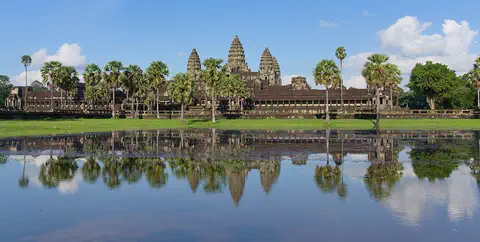
Angkor
Angkor, in northwestern Cambodia, was the capital of the Khmer Empire from the 9th to the 15th century. Its kings built city after city here, with scores of temples, such as Angkor Wat and the Bayon, and giant reservoirs and canals to water the rice fields. Today it covers about 400 square kilometers, and more than 100,000 people live in villages inside it.
-
Watch
Landmark
Angkor Wat
Angkor Wat, near the town of Siem Reap in Cambodia, was built in the 12th century by the Khmer king Suryavarman II. Britannica (2026) calls it the world's largest religious structure. It was built as a Hindu temple and later became a Buddhist place of worship.
-
 Watch
Landmark
Anuradhapura
Anuradhapura, in north-central Sri Lanka, was the island's capital for more than 1,000 years. Its ruins include huge bell-shaped brick monuments called dagobas, monasteries, palaces and ancient reservoirs. It is an important place for Buddhists, and a World Heritage Site since 1982.
-
 Watch
Landmark
Arc de Triomphe
The Arc de Triomphe is a huge stone arch at the top of the Champs-Élysées in Paris. Napoleon ordered it in 1806, but it took 30 years to finish. It is about 50 meters high and 45 meters wide, covered in giant carvings, and under it lies France's Tomb of the Unknown Soldier, with a flame that is rekindled every evening.
-
 Watch
Landmark
Aswan High Dam
The Aswan High Dam crosses the Nile River in southern Egypt. Finished in 1970, it is 111 meters high and 3,830 meters long. It controls the Nile's yearly flood, stores water for farms, makes electricity and created a huge reservoir, Lake Nasser. Ancient temples had to be moved to save them from the rising water.
-
 Watch
Landmark
Baalbek
Baalbek, in the Bekaa Valley of Lebanon, has some of the largest and best-preserved Roman temples ever built. For more than two centuries, builders raised enormous temples on a platform made of giant stone blocks. In a quarry nearby lies a carved block of about 1,650 tons that was never moved.
-
 Watch
Landmark
Babylon
Babylon was one of the most famous cities of the ancient world, beside the Euphrates River in what is now Iraq. Kings like Hammurabi and Nebuchadnezzar II ruled from here. Today its ruins are a UNESCO World Heritage Site, and about 85 percent of it has never been dug up.
-
 Watch
Landmark
Baikonur Cosmodrome
Baikonur Cosmodrome is a huge rocket launch site on the flat grasslands of Kazakhstan. The Soviet Union began building it in secret in 1955. Sputnik 1, the first satellite, launched from here in 1957, and Yuri Gagarin, the first person in space, in 1961. Today Russia rents it from Kazakhstan, and crews have launched from it to the International Space Station as recently as 2025.
-
 Watch
Landmark
Big Ben
Big Ben is the nickname of the Great Bell inside the clock tower of the Houses of Parliament in London. The tower, 96 meters tall, was begun in 1843, and its clock started keeping time in 1859. Since 2012 the tower has been called the Elizabeth Tower.
-
 Watch
Landmark
Borobudur
Borobudur is a huge Buddhist monument in central Java, Indonesia, built about 1,200 years ago. It is shaped like a stepped pyramid around a small hill, with carved walls and 72 bell-shaped stupas on its round top terraces. For centuries it lay hidden under volcanic ash and plants, and today it is a UNESCO World Heritage Site.
-
 Watch
Landmark
Brandenburg Gate
The Brandenburg Gate is a grand sandstone gateway in the center of Berlin, built from 1788 to 1791 with 12 columns and five passages. On top, a statue called the Quadriga shows a chariot pulled by four horses. From 1961 to 1989 the Berlin Wall shut it off, so the gate became a symbol first of a divided Germany and then of its reunification.
-
 Watch
Landmark
British Museum
The British Museum in London was founded in 1753 and opened in 1759. It holds treasures from all over the world, like the Rosetta Stone, which helped people learn to read Egyptian hieroglyphs. Its grand building with columns was built from 1823 to 1847, and in 2025 it had more than 6.4 million visits.
-
 Watch
Landmark
Brooklyn Bridge
The Brooklyn Bridge crosses the East River between Brooklyn and Manhattan in New York City. Built from 1869 to 1883, it was the first bridge to use steel wire for its cables, and its main span was the longest in the world until 1890. Every day, cars, walkers and cyclists still cross it.
-
 Watch
Landmark
Buckingham Palace
Buckingham Palace began as a big house built for the Duke of Buckingham. King George III bought it in 1761, and King George IV had the architect John Nash turn it into a palace. Since 1837 it has been the London home of Britain's kings and queens. It has 775 rooms.
-
 Watch
Landmark
Burj Khalifa
Burj Khalifa in Dubai, United Arab Emirates, is 828 meters tall, the tallest building in the world (2026). It took about six years to build, from 2004 to 2010. Its Y-shaped plan, inspired by a desert flower, helps it stand up to strong winds.
-
 Watch
Landmark
Byblos
Byblos, on the Mediterranean coast of Lebanon, is one of the oldest towns in the world where people have lived without a break. Its ruins stack up like layers of a cake: fishermen's huts, Phoenician temples and walls, a Roman theater and a Crusader castle. The Phoenician alphabet developed here.
-
 Watch
Landmark
Chichén Itzá
Chichén Itzá is the ruin of a great Maya city on the Yucatán Peninsula in Mexico. Its people built pyramids, a huge ball court and a round building for watching the sky. Its most famous pyramid, El Castillo, has 365 steps, as many as the days in a year.
-
 Watch
Landmark
Christ the Redeemer
Christ the Redeemer is a 30-meter statue of Jesus on top of Corcovado mountain in Rio de Janeiro, Brazil. Built from 1926 to 1931 out of reinforced concrete, it is covered in thousands of small soapstone triangles, and it stands on a pedestal 8 meters high.
-
 Watch
Landmark
CN Tower
The CN Tower in Toronto is 553 meters tall. It was built between 1973 and 1975 so that radio and TV signals could reach over the city's new tall buildings. For more than 30 years it was the tallest freestanding structure in the world, and today more than two million people visit it every year.
-
 Watch
Landmark
Colosseum
The Colosseum in Rome is an ancient Roman amphitheater, an oval arena with seats all around. Built between about 70 and 80 CE, it held about 50,000 people, who came to watch shows. Today it is one of Rome's major tourist attractions.
-
 Watch
Landmark
Dome of the Rock
The Dome of the Rock stands on a wide raised plaza in the Old City of Jerusalem. It was finished in 691 or 692, about 1,330 years ago, which makes it the oldest Islamic monument still standing. Its eight walls are covered in marble and mosaics, and its gilded dome, about 20 meters across, covers a large rock that is deeply important to Muslims.
-
 Watch
Landmark
Egyptian pyramids
Egypt's pyramids were giant stone tombs for kings. They did not start out pointed: the first, King Djoser's Step Pyramid, was a stack of six giant steps. King Snefru's builders tried again and again, making the Bent Pyramid and then the Red Pyramid, the first planned true pyramid. Soon after came the great pyramids of Giza.
-
 Watch
Landmark
Eiffel Tower
The Eiffel Tower in Paris was built in just over two years for the 1889 World's Fair. Its 18,038 iron parts are held together by 2.5 million rivets. It was meant to stand for 20 years; today it is 330 meters tall and millions of people visit every year.
-
 Watch
Landmark
Empire State Building
The Empire State Building rises 1,454 feet (443 meters) over Fifth Avenue in New York City. Its steel frame went up at about four and a half floors a week, and the whole building was finished in one year and 45 days, opening on May 1, 1931.
-
 Watch
Landmark
Ephesus
Ephesus was a great Greek and Roman city on the west coast of what is now Türkiye. Its ruins include ancient streets, a theater for nearly 25,000 people and the Library of Celsus, whose two-story front has been rebuilt. Archaeologists have been digging there since 1895.
-
 Watch
Landmark
Fatehpur Sikri
Fatehpur Sikri, the "City of Victory," was built on a ridge near Agra, India, by the Mughal emperor Akbar from 1571. It was his capital until 1585. Its red sandstone palaces, halls and great mosque still stand, and its gateway, the Buland Darwaza, is 40 meters tall.
-
 Watch
Landmark
Forbidden City
The Forbidden City in Beijing was built between 1406 and 1420 as the palace of China's emperors. Over about 500 years, 24 emperors came to the throne there. High walls and a wide moat surround it. Since 1925 it has been the Palace Museum, and it became a World Heritage Site in 1987.
-
 Watch
Landmark
Giza pyramid complex
The Giza pyramid complex is a group of ancient tombs on a rocky plateau beside the Nile River in Egypt. Three kings from one family, Khufu, his son Khafre and his grandson Menkaure, built huge pyramids there about 4,500 years ago. Around them are temples, small pyramids for queens, rows of tombs for nobles, the Great Sphinx and even the town where the builders lived.
-
 Watch
Landmark
Golden Gate Bridge
The Golden Gate Bridge crosses the Golden Gate, the strait where San Francisco Bay meets the Pacific Ocean. Built from 1933 to 1937, it hangs from two huge steel cables slung over towers 746 feet (227 meters) above the water, and it is painted a color called International Orange.
-
Watch
Landmark
Great Pyramid of Giza
The Great Pyramid of Giza was built more than 4,500 years ago as the tomb of King Khufu of Egypt. About 2.3 million stone blocks were cut, moved and stacked to make it. Egypt's antiquities ministry calls it the last of the Seven Wonders of the Ancient World still standing.
-
 Watch
Landmark
Great Wall of China
The Great Wall is not one wall but many walls, built over about 2,000 years across northern China. The best-kept part, built under the Ming emperors, runs about 8,850 kilometers, with watchtowers, gates and signal towers along the way.
-
 Watch
Landmark
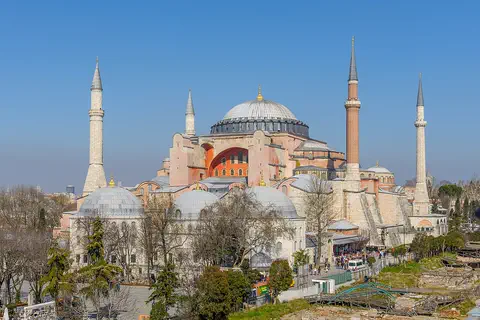
Hagia Sophia
Hagia Sophia in Istanbul was built in under six years, from 532 to 537, for the emperor Justinian. Its enormous dome seems to float on a ring of 40 windows. Over almost 1,500 years it has been a church, a mosque and a museum, and since 2020 it has been a mosque.
-
 Watch
Landmark
Harmandir Sahib (Golden Temple)
Harmandir Sahib, often called the Golden Temple, is the most important gurdwara, or place of worship, for Sikhs. It stands on a small island in a pool in Amritsar, India, and a marble causeway leads out to it. Its upper stories are covered in gilded copper, and its free kitchen serves meals to about 100,000 people a day.
-
 Watch
Landmark
Hermitage Museum
The Hermitage in Saint Petersburg is one of the world's great art museums. Empress Catherine the Great started it in 1764 as her private collection, and it opened to the public in 1852. Today it fills five connected buildings, including the green and white Winter Palace, and holds nearly three million objects, from the Stone Age to today.
-
 Watch
Landmark
Kiyomizu-dera
Kiyomizu-dera is a Buddhist temple on the slope of Mount Otowa in Kyoto, Japan. The temple says it was founded in 778. Its Main Hall, rebuilt in 1633, has a famous wooden stage about 13 meters high, held up by 18 giant pillars joined without nails. The name means "pure water," after a waterfall on the grounds.
-
 Watch
Landmark
Leaning Tower of Pisa
The Leaning Tower is the bell tower of Pisa's cathedral, in Italy. Building began in 1173, and the tower started to lean while workers were still on its second floor, because soft ground lay under shallow foundations. It is 58.36 meters tall, has seven bells and 273 steps, and engineers made it safe between 1990 and 2001.
-
 Watch
Landmark
Lighthouse of Alexandria
The Lighthouse of Alexandria was one of the Seven Wonders of the ancient world. Finished in about 280 BCE on the island of Pharos, it was said to be more than 110 meters tall. An earthquake in the 1300s brought it down, and in 1477 a fortress was built on its ruins.
-
 Watch
Landmark
London Bridge
London Bridge crosses the River Thames between the City of London and Southwark. Today's bridge, made of concrete, opened in 1973, but bridges have stood here for almost 2,000 years. The stone bridge before it was sold and rebuilt in Arizona, in the United States!
-
 Watch
Landmark
London Eye
The London Eye is a huge observation wheel, 135 meters tall, on the South Bank of the River Thames in London. It was built for the year 2000, the new millennium. Its 32 glass capsules carry up to 25 people each, and the wheel turns so slowly that people step on while it moves.
-
 Watch
Landmark
Louvre Museum
The Louvre in Paris began as a castle in 1190, grew into a royal palace and became a museum in 1793. About 30,000 works of art are on show, including the Mona Lisa. Since 1989, visitors have entered through a glass pyramid; 9 million came in 2025.
-
 Watch
Landmark
Machu Picchu
Machu Picchu is a 15th-century Inca town on a ridge high in the Andes Mountains of Peru. Its stone buildings fit together without mortar, and farm terraces step down the slopes. It was left empty in the 1500s and became known to the outside world in 1911.
-
 Watch
Landmark
Mausoleum at Halicarnassus
The Mausoleum at Halicarnassus was the tomb of Mausolus, ruler of Caria, in what is now southwestern Turkey. Built around 353 to 351 BCE, it was covered in sculptures by four famous Greek artists and became one of the Seven Wonders of the World. An earthquake probably brought it down, and its stones went into other buildings, but its name lives on in the word 'mausoleum'.