How does an air compressor store compressed air?
A motor moves a piston that pulls in air, squeezes it and packs it into a strong steel tank, ready to use.
The big idea: A compressor packs more and more air into a tank that cannot grow. The crowded air pushes on the walls. That push is called pressure, and it can do work later.
It's like a bicycle pump that never gets tired: each push squeezes a puff of air into the tire, and a little valve stops it from sneaking back out.

The interactive parts didn't load. The explanations below still work; try reloading the page.
How a compressor stores air
- A flat tire needs air, and lots of it. This machine is an air compressor. It collects air and keeps it squeezed inside a strong tank. How?
- Inside is a piston in a tube called a cylinder. When the piston slides down, it makes more room. A valve opens, and air rushes in to fill the space.
- Then the piston pushes up. The intake valve snaps shut, so the air is trapped. The same air is squeezed into a smaller space, so it pushes back harder.
- When the squeezed air pushes harder than the air in the tank, the outlet valve pops open. The air rushes down the pipe into the tank, and a one-way valve keeps it there.
- Stroke after stroke, the tank fills and the needle on the gauge climbs. When the pressure is high enough, a pressure switch turns the motor off by itself.
- Open the hose and the squeezed air rushes out to where the air is less crowded: into the tire. As the tank empties, the switch starts the motor again.
Look inside an air compressor
Tap each part. Watch how it moves and what it does to the air.
- Electric motor. The electric motor spins a wheel. A rod joined to the wheel turns that spinning into the up-and-down sliding of the piston.
- Piston. The piston fits snugly inside the cylinder. Sliding down makes room for air. Sliding up squeezes that air into a much smaller space.
- Intake valve. Air comes in through a filter that catches dust. The intake valve is a one-way door: it opens when the piston goes down and shuts when the piston comes up.
- Outlet valve. The outlet valve is another one-way door. It opens only when the air in the cylinder pushes harder than the air already in the tank.
- Storage tank. The tank is made of thick steel with rounded ends, so it can hold crowded air safely. The more air packed in, the higher the pressure.
- Pressure gauge. The gauge shows how hard the air in the tank is pushing. The needle climbs as the tank fills and drops as air is used.
- Pressure switch. The pressure switch feels the air in the tank. When the tank is full it turns the motor off, and when the pressure drops it turns the motor back on.
- Safety valve. A strong spring holds the safety valve shut. If the pressure ever got too high, the air would push the spring back and escape with a hiss.
- Regulator and hose. The regulator is a knob that sets how hard the air pushes when it leaves. A ball needs a gentle push. A bike tire needs a strong one.
Fill the tank, stroke by stroke
Switch the motor on and watch each stroke add air to the tank. Try a small tank and a big tank. Then let some air out.
Experiment: The same pump fills a small tank and a big tank. Which one reaches high pressure first?
- Choose the small tank and switch the motor on.
- Watch the needle. How quickly does it reach the green zone?
- Let the air out, choose the big tank and run the motor again.
What we found: The small tank reaches high pressure first, because each puff of air is crowded into less space. The big tank takes longer, but when it is full it holds much more air to use.
Turn on JavaScript to try it yourself.
Air for every job
Fill the ball and then the bike tire until each is in its green zone. Choose how hard the air pushes before you fill.
Why squeezed air pushes back
Air is made of tiny particles, far too small to see, that zoom around and bounce off everything. Each bounce is a tiny push. Billions of bounces every second add up to a steady push that we call pressure.
A compressor crowds more and more air into a tank that cannot get any bigger. More particles in the same space means more bounces on the walls, so the pressure goes up. That is why the needle on the gauge climbs with every stroke of the piston.
One-way doors called valves make it work. The intake valve lets air into the cylinder but not back out. The outlet valve lets squeezed air into the tank but not back into the cylinder. So the air can only move one way: in from outside, and on into the tank.
Squeezed air is like a pressed spring: it is ready to push. Open the hose and it rushes out to where the air is less crowded. That rush can pump up a tire, spray paint or drive a tool. Our bicycle pump comparison breaks down in one way: a compressor also has a big tank, so it can save up air and give it out faster than the pump alone could.
Key words
- Pressure
- How hard something pushes on each bit of a surface.
- Piston
- A sliding plug that fits closely inside a tube called a cylinder.
- Valve
- A door for air or water. A one-way valve lets it through in only one direction.
- Compress
- To squeeze something into a smaller space.
- Regulator
- A knob that sets how hard the air pushes when it leaves the tank.
- Bar
- A unit of pressure. 1 bar is about the pressure of the air around us at sea level.
Check your thinking
-
What happens to the pressure when more air is pushed into the tank?
Show the answer
It goes up. More air crowded into the same space pushes harder on the walls.
-
What does the piston do when it slides up?
Show the answer
It squeezes the trapped air. The intake valve is shut, so the rising piston squeezes the air into a smaller space.
-
Why does the air not rush back out of the tank into the cylinder?
Show the answer
A one-way valve only lets it go in. Valves are one-way doors. The push of the air in the tank holds the door shut.
-
You open the hose into a flat tire. Which way does the air go?
Show the answer
From the crowded tank into the tire. Air always flows from where it is more crowded to where it is less crowded.
-
A 0.2 liter cylinder fills a 2 liter tank. In the simplified model, about how much pressure does each stroke add?
Show the answer
0.1 bar. Pressure gained per stroke is cylinder volume divided by tank volume: 0.2 divided by 2 is 0.1 bar.
You're a Tools & workshop expert!
You watched, looked inside, tried it, solved the challenge and went deeper. Pick another question below, or switch the age at the top to see this topic another way.
More about tools & workshop
 #163
Tools & workshop
How do scissors cut through materials?
Explore how two blades and a pivot create a controlled cutting action.
#163
Tools & workshop
How do scissors cut through materials?
Explore how two blades and a pivot create a controlled cutting action.
 #164
Tools & workshop
How do pliers grip objects firmly?
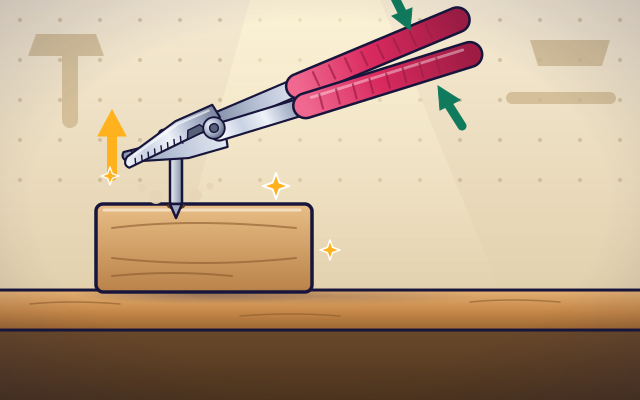
Change handle length and gripping position while comparing the force at the jaws.
#164
Tools & workshop
How do pliers grip objects firmly?
Change handle length and gripping position while comparing the force at the jaws.
 #165
Tools & workshop
How does an adjustable wrench fit different nuts?
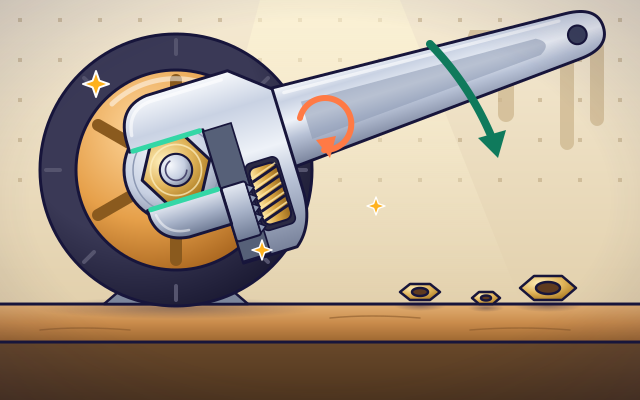
Turn its adjustment mechanism and compare turning effort with different handle lengths.
#165
Tools & workshop
How does an adjustable wrench fit different nuts?
Turn its adjustment mechanism and compare turning effort with different handle lengths.
 #166
Tools & workshop
How does an electric drill make holes?
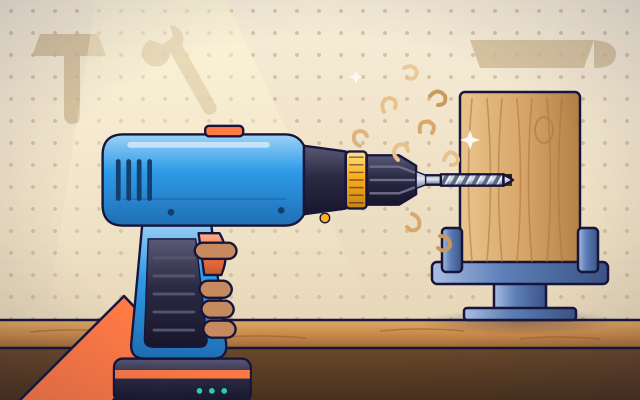
Explore the chuck, drive mechanism, and different drill-bit shapes on simulated materials.
#166
Tools & workshop
How does an electric drill make holes?
Explore the chuck, drive mechanism, and different drill-bit shapes on simulated materials.
Keep exploring
Games to play next
- Machine RepairFix levers, pulleys, gears and ramps so every contraption works.
- Bridge LabBuild a bridge from beams, brace it with triangles, and stay on budget.
Guide for grown-ups
- How to start homeschooling: a step-by-step guide for familiesA guide for parents · 7 min read
Science games by grade
Science worksheets by grade
- Preschool Science Worksheets
- Pre-K Science Worksheets
- Kindergarten Science Worksheets
- 1st Grade Science Worksheets
- 2nd Grade Science Worksheets
- 3rd Grade Science Worksheets
- 4th Grade Science Worksheets
- 5th Grade Science Worksheets
- 6th Grade Science Worksheets
- 7th Grade Science Worksheets
- 8th Grade Science Worksheets