How does an electric drill make holes?
A motor, gears and a gripping chuck spin a sharp bit that shaves its way into wood, metal or brick.
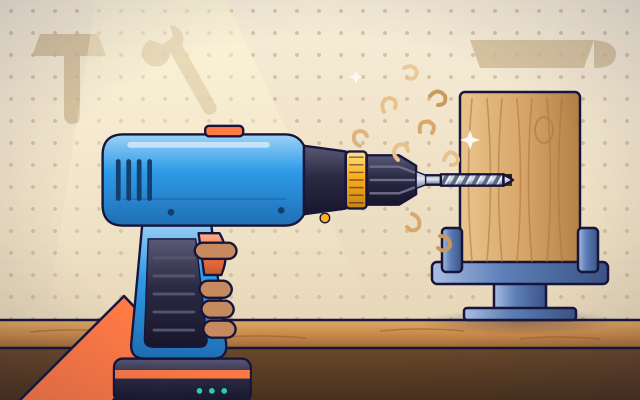
The big idea: A motor spins fast but weakly. Gears trade that speed for strength, and the bit's sharp edges shave off chips that ride up its spiral and out of the hole.
It's like sharpening a pencil: a sharp edge goes round and shaves off thin curls. A drill bit shaves wood the same way, then its spiral carries the curls out.
The interactive parts didn't load. The explanations below still work; try reloading the page.
From trigger to hole
- Mia is building a birdhouse and needs a round hole in a hard board. Pushing with a finger does nothing. She picks up an electric drill.
- Inside the handle, the trigger is a switch. Squeeze it and electricity flows from the battery to the motor. Squeeze harder and more flows.
- Electricity makes magnets inside the motor push and pull, so its shaft spins. It spins very fast, but it is easy to stop: fast and weak.
- A small gear on the motor turns a bigger gear. The big gear turns more slowly, but with much more twisting strength. That strength goes to the bit.
- At the front is the chuck. Twist its sleeve and three metal jaws slide together and grip the bit dead center, tight enough that it cannot slip.
- The bit's two sharp edges shave off thin curls of wood as it turns. The spiral grooves, called flutes, carry the curls up and out. Now the birds have a door!
Look inside a cordless drill
Tap each part. Follow the power from the battery all the way to the tip of the bit.
- Trigger. The trigger is the on switch. A gentle squeeze turns the bit slowly; a full squeeze makes it go fast.
- Battery. The battery pack stores energy and clips to the bottom of the handle. Its weight down low also helps the drill balance in your hand.
- Motor. Electricity makes magnets in the motor push and pull, which spins the shaft in the middle. The motor is fast but not very strong.
- Gearbox. The gears slow the spin down and make it much stronger. Without them, the bit would stall the moment it touched the wood.
- Clutch ring. Turn this numbered ring to set how hard the drill may twist. At that limit it slips with a click, so a screw is not driven too deep.
- Chuck. Twist the chuck and three jaws close around the bit and hold it in the exact center. Twist the other way and they let go.
- Drill bit. The bit does the cutting. Its sharp tip shaves off chips and its spiral flutes lift them out. Different tips suit wood, metal and brick.
Which bit for which job?
Choose a bit and a material, then drill. Watch what comes out of the hole. Which bit suits which material?
Experiment: You need a hole in a brick. Which bit will make it?
- Pick the brick.
- Try each bit in turn and press Drill.
- Watch the dust and how deep each bit gets.
What we found: Each bit's tip is shaped for one kind of material. The masonry bit's wide, very hard tip chips brick into dust. The other bits just rub on the brick and get hot. In wood, the wood bit and the twist bit both cut curly chips.
Turn on JavaScript to try it yourself.
The right bit, the right depth
Drill a hole in each of the three pieces. Pick the right bit, then stop inside the green depth band.
How a drill really cuts
A drill does not push a hole into wood. It shaves one out. The tip of a drill bit has two sharp edges. Each time the bit turns, those edges slice off two thin curls, a bit like a pencil sharpener peeling a pencil. Turn after turn, the hole gets deeper.
The shavings have to go somewhere, or they would jam the hole. That is the job of the spiral grooves, called flutes. As the bit turns, the flutes work like a spiral slide running backward: they carry the chips up and out. Here the pencil sharpener idea stops working, because a sharpener has no spiral to clear its shavings.
Shaving hard material takes a strong twist. The motor inside the drill spins very fast, but it is weak, and you could stop it with your fingers. So the drill uses gears. A small gear turning a big gear makes the spin slower and much stronger. Riding a bike up a hill in a low gear is the same trade: your legs spin more, and the wheel pushes harder.
Different materials need different bits. A wood bit has a sharp center point that keeps it from wandering. A twist bit for metal has a stubbier point and cuts slowly. A masonry bit has a wide tip made of a very hard material that chips brick into dust. Use the wrong bit and it only rubs, heats up and goes blunt.
Key words
- Bit
- The removable cutting tool that a drill spins.
- Chuck
- The part at the front of the drill whose three jaws grip the bit.
- Flutes
- The spiral grooves along a bit that carry chips out of the hole.
- Torque
- Twisting strength: how hard something turns.
- Gear ratio
- How much a pair of gears slows the spin down and strengthens it.
- Clutch
- A part that slips when the twist reaches a set limit, so screws are not driven too far.
Check your thinking
-
How does a drill bit make a hole in wood?
Show the answer
Its sharp edges shave off thin chips, turn after turn. The two sharp edges at the tip slice off thin curls every turn, so the hole grows deeper.
-
What would happen if a bit had no spiral flutes?
Show the answer
Chips would pack the hole and jam the bit. The flutes are the way out for the chips. With nowhere to go, the chips would clog the hole.
-
A small gear on the motor turns a big gear. How does the big gear turn?
Show the answer
More slowly, but with more twisting strength. Gears trade speed for strength. The big gear is slower and stronger, which is what a drill bit needs.
-
You try to drill a brick with a wood bit. What happens?
Show the answer
The bit rubs, gets hot and hardly makes a mark. A wood bit's edges are made for slicing soft fibers. Brick is too hard, so the bit only rubs and gets blunt.
-
The chuck is a little loose and the bit stops turning while the motor still runs. Why?
Show the answer
The jaws grip by friction, and there is not enough friction to carry the torque. The chuck passes the twist to the bit only through friction. Loose jaws slip around the shank.
You're a Tools & workshop expert!
You watched, looked inside, tried it, solved the challenge and went deeper. Pick another question below, or switch the age at the top to see this topic another way.
More about tools & workshop
 #167
Tools & workshop
How does a saw cut wood?
Watch enlarged teeth remove small pieces as the blade moves.
#167
Tools & workshop
How does a saw cut wood?
Watch enlarged teeth remove small pieces as the blade moves.
 #168
Tools & workshop
How does a power sander smooth surfaces?
Compare abrasive sizes and sanding motions on a rough virtual surface.
#168
Tools & workshop
How does a power sander smooth surfaces?
Compare abrasive sizes and sanding motions on a rough virtual surface.
 #169
Tools & workshop
How do clamps hold pieces tightly together?
Tighten a clamp and trace how its mechanism maintains squeezing force.
#169
Tools & workshop
How do clamps hold pieces tightly together?
Tighten a clamp and trace how its mechanism maintains squeezing force.
 #170
Tools & workshop
How does a hammer drive a nail?
Change hammer mass and speed and compare the impact on a model nail.
#170
Tools & workshop
How does a hammer drive a nail?
Change hammer mass and speed and compare the impact on a model nail.
Keep exploring
Games to play next
- Machine RepairFix levers, pulleys, gears and ramps so every contraption works.
- Bridge LabBuild a bridge from beams, brace it with triangles, and stay on budget.
Guide for grown-ups
- How to start homeschooling: a step-by-step guide for familiesA guide for parents · 7 min read
Science games by grade
Science worksheets by grade
- Preschool Science Worksheets
- Pre-K Science Worksheets
- Kindergarten Science Worksheets
- 1st Grade Science Worksheets
- 2nd Grade Science Worksheets
- 3rd Grade Science Worksheets
- 4th Grade Science Worksheets
- 5th Grade Science Worksheets
- 6th Grade Science Worksheets
- 7th Grade Science Worksheets
- 8th Grade Science Worksheets