How do pliers grip objects firmly?
Two levers on one pivot: long handles and short, ridged jaws that grip far harder than fingers can.
The big idea: Pliers are two levers joined at a pivot. Your hand pushes far from the pivot and the jaws grip close to it, so the grip is several times stronger than your squeeze.
It's like a nutcracker: a gentle squeeze on the long handles becomes a mighty squeeze on the nut, close to the hinge.
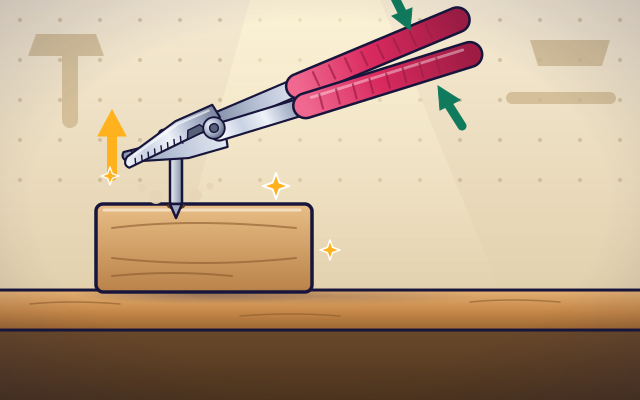
The interactive parts didn't load. The explanations below still work; try reloading the page.
How pliers grip
- A nail is stuck fast. Fingers cannot squeeze its smooth head hard enough, so they slip. Pliers will hold on. Why are they so much stronger?
- Each half of the pliers is a lever. The two cross at a pin called the pivot. Squeeze the handles together and the jaws at the other end close.
- Your hand pushes a long way from the pivot, but the jaws are close to it. That turns a small squeeze into a grip several times stronger.
- The jaws are cut with ridges. They dig in a tiny bit, so there is plenty of friction and the thing you are holding cannot slide out.
- At the tips the grip is gentle, good for small, careful jobs. Close to the pivot it is strongest. That is where the wire cutter sits.
- Long handles for a strong squeeze, ridged jaws that will not slip. One steady pull, and the nail comes out.
The parts of a pair of pliers
Tap each part of the pliers to see how it helps to grip.
- Handles. The handles are long so that your hand can push far from the pivot. The farther out you hold them, the harder the jaws grip.
- Grips. Soft plastic or rubber covers spread the push over your palm, so a hard squeeze does not hurt, and they stop your hand from slipping.
- Pivot. The pivot is a strong rivet that joins the two halves. Both levers turn around it.
- Jaws. The jaws are short and thick. Because they are close to the pivot they grip hard, and because they are thick they do not bend.
- Ridges. Rows of small ridges cross the jaws. They press into whatever you hold and give lots of friction.
- Wire cutter. Next to the pivot are two sharp edges. This is the strongest spot, so the pliers can snip through wire there.
Where is the grip strongest?
Squeeze the foam ball. Change where your hand holds the handles and where the ball sits in the jaws, and watch the gauge.
Experiment: How should you hold the pliers to grip as hard as possible?
- Squeeze, then slide your hand from the pivot out to the handle ends.
- Now slide the ball from the tips of the jaws toward the pivot.
- Find the strongest grip and the gentlest grip.
What we found: The grip is strongest with your hand at the very ends of the handles and the ball close to the pivot. It is gentlest with your hand near the pivot and the ball out at the tips.
Turn on JavaScript to try it yourself.
The right grip for the job
Do three jobs. Slide your hand to get the right grip for each one: not too weak and not too strong.
How pliers grip
Pliers are two levers working as a team. A lever is a stiff bar that turns around a fixed point called a pivot. In pliers the two bars cross at a strong pin, with long handles on one side and short jaws on the other.
The clever part is the difference in length. Your hand pushes on the handles a long way from the pivot, and the jaws grip close to it. A lever pushes harder on its short side, so a gentle squeeze from your hand becomes a much stronger grip at the jaws. If your hand is four times as far from the pivot as the thing you are holding, the grip is four times as strong as your squeeze.
You can change the grip without squeezing any harder. Slide your hand to the very ends of the handles, or push the object deeper into the jaws, and the grip grows. Hold the handles near the pivot, or use only the tips, and the grip is gentle, which is just right for delicate things.
Strength is not enough: the object must not slide out. So the jaws are cut with small ridges that bite and give lots of friction. Right beside the pivot, where the pliers are strongest, two sharp edges can snip wire. A nutcracker is a close comparison, but its hinge is at the very end, so the nut sits between the hinge and your hand.
Key words
- Lever
- A stiff bar that turns around a fixed point to move or squeeze something.
- Pivot
- The fixed point a lever turns around. It is also called the fulcrum.
- Mechanical advantage
- How many times a tool multiplies your push.
- Friction
- The grip between two surfaces that stops them sliding past each other.
- Moment
- The turning effect of a push: bigger when the push is farther from the pivot.
Check your thinking
-
Why do pliers grip harder than your fingers?
Show the answer
The long handles and short jaws work as levers. A lever pushes harder on its short side. The jaws are on the short side.
-
You need a stronger grip but cannot squeeze any harder. What can you do?
Show the answer
Hold the handles nearer their ends. Moving your hand away from the pivot makes its lever arm longer, so the same squeeze grips harder.
-
You squeeze with 30 N, 12 cm from the pivot. The object is 2 cm from the pivot. What is the jaw force?
Show the answer
180 N. 30 × 12 = F × 2, so F = 180 N. The mechanical advantage is 12 ÷ 2 = 6.
-
Why are the jaws of pliers cut with ridges?
Show the answer
To give more friction so things do not slip. The ridges bite into what you hold, so it cannot slide out.
-
Why is the wire cutter placed right next to the pivot?
Show the answer
That is where the pliers push hardest. The shorter the distance from the pivot, the bigger the force, and cutting wire needs a lot of force.
-
Long-nose pliers have very long, thin jaws. What do they give up, and what do they gain?
Show the answer
They give up grip force and gain reach into tight places. Long jaws mean a long load arm, so less force, but they can reach and hold small things in narrow spaces.
You're a Tools & workshop expert!
You watched, looked inside, tried it, solved the challenge and went deeper. Pick another question below, or switch the age at the top to see this topic another way.
More about tools & workshop
 #165
Tools & workshop
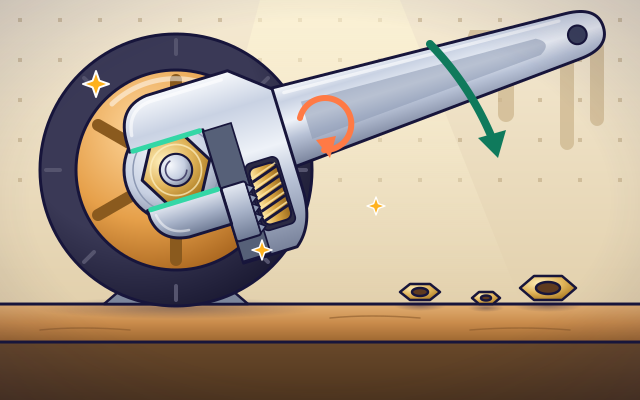
How does an adjustable wrench fit different nuts?
Turn its adjustment mechanism and compare turning effort with different handle lengths.
#165
Tools & workshop
How does an adjustable wrench fit different nuts?
Turn its adjustment mechanism and compare turning effort with different handle lengths.
 #166
Tools & workshop
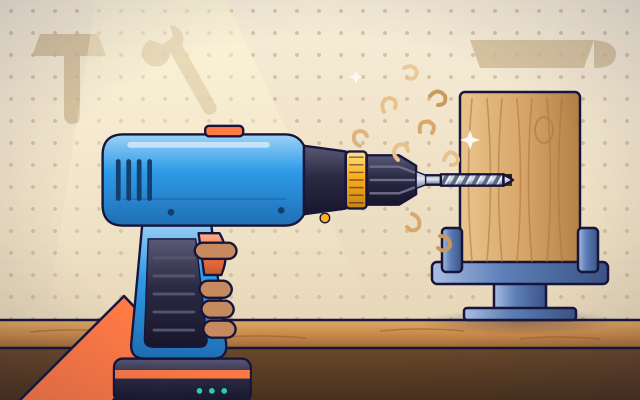
How does an electric drill make holes?
Explore the chuck, drive mechanism, and different drill-bit shapes on simulated materials.
#166
Tools & workshop
How does an electric drill make holes?
Explore the chuck, drive mechanism, and different drill-bit shapes on simulated materials.
 #167
Tools & workshop
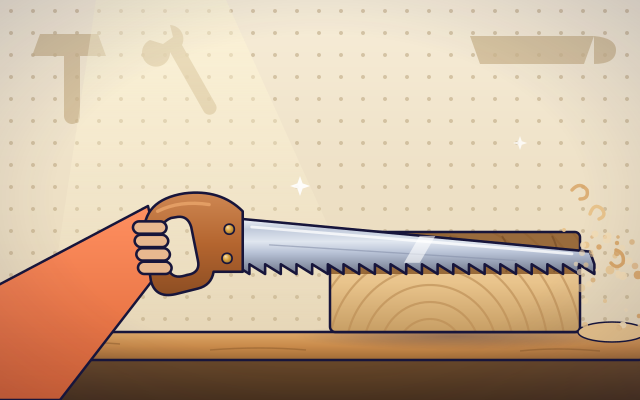
How does a saw cut wood?
Watch enlarged teeth remove small pieces as the blade moves.
#167
Tools & workshop
How does a saw cut wood?
Watch enlarged teeth remove small pieces as the blade moves.
 #168
Tools & workshop
How does a power sander smooth surfaces?
Compare abrasive sizes and sanding motions on a rough virtual surface.
#168
Tools & workshop
How does a power sander smooth surfaces?
Compare abrasive sizes and sanding motions on a rough virtual surface.
Keep exploring
Games to play next
- Machine RepairFix levers, pulleys, gears and ramps so every contraption works.
- Bridge LabBuild a bridge from beams, brace it with triangles, and stay on budget.
Guide for grown-ups
- How to start homeschooling: a step-by-step guide for familiesA guide for parents · 7 min read
Science games by grade
Science worksheets by grade
- Preschool Science Worksheets
- Pre-K Science Worksheets
- Kindergarten Science Worksheets
- 1st Grade Science Worksheets
- 2nd Grade Science Worksheets
- 3rd Grade Science Worksheets
- 4th Grade Science Worksheets
- 5th Grade Science Worksheets
- 6th Grade Science Worksheets
- 7th Grade Science Worksheets
- 8th Grade Science Worksheets