How does an adjustable wrench fit different nuts?
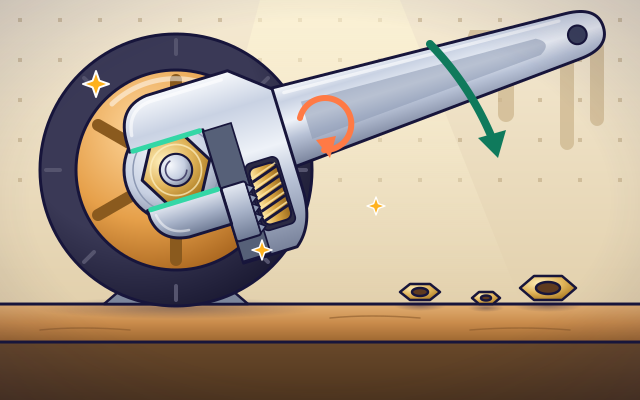
A screw called a worm slides one jaw to fit any nut, and a long handle makes the nut easy to turn.
The big idea: One jaw is fixed and one slides. Turning a small screw moves the sliding jaw to fit the nut snugly, and the long handle gives a big turning push.
It's like a glue stick: twisting the end makes the stick creep in or out. The wrench's little screw makes its jaw creep in or out in the same way.
The interactive parts didn't load. The explanations below still work; try reloading the page.
How an adjustable wrench fits and turns
- Nuts come in many sizes, and an ordinary wrench fits just one. You would need a whole box of them. Or one wrench that can change its size.
- Look at the head. The top jaw is part of the wrench and never moves. The bottom jaw slides in and out along a groove.
- The little wheel is a screw called a worm. Its spiral ridge fits between teeth cut into the sliding jaw. Turn the worm and the ridge pushes the teeth along.
- A nut has six flat sides. If the jaws are loose they slip and chew the corners. Close them until they press on two flat sides, snug and tight.
- Now turn. Pushing close to the nut is hard work. Pushing at the far end of the handle is easy, because a long handle gives a bigger turning push.
- A sliding jaw to fit, a worm to set it and a long handle to turn. One adjustable wrench does the work of a whole set.
The parts of an adjustable wrench
Tap each part of the wrench to see how it fits and turns a nut.
- Fixed jaw. The fixed jaw is made in one piece with the handle, so it is very strong. It does most of the pushing when you turn a nut.
- Sliding jaw. The sliding jaw moves in a groove in the head. It always stays level with the fixed jaw, so the two can press on the flat sides of a nut.
- Teeth on the jaw. A row of teeth is cut into the sliding jaw. A straight row of teeth like this is called a rack.
- Worm screw. The thumbwheel is a worm: a short, fat screw. Its spiral ridge sits between the teeth of the rack, so turning it pushes the jaw in or out.
- Handle. The handle is a lever. The farther from the nut you push, the easier the nut is to turn.
- Nut. A nut has six flat sides. The jaws press on two opposite sides, so the wrench can turn the nut without slipping.
Set the jaws, then turn
Turn the worm to fit the jaws to the nut. Then choose where to push on the handle and turn the nut. Try each size of nut.
Experiment: Where on the handle is it easiest to turn a tight nut?
- Push the handle before you close the jaws. What happens?
- Turn the worm until the jaws are snug. Push near the nut.
- Slide your hand to the end of the handle and push again.
What we found: With loose jaws the wrench slips. With snug jaws, the far end of the handle turns the nut easily, and near the nut the same push is not enough. A longer lever gives a bigger turning push.
Turn on JavaScript to try it yourself.
Three nuts, one wrench
Tighten three nuts of different sizes. Fit the jaws to each one and push in the right place: not too weakly and not too hard.
How an adjustable wrench works
A wrench turns nuts and bolts by gripping their flat sides. Most wrenches fit just one size. An adjustable wrench has one jaw that is part of the handle and one jaw that slides, so it can be set to fit many sizes.
The sliding jaw is moved by a small wheel in the head. The wheel is really a short screw, called a worm. A spiral ridge runs around it, and that ridge sits between teeth cut into the sliding jaw. When you turn the worm with your thumb, the ridge pushes the teeth along and the jaw creeps in or out. A glue stick works in a similar way when you twist its end.
The worm has a second job: it locks the jaw. You can move the jaw by turning the worm, but pushing on the jaw will not turn the worm back. So once you have set the width, it stays set while you work.
Fit matters. A nut has six flat sides, and the jaws should press firmly on two opposite ones. If the jaws are loose, they slip and round off the corners. Then comes the turning. The handle is a lever: the farther from the nut you push, the bigger the turning push you get. The glue stick comparison only goes so far: a glue stick just moves its stick, while the wrench's screw must also hold firm against a strong push.
Key words
- Worm
- A short screw whose spiral ridge pushes on a row of teeth.
- Rack
- A straight row of teeth. A worm or gear can push it along.
- Torque
- Turning push: how hard something is being twisted.
- Pitch
- The distance between one ridge of a screw thread and the next. It is how far the screw moves things in one turn.
- Self-locking
- Able to move only when you turn the screw, never by pushing back on it.
Check your thinking
-
What happens when you turn the worm on an adjustable wrench?
Show the answer
Its spiral ridge pushes the jaw's teeth, so the jaw slides. The worm is a screw. Its ridge sits between the rack's teeth and pushes them along as it turns.
-
A nut is too tight to turn. What is the best thing to try?
Show the answer
Push at the far end of the handle. The farther your hand is from the nut, the bigger the turning push.
-
You push with 60 N at 20 cm from the center of the nut. What is the torque?
Show the answer
12 newton-meters. Torque = force × distance = 60 N × 0.20 m = 12 newton-meters. Remember to change centimeters into meters.
-
Why should the jaws be snug against the nut before you turn?
Show the answer
Loose jaws slip and round off the nut's corners. With a gap, the wrench twists before it grips and pushes on the corners, which wear away.
-
Once you set the jaws, why do they not slide open while you push?
Show the answer
The worm locks the jaw: pushing the jaw cannot turn the screw. A screw moves things when you turn it, but pushing on those things will not turn the screw back.
-
A small bolt needs only 6 newton-meters. With a 25 cm wrench, why is it easy to over-tighten it?
Show the answer
A light push of 24 N at the end already gives 6 newton-meters. 6 N·m ÷ 0.25 m = 24 N, a very gentle push. A normal push at the end of a long handle gives far more torque than a small bolt can take.
You're a Tools & workshop expert!
You watched, looked inside, tried it, solved the challenge and went deeper. Pick another question below, or switch the age at the top to see this topic another way.
More about tools & workshop
 #166
Tools & workshop
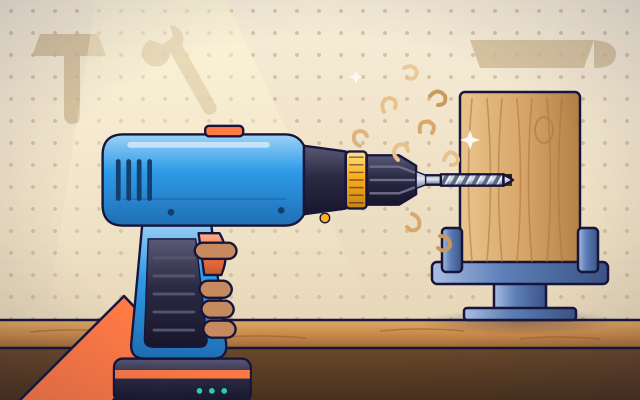
How does an electric drill make holes?
Explore the chuck, drive mechanism, and different drill-bit shapes on simulated materials.
#166
Tools & workshop
How does an electric drill make holes?
Explore the chuck, drive mechanism, and different drill-bit shapes on simulated materials.
 #167
Tools & workshop
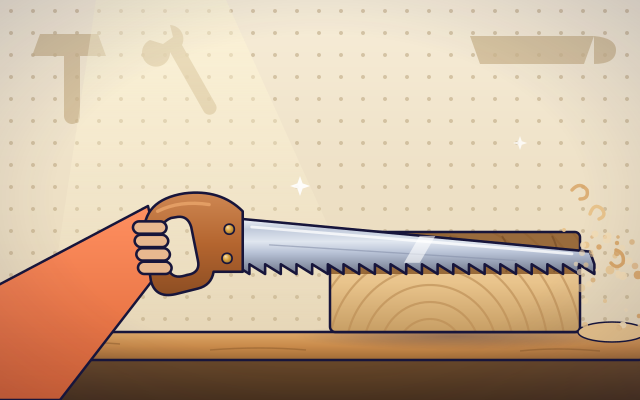
How does a saw cut wood?
Watch enlarged teeth remove small pieces as the blade moves.
#167
Tools & workshop
How does a saw cut wood?
Watch enlarged teeth remove small pieces as the blade moves.
 #168
Tools & workshop
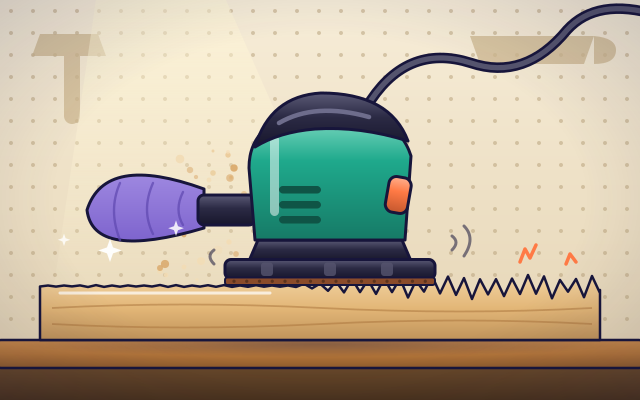
How does a power sander smooth surfaces?
Compare abrasive sizes and sanding motions on a rough virtual surface.
#168
Tools & workshop
How does a power sander smooth surfaces?
Compare abrasive sizes and sanding motions on a rough virtual surface.
 #169
Tools & workshop
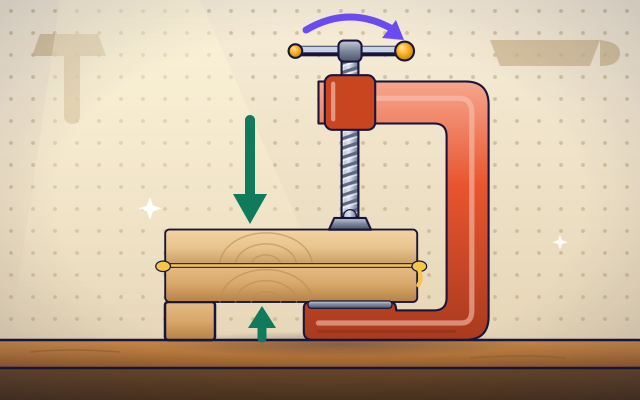
How do clamps hold pieces tightly together?
Tighten a clamp and trace how its mechanism maintains squeezing force.
#169
Tools & workshop
How do clamps hold pieces tightly together?
Tighten a clamp and trace how its mechanism maintains squeezing force.
Keep exploring
Games to play next
- Machine RepairFix levers, pulleys, gears and ramps so every contraption works.
- Bridge LabBuild a bridge from beams, brace it with triangles, and stay on budget.
Guide for grown-ups
- How to start homeschooling: a step-by-step guide for familiesA guide for parents · 7 min read
Science games by grade
Science worksheets by grade
- Preschool Science Worksheets
- Pre-K Science Worksheets
- Kindergarten Science Worksheets
- 1st Grade Science Worksheets
- 2nd Grade Science Worksheets
- 3rd Grade Science Worksheets
- 4th Grade Science Worksheets
- 5th Grade Science Worksheets
- 6th Grade Science Worksheets
- 7th Grade Science Worksheets
- 8th Grade Science Worksheets