How do airbags cushion passengers?
In a crash, an airbag fills with gas faster than you can blink, then lets the gas out again to make a soft landing. Watch a lab test in slow motion.
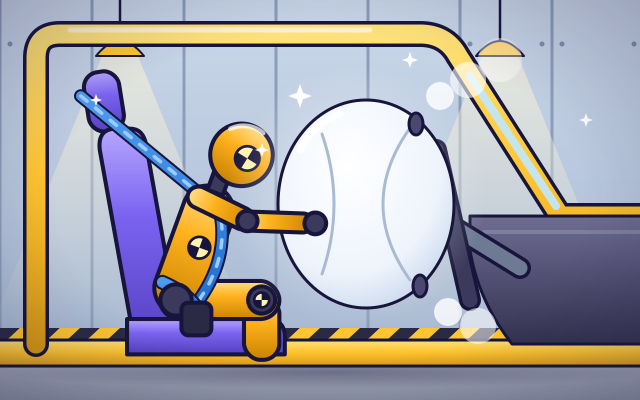
The big idea: An airbag is a folded fabric bag. When sensors feel a crash, it fills with gas in a split second and then lets the gas out, so it catches a passenger like a soft pillow.
It's like catching an egg in a pillow instead of on a plate: the pillow gives way, so the egg slows down gently instead of stopping all at once.
The interactive parts didn't load. The explanations below still work; try reloading the page.
A blink in slow motion
- In a safety lab, a test car with a dummy inside runs into a barrier. It all happens faster than a blink, so we will watch it in slow motion.
- The moment the car hits, a small sensor feels how suddenly it is slowing down. It sends an electric signal to the car's safety computer.
- The signal sets off a small gas maker. It makes a lot of harmless gas very quickly. The folded bag bursts out of the steering wheel and fills up in less time than a blink.
- The dummy is still moving forward. Its head and chest sink into the full bag. The bag is big, so the push is spread out, and it squashes, so the stop is gentle.
- An airbag is not a balloon. Holes in the back let the gas out as the dummy presses in. That soaks up the motion, so the dummy does not bounce back.
- An airbag is a helper for the seat belt, not a replacement. The belt holds the body in place and the bag cushions the head. Children ride in the back seat, buckled up.
Look inside an airbag system
Here is the test car, with a magnifier on the airbag hidden in the steering wheel. Tap each part.
- Crash sensor. The crash sensor feels how quickly the car is slowing down. A gentle stop does nothing. A very sudden stop sends a signal.
- Control unit. The control unit is a small computer. It reads the sensors and decides in a split second whether this is a real crash. If it is, it fires the airbag.
- Inflator. The inflator is a small metal can. An electric signal sets off a chemical inside that turns into a lot of gas, very fast. The gas rushes into the bag.
- Folded bag. The bag is made of thin, strong nylon cloth and is folded tightly into the middle of the steering wheel. When gas rushes in, it unfolds into a big cushion.
- Cover. The cover in the middle of the steering wheel hides the bag. It has a weak line molded into it, so it splits open neatly when the bag pushes out.
- Vent holes. Vent holes in the back of the bag let the gas escape as someone presses into it. That is what makes the bag a soft cushion instead of a bouncy ball.
- Seat belt. The seat belt holds the body in the seat, in the right place for the airbag to catch the head. Airbags only work properly when you are buckled up.
Slow-motion test: bag or no bag?
Switch the airbag on or off, make it fire late, and change the vent holes. Drag the slow-motion slider to see every moment of the test.
Experiment: The airbag has no vent holes at all. What will the dummy's head do?
- Run the test with the airbag on and the vents just right.
- Close the vents and run it again. Watch the head.
- Then make the vents huge, and try a bag that fires late.
What we found: With no vents the bag is like a hard balloon, and the head bounces back. With just-right vents the gas is squeezed out as the head sinks in, so the stop is soft. With huge vents the bag goes flat too soon. Timing matters too: a late bag is still filling when the head arrives.
Turn on JavaScript to try it yourself.
You are the sensor
You are the crash sensor. Pick the vent holes, start the test, and fire the bag the moment the car hits. Catch the dummy softly in three tests, each one faster.
How airbags work
When a car stops very suddenly, the people inside keep moving forward. A seat belt holds the body, but the head can still swing forward. An airbag is there to catch it. It is a bag of thin, strong cloth, folded up inside the steering wheel and other parts of the car.
Everything happens faster than a blink. A tiny sensor feels the sudden stop and tells the car's safety computer. The computer sends a signal to a small gas maker called an inflator. The inflator makes a lot of harmless gas in an instant, and the bag bursts out and fills up. All of that takes less than a twentieth of a second.
Then comes the clever part. The bag has holes in the back. As the head sinks in, the gas is squeezed out through the holes. This makes the bag give way, like a pillow, instead of bouncing like a balloon. A moment later the bag is soft and flat again.
The pillow comparison is not perfect. A pillow is always there, but an airbag has to appear at exactly the right moment and then get out of the way. Because the bag comes out so fast, people need to sit back and wear their belts. Front airbags are made for grown-ups, so children ride in the back seat.
Key words
- Airbag
- A fabric cushion that fills with gas in a crash and then lets the gas out, to catch a passenger softly.
- Sensor
- A part that notices something, here a very sudden stop, and sends a signal.
- Inflator
- The small gas generator that fills the bag.
- Millisecond
- One thousandth of a second. A blink of your eye takes one hundred or more.
- Vent
- A hole that lets gas escape from the bag so it gives way like a pillow.
- Deceleration
- Slowing down. A big deceleration means slowing down very suddenly.
Check your thinking
-
How does an airbag make a stop gentler?
Show the answer
It gives way, so the head slows down over a longer time. A longer, softer stop needs a much smaller push than a sudden one.
-
How long does an airbag take to fill?
Show the answer
Less time than a blink of an eye. It fills in about 30 thousandths of a second. A blink takes at least three times as long.
-
Why does an airbag have holes in it?
Show the answer
So the gas can escape and the bag gives way softly. Letting the gas out soaks up the motion. Without holes the bag would bounce you back like a balloon.
-
In a 65 km/h test the head arrives after 54 ms. The control unit needs 15 ms. What is the longest fill time that still has the bag full in time?
Show the answer
About 39 ms. Sensing plus filling must be done before the head arrives: 54 - 15 = 39 ms.
-
Why do you still need a seat belt in a car with airbags?
Show the answer
The belt holds your body in the right place so the bag can cushion your head. The belt holds you back and keeps you from being too close while the bag is filling. The two work as a team.
-
What tells the airbag to fill?
Show the answer
A sensor that feels a very sudden stop. No person could react fast enough, so a sensor and a small computer do it in a few thousandths of a second.
You're a Flight & transportation expert!
You watched, looked inside, tried it, solved the challenge and went deeper. Pick another question below, or switch the age at the top to see this topic another way.
More about flight & transportation
 #135
Flight & transportation
How do windshield wipers move back and forth?
Follow a rotating motor's movement through the linkage that sweeps the wiper blades.
#135
Flight & transportation
How do windshield wipers move back and forth?
Follow a rotating motor's movement through the linkage that sweeps the wiper blades.
 #136
Flight & transportation
How do tracked vehicles cross soft ground?
Compare wheels and tracks while moving the same load across simulated mud or sand.
#136
Flight & transportation
How do tracked vehicles cross soft ground?
Compare wheels and tracks while moving the same load across simulated mud or sand.
 #137
Flight & transportation
How do snowmobiles move over snow?
Explore the driving track and steering skis while navigating a snowy course.
#137
Flight & transportation
How do snowmobiles move over snow?
Explore the driving track and steering skis while navigating a snowy course.
 #138
Flight & transportation
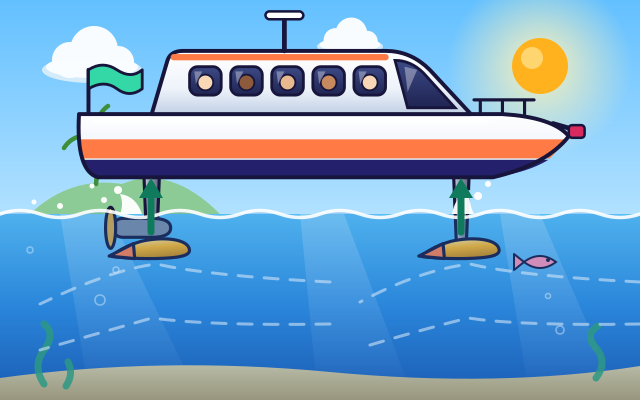
How do hydrofoil boats rise above the water?
Increase speed and watch underwater wings lift a model boat's hull.
#138
Flight & transportation
How do hydrofoil boats rise above the water?
Increase speed and watch underwater wings lift a model boat's hull.
Keep exploring
Games to play next
- City Driving AdventureExplore the city behind the wheel, park safely and collect roadside deliveries.
- Plane Flight SimulatorTake off from the runway and thread numbered sky hoops in order. Every clean flight is a new personal best.
- Machine RepairFix levers, pulleys, gears and ramps so every contraption works.
Guide for grown-ups
- How to start homeschooling: a step-by-step guide for familiesA guide for parents · 7 min read
Science games by grade
Science worksheets by grade
- Preschool Science Worksheets
- Pre-K Science Worksheets
- Kindergarten Science Worksheets
- 1st Grade Science Worksheets
- 2nd Grade Science Worksheets
- 3rd Grade Science Worksheets
- 4th Grade Science Worksheets
- 5th Grade Science Worksheets
- 6th Grade Science Worksheets
- 7th Grade Science Worksheets
- 8th Grade Science Worksheets