How do hydrofoil boats rise above the water?
A hydrofoil boat has wings under the water. At speed they lift the hull right out, so the boat skims along above the waves.
The big idea: Water rushing past a tilted underwater wing, called a foil, pushes it up. Go fast enough and that push is bigger than the boat's weight, so the hull rises out of the water.
It's like sweeping your flat hand through bath water with the front edge tilted up: the water pushes your hand up. A foil is that hand, shaped like a wing.
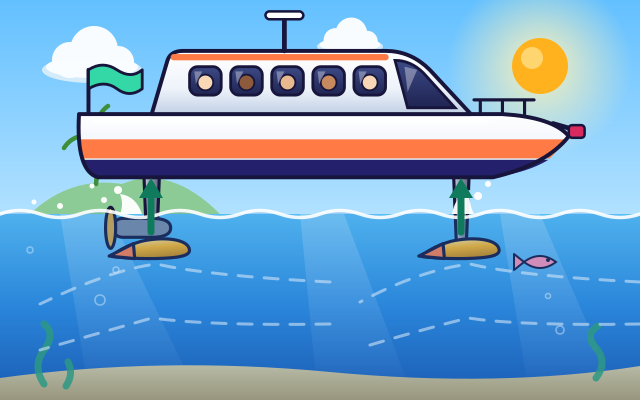
The interactive parts didn't load. The explanations below still work; try reloading the page.
Wings under the water
- An ordinary boat has to shove water aside all the time. The faster it goes, the harder the water pushes back. What if the boat could rise above the water?
- Look under this boat. Long legs called struts reach down to small wings called foils. When the boat is still, it floats on its hull like any other boat.
- As the boat moves, water flows over and under each foil. The foil is curved and tilted, so it turns the water downward. The water pushes back up on the foil. That push is called lift.
- The faster the boat goes, the bigger the lift. When the lift grows bigger than the boat's weight, the hull rises out of the water. The boat is flying on its foils!
- Now only the thin struts and foils are in the water. There is much less water to push aside, so the boat goes faster on the same power, and the waves pass underneath.
- Small flaps on the foils tilt up and down to keep the boat at a steady height. When the boat slows, the lift shrinks and the hull settles gently back onto the water.
Look at a hydrofoil boat
Tap each part of the flying boat. Watch what it does!
- Hull. The hull is the body of the boat. At low speed it floats in the water. At high speed the foils lift it clear.
- Cabin. Passengers ride in the cabin. Because the hull flies above the waves, the ride is smooth even when the sea is choppy.
- Struts. Struts are the thin legs that join the foils to the hull. They are shaped like knife blades so they slice through the water easily.
- Foils. The foils are the underwater wings. Water flowing over them makes lift, just as air flowing over an airplane's wings does.
- Flaps. Flaps on the back edge of each foil tilt down for more lift and up for less. They hold the boat level and help it bank into turns.
- Propeller. The propeller is deep under the water at the bottom of the rear strut, so it stays in the water even when the hull is flying.
- Height sensor. A sensor at the front measures how far the hull is above the water. It tells the flaps when to add or take away lift.
Speed and lift
Push the speed up and watch the green lift arrows grow. What happens when they are as long as the red weight arrow?
Experiment: What will happen to the hull as the boat goes faster and faster?
- Start slowly. Is the hull in the water? Look at the arrows.
- Speed up a little at a time and watch the lift arrows.
- Keep going until the hull is clear of the water. Then slow down again.
What we found: At low speed the foils make only a little lift, so the hull floats in the water. As the speed rises the lift grows quickly. Once the lift matches the boat's weight, the hull rises out of the water and the boat flies on its foils.
Turn on JavaScript to try it yourself.
A smooth ride
Get the ferry flying before it reaches the choppy waves. Choose the speed, the foil angle and the load.
Flying on water
Water is much harder to push through than air. Try running in a swimming pool and you will feel it. A boat's hull has to push water aside all the time, and the faster it goes, the harder the water pushes back. That push is called drag.
A hydrofoil boat has a clever answer: get the hull out of the water. Under the boat, on long thin struts, are small wings called foils. They work just like airplane wings. Each foil is curved and tilted so that it turns the water flowing past it downward, and the water pushes the foil up. That upward push is lift.
At low speed the lift is small, and the boat floats like any other. But lift grows very quickly as the boat speeds up. At takeoff speed the lift equals the boat's weight, and the hull rises clear of the water.
Now only the struts and foils are in the water, so there is far less drag. The boat can go much faster using the same engine, and it glides smoothly above the waves. Flaps on the foils keep it steady. Hydrofoils are used for fast ferries, racing sailboats and even surfboards.
Key words
- Foil
- A wing that works under water.
- Lift
- The upward push of water on the foils.
- Drag
- The force of the water (and air) that holds a moving boat back.
- Strut
- A thin, streamlined leg that joins a foil to the hull.
- Foilborne
- Flying: when the foils carry the whole boat and the hull is out of the water.
- Takeoff speed
- The speed at which the lift first equals the boat's weight.
Check your thinking
-
What lifts a hydrofoil boat out of the water?
Show the answer
Water flowing past its underwater wings. The foils turn the water downward, and the water pushes the foils up.
-
Why does a hydrofoil only fly when it is going fast?
Show the answer
Lift grows with speed, and it must be bigger than the boat's weight. At low speed the foils make too little lift. Above takeoff speed the lift can carry the whole boat.
-
Why can a hydrofoil go faster than an ordinary boat with the same engine?
Show the answer
Its hull is out of the water, so there is less water to push aside. Only the thin struts and foils stay in the water, so much less water holds the boat back.
-
Why are a hydrofoil's wings so much smaller than an airplane's?
Show the answer
Water is much thicker than air, so a small wing gets a big push. Water is about 800 times denser than air, so even a small foil makes a lot of lift.
-
What do the flaps on the foils do?
Show the answer
They add or take away lift to keep the boat level. Tilting the flaps changes the lift a little, which keeps the boat steady.
You're a Flight & transportation expert!
You watched, looked inside, tried it, solved the challenge and went deeper. Pick another question below, or switch the age at the top to see this topic another way.
More about flight & transportation
 #139
Flight & transportation
How do paddles move and steer a kayak?
Compare paddle strokes that propel, turn, slow, or reverse a virtual kayak.
#139
Flight & transportation
How do paddles move and steer a kayak?
Compare paddle strokes that propel, turn, slow, or reverse a virtual kayak.
 #140
Flight & transportation
How do scuba regulators deliver breathing gas?
Follow compressed gas through a simplified regulator as surrounding water pressure changes.
#140
Flight & transportation
How do scuba regulators deliver breathing gas?
Follow compressed gas through a simplified regulator as surrounding water pressure changes.
 #141
Flight & transportation
How do self-righting lifeboats turn upright again?
Tilt model boats and compare how hull shape and weight placement affect recovery.
#141
Flight & transportation
How do self-righting lifeboats turn upright again?
Tilt model boats and compare how hull shape and weight placement affect recovery.
 #142
Flight & transportation
How do life jackets help people float?
Explore buoyant material, body position, and stability around a floating character.
#142
Flight & transportation
How do life jackets help people float?
Explore buoyant material, body position, and stability around a floating character.
Keep exploring
Games to play next
- Plane Flight SimulatorTake off from the runway and thread numbered sky hoops in order. Every clean flight is a new personal best.
- Fly with OllyBe Olly the owl: waddle, take off and fly over the city of Owlbridge, through hoops and between skyscrapers, snatching snacks as you go.
- Downriver Kayak SlalomFind the rhythm of the current, one paddle stroke at a time.
Guide for grown-ups
- How to start homeschooling: a step-by-step guide for familiesA guide for parents · 7 min read
Science games by grade
Science worksheets by grade
- Preschool Science Worksheets
- Pre-K Science Worksheets
- Kindergarten Science Worksheets
- 1st Grade Science Worksheets
- 2nd Grade Science Worksheets
- 3rd Grade Science Worksheets
- 4th Grade Science Worksheets
- 5th Grade Science Worksheets
- 6th Grade Science Worksheets
- 7th Grade Science Worksheets
- 8th Grade Science Worksheets