How do tracked vehicles cross soft ground?
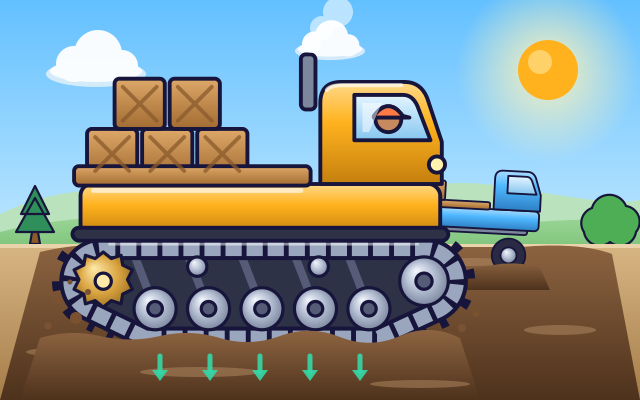
A track is a loop of steel plates that spreads a heavy machine's weight, so it rolls over mud and sand where wheels sink.
The big idea: A track touches the ground along a long, wide strip. The same weight spread over a bigger patch pushes more gently on each bit of ground, so soft ground can hold it up.
It's like walking on deep snow in snowshoes: you weigh just the same, but the big shoes spread your weight so the snow can hold you up.
The interactive parts didn't load. The explanations below still work; try reloading the page.
Why tracks do not sink
- A truck carries crates to a building site. When it reaches the soft mud, its wheels sink in and spin. Why can't it get across?
- Look closely at a wheel. Only a small patch of tire touches the ground. All the truck's weight pushes down on those few small patches, so the mud is squashed aside.
- Here comes a crawler. Instead of tires, it has a track: a loop of steel plates joined like a bicycle chain. The wheels roll along inside the loop.
- The track touches the ground along its whole length. The weight is spread over a much bigger patch, so each bit of mud is pushed only gently and can hold the crawler up.
- The engine turns a toothed wheel called a sprocket. Its teeth pull the track around. Ridges on the plates, called grousers, dig in and grip, so the crawler pushes itself across the mud.
- The crates arrive! The crawler is just as heavy as the truck. It crossed because its tracks spread that weight over a much bigger footprint.
Look inside a crawler's track
Tap each part of the track system. Watch what moves when you find it!
- Engine. The engine makes the turning power. A shaft and gears carry that power back to the sprocket.
- Drive sprocket. The sprocket is the only wheel the engine turns. Its teeth fit into the track and pull it around, like the gear that pulls a bicycle chain.
- Idler wheel. The idler wheel guides the track around the front. It can slide forward a little to keep the track tight.
- Road wheels. The road wheels carry the machine's weight. They roll along the inside of the track, as if the track were their own steel road.
- Return rollers. Small rollers hold up the top of the track as it travels back to the front, so it does not sag and slap.
- Track shoes. The track is a loop of flat steel plates called shoes, joined with pins so the loop can bend around the wheels.
- Grousers. Each plate has a ridge called a grouser. The ridges dig into the ground and grip, like the tread on the bottom of your boots.
Same load, two footprints
Both machines carry the same crates. Change the ground and the load. Watch the footprints, the sinking and the dials.
Experiment: A truck and a crawler carry the same crates onto soft mud. What will happen?
- Start on the firm road and press Drive. Do both machines roll along?
- Now choose Mud and look at the two dials.
- Add crates. Press Drive again and watch who gets across.
What we found: On firm ground both machines roll along. On soft ground the wheels sink and spin, but the tracks stay near the top. The load is the same; what differs is the footprint. A bigger footprint means a gentler push on each bit of ground.
Turn on JavaScript to try it yourself.
Swamp delivery
Carry 6 crates across the swamp. Choose the running gear and how many crates to take on each trip.
Pressure: weight and footprint
Press your thumb gently into soft clay and it leaves a small dent. Press just as hard with your whole flat hand and the clay hardly changes. You pushed with the same force both times. What changed was how much clay shared that push. Scientists call the push on each bit of surface the pressure.
A truck's tires touch the ground in a few small patches, each about as big as this page. All the truck's weight squeezes down through those patches, so the pressure is high. Hard road can push back that hard. Soft mud cannot, so it squishes out of the way and the wheel sinks.
A track is a loop of steel plates that touches the ground along its whole length. The crawler's weight is spread over a footprint many times bigger, so the pressure is many times smaller. The mud can push back that much, and the crawler stays near the top.
Tracks also grip. Ridges called grousers dig into the ground, so the crawler pushes against a long strip of soil instead of one slippery spot. But tracks are heavy, slow and noisy, and they chew up roads. That is why cars and buses keep their wheels, and tracks are saved for bulldozers, diggers, snow groomers and other machines that work on soft ground.
Key words
- Pressure
- How hard something pushes on each bit of a surface.
- Footprint
- The patch of ground a wheel or track touches.
- Track
- A loop of hinged steel plates that a vehicle lays down, rolls over and picks up again.
- Sprocket
- The toothed wheel, turned by the engine, that pulls the track around.
- Grouser
- A raised ridge on a track plate that digs into the ground for grip.
- Bearing strength
- How hard the ground can be pushed before it gives way.
Check your thinking
-
Why do tracks sink less than wheels in mud?
Show the answer
They spread the weight over a bigger footprint. The weight is the same. A bigger footprint means a gentler push on each bit of ground.
-
Which wheel does the engine turn to move the track?
Show the answer
The drive sprocket. Only the sprocket is driven. Its teeth catch the track and pull it around.
-
You put twice as many crates on the crawler. What happens to the push on the mud?
Show the answer
It gets bigger, so the crawler sinks a little more. More weight on the same footprint means a harder push on each bit of ground.
-
Why don't cars and buses use tracks?
Show the answer
Tracks are heavy and slow, and they damage roads. Hard roads hold wheels up easily, and wheels are lighter, faster and quieter.
-
A 10 tonne crawler (weight about 98,000 newtons) has 2.5 square meters of track on the ground. What is its ground pressure?
Show the answer
About 39 kilopascals. 98,000 newtons ÷ 2.5 square meters = 39,200 pascals, which is about 39 kilopascals.
-
What do grousers do?
Show the answer
They dig into the ground and grip. Grousers bite into the soil, so the crawler has something solid to push against.
You're a Flight & transportation expert!
You watched, looked inside, tried it, solved the challenge and went deeper. Pick another question below, or switch the age at the top to see this topic another way.
More about flight & transportation
 #137
Flight & transportation
How do snowmobiles move over snow?
Explore the driving track and steering skis while navigating a snowy course.
#137
Flight & transportation
How do snowmobiles move over snow?
Explore the driving track and steering skis while navigating a snowy course.
 #138
Flight & transportation
How do hydrofoil boats rise above the water?
Increase speed and watch underwater wings lift a model boat's hull.
#138
Flight & transportation
How do hydrofoil boats rise above the water?
Increase speed and watch underwater wings lift a model boat's hull.
 #139
Flight & transportation
How do paddles move and steer a kayak?
Compare paddle strokes that propel, turn, slow, or reverse a virtual kayak.
#139
Flight & transportation
How do paddles move and steer a kayak?
Compare paddle strokes that propel, turn, slow, or reverse a virtual kayak.
 #140
Flight & transportation
How do scuba regulators deliver breathing gas?
Follow compressed gas through a simplified regulator as surrounding water pressure changes.
#140
Flight & transportation
How do scuba regulators deliver breathing gas?
Follow compressed gas through a simplified regulator as surrounding water pressure changes.
Keep exploring
Games to play next
- Plane Flight SimulatorTake off from the runway and thread numbered sky hoops in order. Every clean flight is a new personal best.
- Machine RepairFix levers, pulleys, gears and ramps so every contraption works.
- Timetable TerminalRead the departure board, count the minutes and catch your connection on time.
Guide for grown-ups
- How to start homeschooling: a step-by-step guide for familiesA guide for parents · 7 min read
Science games by grade
Science worksheets by grade
- Preschool Science Worksheets
- Pre-K Science Worksheets
- Kindergarten Science Worksheets
- 1st Grade Science Worksheets
- 2nd Grade Science Worksheets
- 3rd Grade Science Worksheets
- 4th Grade Science Worksheets
- 5th Grade Science Worksheets
- 6th Grade Science Worksheets
- 7th Grade Science Worksheets
- 8th Grade Science Worksheets