How do windshield wipers move back and forth?
A wiper motor only spins in circles. See how a crank and a set of rods turn that spinning into the back-and-forth sweep that clears the rain.
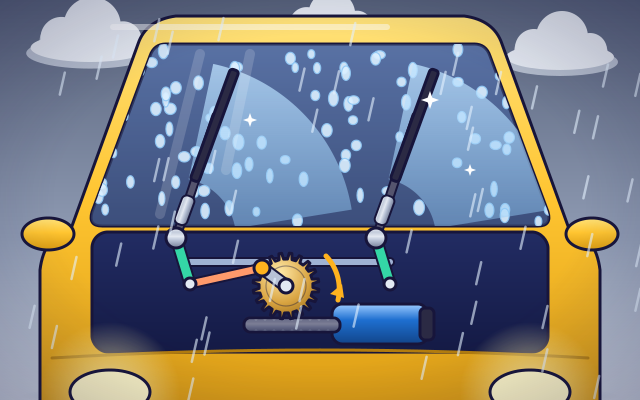
The big idea: The motor turns a short arm called a crank in circles. A rod joins the crank to a lever, and as the crank goes around, the rod pushes and pulls the lever back and forth. The wiper is fixed to that lever.
It's like pedaling a bike in reverse: your knee pumps up and down to make the pedal go around. In a wiper, the going around makes the swinging.
The interactive parts didn't load. The explanations below still work; try reloading the page.
From round and round to back and forth
- Rain covers the windshield, and the wipers sweep it away, back and forth, again and again. But the motor that drives them can only spin in a circle. How does that work?
- Hidden under the windshield is a small electric motor. It spins very fast. A screw-shaped gear called a worm turns a toothed wheel, which goes around much more slowly but pushes much harder.
- A short arm called a crank is fixed to the slow wheel. Its end travels in a circle. A long rod is hooked onto that end, so the rod is pushed and then pulled, once every turn.
- The other end of the rod is joined to a lever on the wiper's pivot. The lever is longer than the crank, so it cannot go all the way around. It can only rock back and forth, and the wiper arm rocks with it.
- A second rod links the first lever to a matching lever on the other wiper. Now one motor moves both wipers, and they always stay in step.
- A spring in the wiper arm presses a soft rubber blade onto the glass. The thin rubber edge tips over and pushes the water ahead of it like a squeegee, leaving clear glass behind.
Look under the windshield
In the garage, the panel under the windshield has been taken off. Tap each part of the wiper mechanism.
- Electric motor. The electric motor spins very fast when the wiper switch is on. It always spins the same way.
- Worm gear. A worm is a gear shaped like a screw. Each turn of the worm moves the big wheel by just one tooth, so the wheel turns slowly and pushes hard.
- Crank. The crank is a short arm fixed to the slow gear wheel. Its end goes around in a circle and carries one end of the rod with it.
- Connecting rod. The connecting rod joins the crank to the lever. As the crank goes around, the rod moves mostly back and forth, pushing and pulling the lever.
- Rocker lever. The rocker is a lever fixed to the wiper's pivot. The rod pushes its end one way and then the other, so it rocks, and the wiper arm on the same pivot rocks with it.
- Tie rod. The tie rod joins the two rocker levers. When one lever moves, it drags the other along, so the two wipers always sweep together.
- Wiper arm. The wiper arm is fixed to the pivot that pokes out below the glass. A spring inside the arm pulls it down so the blade presses on the windshield.
- Rubber blade. The blade is a strip of soft rubber with a thin edge. It works like a squeegee, pushing the water off the glass and leaving it clear.
Turn the crank, watch the wipers
Drag the crank around by hand, or switch the motor on. Then make the crank shorter or longer. How does the sweep of the wipers change?
Experiment: What happens to the wipers when you make the crank longer?
- Switch the motor on with a short crank. How much glass do the wipers clear?
- Make the crank longer, a little at a time.
- Find where the blades start to bump the window frame.
What we found: A longer crank travels around a bigger circle, so it pushes and pulls the rod farther. That rocks the lever through a bigger angle and the wipers sweep a wider arc. If the crank is too long, the blades bump the frame.
Turn on JavaScript to try it yourself.
Clear the driver's view
It is pouring! Choose a crank length and a motor speed so the wipers clear most of the glass, keep up with the rain and do not bump the frame. Then press Test.
How wipers work
Electric motors are good at one thing: spinning. A wiper has to do something different. It must swing one way, stop, swing back, stop, and do it again and again. The parts between the motor and the wiper change one kind of motion into the other.
First the motor is slowed down. Its shaft has a screw-shaped gear called a worm, which turns a toothed wheel. The wheel goes around about once a second, slowly but with a lot of push. A short arm called a crank is fixed to this wheel, so the end of the crank travels around in a circle.
A rod joins the end of the crank to a lever on the wiper's pivot. When the crank's end moves away, the rod pushes the lever. When it comes back around, the rod pulls the lever. The lever is longer than the crank, so it can never go all the way around. It just rocks, and the wiper arm rocks with it. One more rod passes the rocking on to the second wiper.
At the end of the arm, a spring presses a soft rubber blade onto the glass, and the blade pushes the water away. Waving your hand is a good picture of the wiper's motion, but your arm uses muscles that pull both ways. The wiper needs none of that: one small motor, always turning the same way, does it all.
Key words
- Crank
- A short arm that turns in full circles around one end.
- Linkage
- A set of rods and levers joined by pins that passes motion from one place to another.
- Rocker
- A lever that swings back and forth through part of a circle instead of going all the way around.
- Worm gear
- A screw-shaped gear that turns a toothed wheel slowly and strongly.
- Oscillate
- To move back and forth again and again, like a swing or a wiper.
- Sweep angle
- The angle a wiper arm turns through from one end of its stroke to the other.
Check your thinking
-
What kind of motion does the wiper motor make?
Show the answer
It spins around and around, always the same way. The motor only spins. The crank, rod and lever turn that into the back-and-forth sweep.
-
Why does the lever rock instead of going all the way around?
Show the answer
It is longer than the crank, so the rod can only push it part of the way. The crank's small circle can only move the end of the long lever a short distance each way, so the lever rocks.
-
You fit a longer crank. What happens to the wipers?
Show the answer
They sweep through a wider angle. A longer crank makes a bigger circle, so the rod is pushed and pulled farther and the lever rocks more.
-
A wiper motor spins at 3,000 rpm and drives the crank through a 50 to 1 worm gear. How many wipes a minute?
Show the answer
60. The crank turns at 3,000 / 50 = 60 turns a minute, and each turn of the crank is one complete wipe, there and back.
-
Why is the motor's fast spin slowed down by the worm gear?
Show the answer
So the crank turns slowly but pushes hard enough to move the wipers. Gearing down trades speed for push. The slow wheel is strong enough to drag two blades across wet glass.
-
How do both wipers stay exactly in step?
Show the answer
A tie rod joins their two levers. The tie rod makes the second lever copy the first one, so one motor drives both wipers together.
You're a Flight & transportation expert!
You watched, looked inside, tried it, solved the challenge and went deeper. Pick another question below, or switch the age at the top to see this topic another way.
More about flight & transportation
 #136
Flight & transportation
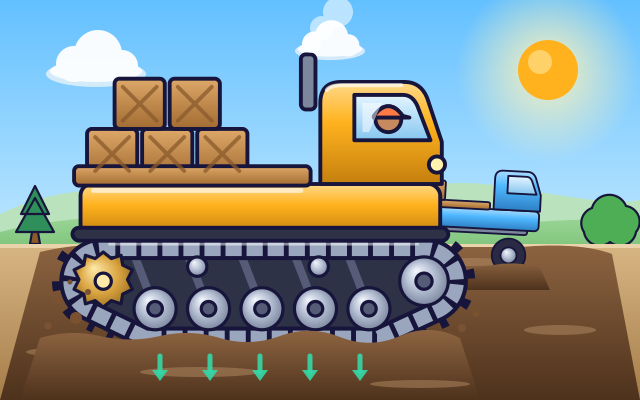
How do tracked vehicles cross soft ground?
Compare wheels and tracks while moving the same load across simulated mud or sand.
#136
Flight & transportation
How do tracked vehicles cross soft ground?
Compare wheels and tracks while moving the same load across simulated mud or sand.
 #137
Flight & transportation
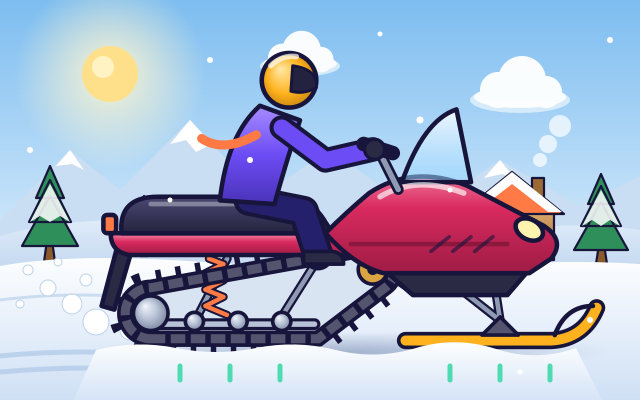
How do snowmobiles move over snow?
Explore the driving track and steering skis while navigating a snowy course.
#137
Flight & transportation
How do snowmobiles move over snow?
Explore the driving track and steering skis while navigating a snowy course.
 #138
Flight & transportation
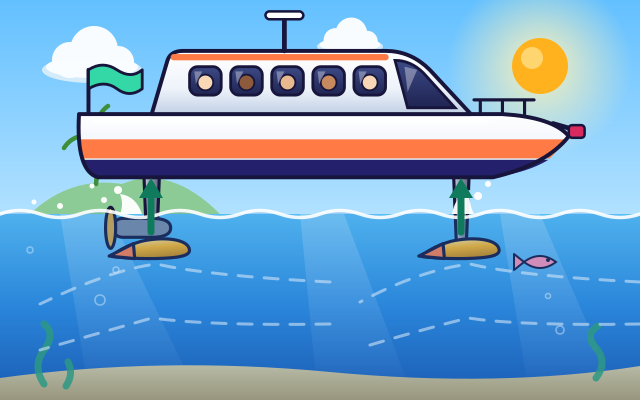
How do hydrofoil boats rise above the water?
Increase speed and watch underwater wings lift a model boat's hull.
#138
Flight & transportation
How do hydrofoil boats rise above the water?
Increase speed and watch underwater wings lift a model boat's hull.
 #139
Flight & transportation
How do paddles move and steer a kayak?
Compare paddle strokes that propel, turn, slow, or reverse a virtual kayak.
#139
Flight & transportation
How do paddles move and steer a kayak?
Compare paddle strokes that propel, turn, slow, or reverse a virtual kayak.
Keep exploring
Games to play next
- City Driving AdventureExplore the city behind the wheel, park safely and collect roadside deliveries.
- Machine RepairFix levers, pulleys, gears and ramps so every contraption works.
- Plane Flight SimulatorTake off from the runway and thread numbered sky hoops in order. Every clean flight is a new personal best.
Guide for grown-ups
- How to start homeschooling: a step-by-step guide for familiesA guide for parents · 7 min read
Science games by grade
Science worksheets by grade
- Preschool Science Worksheets
- Pre-K Science Worksheets
- Kindergarten Science Worksheets
- 1st Grade Science Worksheets
- 2nd Grade Science Worksheets
- 3rd Grade Science Worksheets
- 4th Grade Science Worksheets
- 5th Grade Science Worksheets
- 6th Grade Science Worksheets
- 7th Grade Science Worksheets
- 8th Grade Science Worksheets