How does an ATM dispense money?
Follow a pretend withdrawal: the card check, the question to the bank, the note counting and the cash slot.
The big idea: A cash machine does not know how much money you have. It checks your card, asks your bank, and only then counts out notes from its safe.
It's like asking a helper to fetch coins from your piggy bank at home: the helper phones home first to ask if there are enough, then counts them out for you.
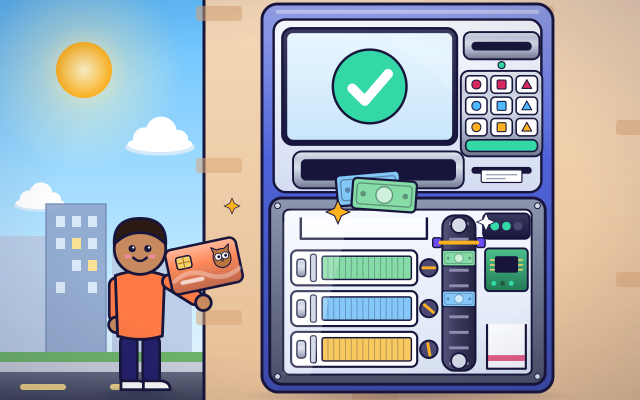
The interactive parts didn't load. The explanations below still work; try reloading the page.
From card to cash
- Mina wants $30 of her own pretend money for the fair. Her money is kept safe in a bank account. A cash machine, called an ATM, can hand some of it to her. But how does it know what to give?
- First the machine reads the tiny chip on the card. The chip says which account to look for. Then Mina taps in a secret code that only she knows. That shows the card is really hers.
- The machine has no idea how much money Mina has. So it sends a message along a cable to her bank's computer: can Mina take out $30? The bank checks her balance and answers yes.
- Now the machine counts. Inside its strong safe are boxes of notes called cassettes. Rubber rollers pull out one note at a time, and a sensor counts each note as it passes.
- A belt carries the counted notes up to the cash slot. The card comes back first, so nobody forgets it. Then a little shutter slides open and the notes poke out.
- Mina has $30 in her hand, and her account has $30 less. The money did not appear from nowhere. It moved from her account to her pocket. Card check, bank check, count, deliver!
Look inside a see-through ATM
The front of this machine is see-through. Tap each part to find out what it does. They move when you find them!
- Screen. The screen asks questions one step at a time: card, secret code, how much? It also tells you if the bank said yes or no.
- Card reader. The card reader touches the tiny gold chip on the card. The chip tells the machine which bank and which account the card belongs to.
- Keypad. You tap your secret code on the keypad. Only the right code unlocks the account, so a lost card is no use to a stranger.
- Computer and bank link. A small computer runs the whole machine. It sends a message down a cable to the bank's computer and waits for the answer: yes or no.
- Note boxes in the safe. The notes sit in boxes called cassettes, one box for each kind of note. They are locked inside a thick steel safe at the bottom of the machine.
- Pick rollers and counter. A rubber roller spins and slides exactly one note out of the box. A sensor watches each note go by and counts it.
- Moving belt. A moving belt carries each counted note up to a tray, where the notes wait in a neat stack.
- Cash slot. A metal shutter covers the cash slot. It slides open only when the right number of notes is ready, then closes again.
Ask the machine for cash
Tap the card, then ask for an amount. Watch the message go to the bank and the notes get counted. Try asking for more than Mina has. It is all pretend money.
Experiment: Mina has $50 in her pretend account. What happens if she asks the machine for $80?
- Tap the card so it slides in.
- Ask for $20. Watch the bank check and the notes come out.
- Now ask for $80. What does the bank answer?
What we found: The machine only counts out notes after the bank says yes. When Mina asks for more than she has, the bank answers not enough, and the rollers never move. Her balance stays the same.
Turn on JavaScript to try it yourself.
Be the cash machine
Three customers are waiting. Count out exactly what each one asks for, but only if the bank says they have enough.
What happens in those few seconds
A cash machine looks like a box full of money that anyone could empty. In fact it is a careful robot that will not hand over one note until three checks have passed.
The first check is you. The card's chip tells the machine which account to look for, and the secret code shows that the person holding the card is its owner. That is why you never tell anyone your code, not even a friend.
The second check is the money. The machine does not keep a list of what people have. It sends a message to the bank's computer, which looks up the balance. If there is enough, the bank answers yes and takes the amount off the account straight away.
The third check is the counting. Rollers pull notes out of the cassettes one at a time while a sensor counts them. Only when the stack is exactly right does the shutter open. So the notes in your hand and the amount taken from your account always match. The snack machine comparison stops working here: a snack machine never has to ask anyone before it gives you a snack.
Key words
- ATM
- A cash machine. The letters stand for automated teller machine.
- Bank account
- A record kept by a bank of how much money belongs to you.
- Balance
- The amount of money in an account right now.
- PIN
- A secret code that shows a card is being used by its owner.
- Cassette
- A locked box inside the machine that holds one kind of note.
- Authorization
- The bank's yes or no to a withdrawal.
Check your thinking
-
How does the cash machine find out whether you have enough money?
Show the answer
It sends a message to your bank's computer. The machine does not know your balance. Only the bank's computer does, so the machine asks it.
-
An account holds $50. Someone asks for $80. What comes out of the machine?
Show the answer
Nothing. The bank says no and the rollers never start. The machine counts notes only after the bank approves the whole amount.
-
Why does the machine count notes one at a time past a sensor?
Show the answer
So the number of notes is exactly right. Counting each note means the cash in your hand matches the amount taken from your account.
-
Why should you never tell anyone your secret code?
Show the answer
Because the code is the proof that the card is yours. Anyone with the card and the code could take the money, so the code must stay secret.
-
A machine is loaded only with $50 and $20 notes. Which amount can it NOT pay?
Show the answer
$35. $40 is two $20s and $90 is a $50 and two $20s, but no mix of $50 and $20 notes adds up to $35.
-
The bank approves $60, but the machine jams and no cash comes out. What should happen to the account?
Show the answer
The $60 is put back, because the journal shows no notes were presented. The balance must match the cash that really left the machine, so the bank reverses a withdrawal that was not paid out.
You're a Money, shops & services expert!
You watched, looked inside, tried it, solved the challenge and went deeper. Pick another question below, or switch the age at the top to see this topic another way.
More about money, shops & services
 #482
Money, shops & services
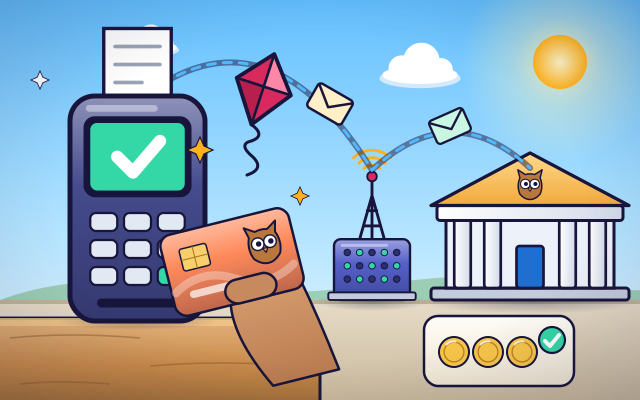
How does a debit-card payment work?
Trace a purchase through merchant, payment network, and bank using pretend account balances.
#482
Money, shops & services
How does a debit-card payment work?
Trace a purchase through merchant, payment network, and bank using pretend account balances.
 #483
Money, shops & services
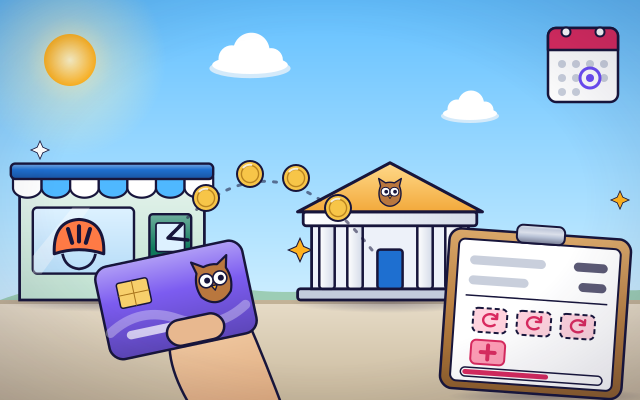
How does a credit-card payment work?
Follow a purchase, statement, and repayment using a fictional account and simple balances.
#483
Money, shops & services
How does a credit-card payment work?
Follow a purchase, statement, and repayment using a fictional account and simple balances.
 #484
Money, shops & services
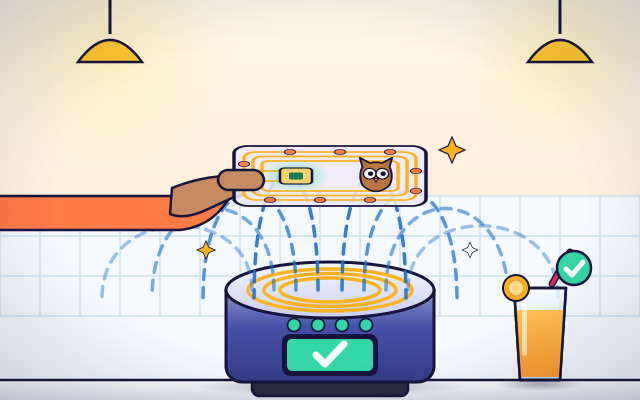
How do contactless payments work?
Bring a virtual card near a reader and follow the short-range exchange and authorization.
#484
Money, shops & services
How do contactless payments work?
Bring a virtual card near a reader and follow the short-range exchange and authorization.
 #485
Money, shops & services
How does a bank transfer move money?
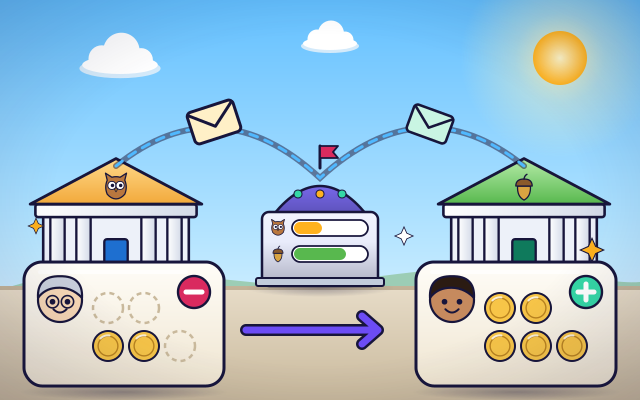
Follow payment instructions and changing balances between two fictional bank accounts.
#485
Money, shops & services
How does a bank transfer move money?
Follow payment instructions and changing balances between two fictional bank accounts.
Keep exploring
Games to play next
- Coin MarketRun a pretend market stall: pay exactly, use the fewest coins, and give the right change.
- Festival PlannerPlace the stalls, book the acts and keep the budget — make every rule true.
- Supermarket StockerRoll out your cart and make every shelf ready for the day.
Guide for grown-ups
- How to start homeschooling: a step-by-step guide for familiesA guide for parents · 7 min read