How do contactless payments work?
Bring a pretend card near a reader and follow the invisible field, the quick chat and the bank's yes.
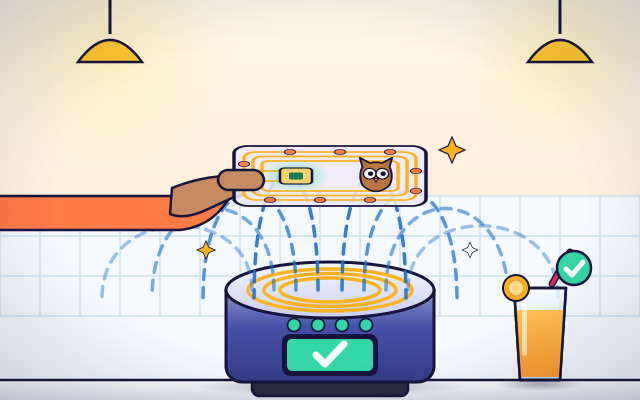
The big idea: A contactless card has a tiny chip and a loop of wire inside. The reader's invisible magnetic field gives the chip power, and they swap a short message when the card is only a few centimeters away.
It's like whispering a secret word to a friend: it only works when you are very close, and you pick a new word every time.
The interactive parts didn't load. The explanations below still work; try reloading the page.
Paying without touching
- Leo pays for a $3 juice by holding his pretend card near the reader. Beep! No slot, no swipe. How can the card and the reader talk without touching?
- Inside the card is a chip, a tiny computer, joined to a thin loop of wire that runs around the edge. The loop is an antenna. There is no battery, so the chip is asleep.
- The reader has a wire loop too. Electricity racing back and forth in it makes an invisible magnetic field. When the card's loop enters the field, electricity starts to flow in it, and the chip wakes up.
- Now the two can talk by tiny radio signals. The reader says how much to pay. The card answers with a secret code that it makes up just for this one payment.
- The reader sends the code to the bank, just like any card payment. The bank checks it and says yes. Four green lights and a beep: paid!
- The field fades quickly with distance, so the card only works within about four centimeters. That is on purpose. And because the code is new every time, a copied code is useless.
Look inside a card and a reader
The card and the reader are drawn see-through. Tap each part to find out what it does.
- Card antenna. A thin loop of wire runs around the inside edge of the card. It catches energy from the reader's field and also sends and receives the messages.
- Chip. The chip is a tiny computer with no battery. When the antenna feeds it power, it wakes up, makes a one-time code and sends it.
- Reader coil. Under the reader's top is another loop of wire. Electricity surging back and forth in it makes the magnetic field.
- Magnetic field. The field is invisible. Here it is drawn as blue lines. It is strong near the reader and fades away within a few centimeters.
- Lights and beep. The lights fill up as the reader and card talk. Four green lights and a beep tell you the payment went through.
- Link to the bank. The reader passes the card's code on to the bank through the payment network. Only when the bank says yes is the payment done.
How close is close enough?
Drag the pretend card toward the reader, or use the slider. Find out how close it must be before the chip wakes up and the payment goes through.
Experiment: How close does the card have to be before the reader can take the payment?
- Hold the card far above the reader. Does anything happen?
- Bring it down slowly and watch the loop of wire.
- Find the distance where the chip wakes up.
What we found: Far away, nothing happens: the field does not reach. Only within about 4 centimeters does enough energy flow into the loop to wake the chip. That short range is on purpose: you have to mean to pay.
Turn on JavaScript to try it yourself.
Fix the taps
Three customers cannot pay. Work out what is wrong each time, fix it, then bring the card close.
Power and a message through thin air
A contactless card looks like plain plastic, but two things are hidden inside it: a chip, which is a tiny computer, and a thin loop of wire around the edge. There is no battery. Until the card comes close to a reader, the chip is fast asleep.
The reader has a loop of wire as well. Electricity surges back and forth in it, and that makes an invisible magnetic field around the reader. When the card's loop is inside the field, the field pushes electricity around the card's loop too. Now the chip has power and wakes up. Scientists call this induction.
With the chip awake, the two swap short radio messages. The reader says how much to pay. The card answers with a secret code that it makes up for this one payment only. The reader passes the code to the bank, the bank says yes, and you hear the beep. All of that takes about half a second.
The field is strong near the reader and fades very fast, so it reaches only about four centimeters. That is on purpose: you have to hold your card right up to the reader, so you cannot pay by accident from across the room. The whispering comparison is not perfect, though. A whisper needs your own breath, but the card gets all of its power from the reader.
Key words
- Contactless
- Paying by holding a card or phone near a reader, without putting it into a slot.
- Antenna
- A loop of wire that catches and sends invisible signals.
- Magnetic field
- The invisible region around a magnet, or around a wire carrying electricity, where magnetic pushes can be felt.
- Induction
- Making electricity flow in a wire loop with a changing magnetic field, without touching it.
- NFC
- Near-field communication: very short-range wireless links between two coils, at 13.56 megahertz.
- One-time code
- A secret code made for a single payment. It is useless if anyone copies it.
Check your thinking
-
Where does the card's chip get its power?
Show the answer
From the reader's magnetic field. The card has no battery. The reader's field pushes electricity around the card's loop.
-
Why does a contactless card only work within a few centimeters?
Show the answer
The field fades very quickly with distance. Beyond a few centimeters too little energy reaches the loop to wake the chip.
-
Why does the card make a new secret code for every payment?
Show the answer
So that a copied code cannot be used again. A code that works only once is worthless to anyone who records it.
-
A card is wrapped in metal foil. Why can't it pay?
Show the answer
Metal blocks the field, so no power reaches the chip. The field cannot pass through the metal, so the chip never wakes.
-
Which design choice most directly stops someone paying by accident from across a room?
Show the answer
The very short range of the field. The field reaches only a few centimeters, so the card must be brought right up to the reader.
You're a Money, shops & services expert!
You watched, looked inside, tried it, solved the challenge and went deeper. Pick another question below, or switch the age at the top to see this topic another way.
More about money, shops & services
 #485
Money, shops & services
How does a bank transfer move money?
Follow payment instructions and changing balances between two fictional bank accounts.
#485
Money, shops & services
How does a bank transfer move money?
Follow payment instructions and changing balances between two fictional bank accounts.
 #486
Money, shops & services
How does depositing a check work?
Trace a check through capture, verification, clearing, and settlement in a simplified model.
#486
Money, shops & services
How does depositing a check work?
Trace a check through capture, verification, clearing, and settlement in a simplified model.
 #487
Money, shops & services
What happens after an online order is placed?
Follow an order through stock checks, picking, packing, shipping, and delivery.
#487
Money, shops & services
What happens after an online order is placed?
Follow an order through stock checks, picking, packing, shipping, and delivery.
 #488
Money, shops & services
How do parcel centers sort packages?
Scan labels and route packages along conveyors toward the correct destinations.
#488
Money, shops & services
How do parcel centers sort packages?
Scan labels and route packages along conveyors toward the correct destinations.
Keep exploring
Games to play next
- Coin MarketRun a pretend market stall: pay exactly, use the fewest coins, and give the right change.
- Festival PlannerPlace the stalls, book the acts and keep the budget — make every rule true.
- Supermarket StockerRoll out your cart and make every shelf ready for the day.
Guide for grown-ups
- How to start homeschooling: a step-by-step guide for familiesA guide for parents · 7 min read