How does a credit-card payment work?
Follow a pretend purchase, the monthly statement and the payback, and see what borrowing can cost.
The big idea: A credit card borrows money from a bank. The bank pays the shop now, and the cardholder has to pay the bank back later, sometimes with a little extra.
It's like a friend paying for your snack today: you write down what you owe, and you pay them back on pocket-money day.
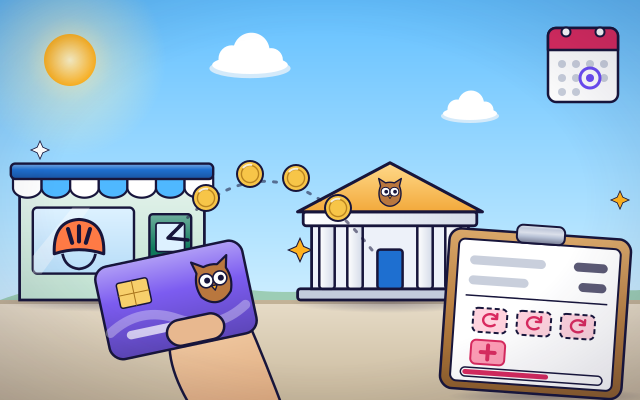
The interactive parts didn't load. The explanations below still work; try reloading the page.
Borrowing with a card
- Aunt Rosa buys a $40 bike helmet with her credit card. A credit card is for grown-ups. It looks like a debit card, but it works in a different way. Whose money pays the shop?
- The bank pays the shop straight away with the bank's own money. Rosa has paid nothing yet. She has borrowed $40, and borrowed money has to be paid back.
- Later Rosa buys $60 skates the same way. Now she owes $100. The bank sets a credit limit, the most it will lend her. A purchase that would go past the limit is refused.
- At the end of the month the bank sends a statement. It lists everything Rosa bought, the total she owes and the date by which to pay.
- Rosa pays the whole $100 back from her own bank account before the due date. Her debt drops to zero, and the bank adds nothing extra. Borrowing cost her nothing this month.
- What if Rosa pays back only $50? The other $50 stays owed, and the bank adds a small fee for borrowing, called interest. Next month she owes a little more than she left.
Read a credit card statement
This is Aunt Rosa's pretend statement, the list the bank sends each month. Tap each part to see what it tells her.
- Credit card. The credit card tells the shop which bank will pay. It is for grown-ups, because using it means borrowing money.
- List of purchases. Every purchase made with the card this month is listed here with its price. It is worth checking that each one is really yours.
- Total owed. All the purchases are added up. The total is what Rosa has borrowed and has to pay back.
- Due date. The due date is the day by which the bank must be paid. Paying late costs extra.
- Smallest payment. The bank asks for at least a small part by the due date. Paying only this small part keeps the rest of the debt, and interest is added to it.
- Credit limit. The limit is the most the bank will lend. The bar shows how much of it Rosa has used so far.
- Interest. Interest is a fee for borrowing. It is added only when part of the total is left unpaid after the due date.
A month with a credit card
Buy a few things with Aunt Rosa's pretend credit card and watch who pays the shop. Then end the month: pay back half, or all of it. What is different?
Experiment: Aunt Rosa owes $100 on her pretend card. She pays back only half this month. What happens to the other half?
- Buy the helmet and the skates. Watch who pays the shop.
- End the month and pay back half. Look for a new line on the list.
- End the next month and pay it all back. Is anything extra added now?
What we found: The bank paid the shop straight away, so Rosa owed the bank. When she paid back only half, the rest stayed on the list and the bank added a small fee for borrowing, called interest. When she paid everything, nothing extra was added.
Turn on JavaScript to try it yourself.
Borrow now, pay back smartly
Rosa needs $90 skates today but has only $40. Buy them with the card, then pay the bank back month by month with as little interest as you can.
What borrowing with a card means
A debit card spends your own money. A credit card spends the bank's money. That is the big difference, and it is why credit cards are only for grown-ups.
When a grown-up pays with a credit card, the bank pays the shop straight away. The shop is happy, and the grown-up walks out with the helmet. But now the grown-up owes the bank. Every purchase is added to a list, and the bank will only lend up to a limit.
Once a month the bank sends a statement: the list of purchases, the total owed and a due date. If the whole total is paid back by that date, most cards add nothing extra. Borrowing for those few weeks was free.
If only part is paid back, the rest stays owed and the bank adds interest, a fee for borrowing. Next month there is a little more to pay, and the month after that even more. Borrowing is a useful tool, for example for something needed right now, but everything borrowed has to be paid back. Here the snack comparison breaks down: a kind friend does not charge you extra for waiting, but a bank does.
Key words
- Credit card
- A card for grown-ups that pays with money borrowed from a bank.
- Borrow
- To use something that belongs to someone else, promising to give it back.
- Credit limit
- The most the bank will lend on the card.
- Statement
- The monthly list from the bank: what was bought, the total owed and the date to pay by.
- Interest
- A fee for borrowing, added when the total is not fully paid back on time.
- Debt
- Money that is owed and has to be paid back.
Check your thinking
-
Whose money pays the shop when a credit card is used?
Show the answer
The bank's money, which the cardholder then owes. The bank pays the shop at once. That makes it a loan, which has to be repaid.
-
Rosa pays the whole total by the due date. What extra does the bank add on most cards?
Show the answer
Nothing extra. Interest is added to what is left unpaid. If nothing is left, there is nothing to add it to.
-
Rosa owes $100 and pays back $60. What is the fee called that the bank adds to the $40 that is left?
Show the answer
Interest. Interest is the fee for borrowing. It is worked out from the part still owed.
-
The credit limit is $200 and Rosa already owes $170. She tries to buy $60 skates. What happens?
Show the answer
The purchase is refused, because it would go past the limit. $170 and $60 make $230, more than the bank agreed to lend.
-
Which is the main difference between a debit card and a credit card?
Show the answer
Debit spends your own money; credit spends borrowed money. A debit payment comes out of your own account. A credit payment is lent by the bank and repaid later.
You're a Money, shops & services expert!
You watched, looked inside, tried it, solved the challenge and went deeper. Pick another question below, or switch the age at the top to see this topic another way.
More about money, shops & services
 #484
Money, shops & services
How do contactless payments work?
Bring a virtual card near a reader and follow the short-range exchange and authorization.
#484
Money, shops & services
How do contactless payments work?
Bring a virtual card near a reader and follow the short-range exchange and authorization.
 #485
Money, shops & services
How does a bank transfer move money?
Follow payment instructions and changing balances between two fictional bank accounts.
#485
Money, shops & services
How does a bank transfer move money?
Follow payment instructions and changing balances between two fictional bank accounts.
 #486
Money, shops & services
How does depositing a check work?
Trace a check through capture, verification, clearing, and settlement in a simplified model.
#486
Money, shops & services
How does depositing a check work?
Trace a check through capture, verification, clearing, and settlement in a simplified model.
 #487
Money, shops & services
What happens after an online order is placed?
Follow an order through stock checks, picking, packing, shipping, and delivery.
#487
Money, shops & services
What happens after an online order is placed?
Follow an order through stock checks, picking, packing, shipping, and delivery.
Keep exploring
Games to play next
- Coin MarketRun a pretend market stall: pay exactly, use the fewest coins, and give the right change.
- Festival PlannerPlace the stalls, book the acts and keep the budget — make every rule true.
- Supermarket StockerRoll out your cart and make every shelf ready for the day.
Guide for grown-ups
- How to start homeschooling: a step-by-step guide for familiesA guide for parents · 7 min read