How does a debit-card payment work?
Follow a pretend purchase from the shop, through the payment network, to the bank and back again.
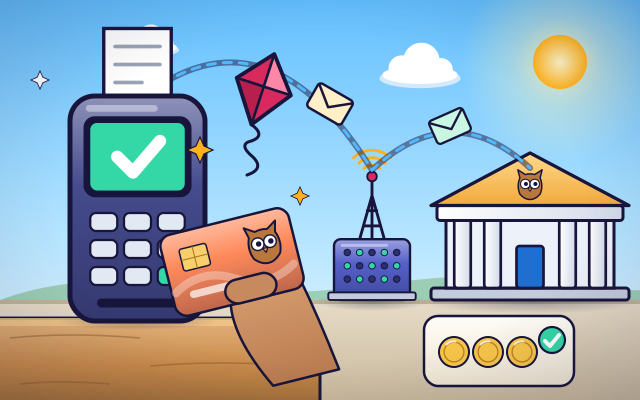
The big idea: A debit card spends money that is already yours. The shop's machine asks your bank if there is enough, and the bank moves that money to the shop.
It's like passing a note along a row of friends to ask a grown-up for pocket money: the note travels along, the grown-up checks your piggy bank, and the answer comes back.
The interactive parts didn't load. The explanations below still work; try reloading the page.
From the shop to the bank and back
- Mina wants a kite that costs $12. She has no coins or notes with her, only her pretend debit card. A few seconds later the kite is hers. How did the shop get paid?
- The shop's card machine is called a terminal. It reads the chip on the card to learn which account to ask. Then it writes a little message: Mina's card, $12, for the kite shop.
- The message goes first to the shop's own bank. That bank passes it to a payment network, a giant switchboard that links thousands of banks. The network sends it on to Mina's bank.
- Mina's bank checks two things: is this really her card, and is there at least $12 in her account? She has $30, so the bank says yes and sets $12 aside.
- The answer travels back the same way: approved! The terminal beeps and prints a receipt, a paper record of what was paid. Mina can take her kite.
- That night the two banks settle up. $12 leaves Mina's account and arrives in the shop's account. Nothing was lost on the way: the money just changed places.
The stops on a payment's journey
A card payment visits several stops in about a second. Tap each one to see what it does.
- Card and chip. The gold square is a chip, a tiny computer. It tells the terminal which bank and which account this card belongs to. The card itself holds no money.
- Terminal. The terminal reads the card, adds the price and the shop's name, and sends the request on its way. Then it waits for the answer and shows it.
- The shop's bank. The shop keeps its own account at a bank. That bank collects the shop's card payments and passes each request on to the network.
- Payment network. The payment network is like a giant switchboard. It links thousands of banks and knows which one each card belongs to.
- Mina's bank. Mina's bank gave her the card. It checks that the card is real and that there is enough money, then answers approved or declined.
- Mina's account. The account is a record of how much money Mina has. When the bank approves $12, it sets that money aside, so her balance drops straight away.
- Receipt. The receipt is a record of the payment: what was bought, how much it cost and when. It is handy if something has to go back to the shop.
Send a payment on its way
Tap something in the shop to pay for it with Mina's pretend debit card. Follow the message to her bank and back. Then try to buy the scooter.
Experiment: Mina has $30 in her pretend account. What happens when she tries to buy the $80 scooter with her debit card?
- Buy the ball. Watch the message travel and both accounts change.
- Buy the kite. How much is left in Mina's account?
- Now try the $80 scooter. What comes back from the bank?
What we found: A debit card can only spend money that is in the account. When the price was bigger than Mina's balance, her bank answered declined, and neither account changed.
Turn on JavaScript to try it yourself.
Be Mina's bank
Answer five payment requests. Approve a payment only if the account holds enough, and watch the balance change.
A one-second journey
When you pay with coins, you can see the money move from your hand to the shopkeeper's. A debit card payment moves money too, but as messages between computers. No coins travel anywhere.
The trip starts at the terminal, the shop's card machine. It reads the chip to find out whose account to ask, and sends a request: this card, this price, this shop. The request goes to the shop's bank, then through the payment network, a kind of switchboard that knows the way to every bank, and arrives at the bank that gave you the card.
Your bank does the checking. Is the card real? Is there enough money in the account? If so, it answers approved and sets the money aside right away. If not, it answers declined. The answer races back along the same path, and the whole round trip usually takes only a second or two.
Later the banks settle up, and the money that was set aside lands in the shop's account. A debit card never lends you anything: it can only spend what is already in your account. The comparison with passing a note along a row of friends is not perfect, because the computers answer in a blink and never get tired or forget.
Key words
- Debit card
- A card that pays with money already in your own bank account.
- Terminal
- The shop's card machine. It reads the card and sends the payment request.
- Payment network
- A giant switchboard that passes payment messages between banks.
- Authorization
- The bank's yes or no to a payment.
- Hold
- Money set aside for an approved payment, so it cannot be spent again before it is settled.
- Settlement
- When the banks actually move the money to the shop.
Check your thinking
-
Where does the money for a debit card payment come from?
Show the answer
Your own bank account. A debit card spends money you already have in your account. The card and chip hold no money.
-
An account holds $13. The card is used to pay $25. What happens?
Show the answer
The bank declines and no money moves. A debit card cannot spend more than the account holds, so the bank says no and nothing changes.
-
What is the payment network's job?
Show the answer
To pass each request to the right bank and bring back the answer. The network is a switchboard. It holds no money; it carries messages between banks.
-
Why does the bank set the money aside as soon as it approves a payment?
Show the answer
So the same money cannot be spent twice. If the money stayed free, Mina could promise the same $12 to two shops.
-
An account shows a balance of $30 with a $12 hold. How much can still be spent by debit card?
Show the answer
$18. The available balance is the balance minus the holds: 30 minus 12 leaves 18.
You're a Money, shops & services expert!
You watched, looked inside, tried it, solved the challenge and went deeper. Pick another question below, or switch the age at the top to see this topic another way.
More about money, shops & services
 #483
Money, shops & services
How does a credit-card payment work?
Follow a purchase, statement, and repayment using a fictional account and simple balances.
#483
Money, shops & services
How does a credit-card payment work?
Follow a purchase, statement, and repayment using a fictional account and simple balances.
 #484
Money, shops & services
How do contactless payments work?
Bring a virtual card near a reader and follow the short-range exchange and authorization.
#484
Money, shops & services
How do contactless payments work?
Bring a virtual card near a reader and follow the short-range exchange and authorization.
 #485
Money, shops & services
How does a bank transfer move money?
Follow payment instructions and changing balances between two fictional bank accounts.
#485
Money, shops & services
How does a bank transfer move money?
Follow payment instructions and changing balances between two fictional bank accounts.
 #486
Money, shops & services
How does depositing a check work?
Trace a check through capture, verification, clearing, and settlement in a simplified model.
#486
Money, shops & services
How does depositing a check work?
Trace a check through capture, verification, clearing, and settlement in a simplified model.
Keep exploring
Games to play next
- Coin MarketRun a pretend market stall: pay exactly, use the fewest coins, and give the right change.
- Festival PlannerPlace the stalls, book the acts and keep the budget — make every rule true.
- Supermarket StockerRoll out your cart and make every shelf ready for the day.
Guide for grown-ups
- How to start homeschooling: a step-by-step guide for familiesA guide for parents · 7 min read