How does a bank transfer move money?
Follow a payment instruction between two pretend banks and watch both balances change.
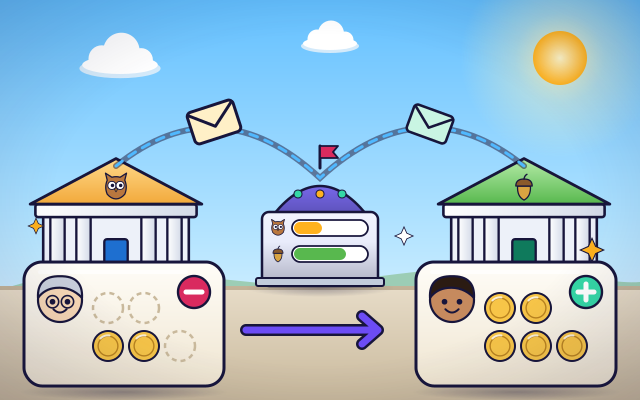
The big idea: A bank transfer moves no coins. One bank subtracts the amount from the sender's account, sends a message, and the other bank adds the same amount to the receiver's account.
It's like two friends keeping score on paper: you cross three points off your sheet, call out to your friend, and they add three points to theirs.
The interactive parts didn't load. The explanations below still work; try reloading the page.
How money moves between banks
- Grandma Ada wants to send Mina $25 for her birthday, but Mina lives far away. No truck will carry the money. Both of them have bank accounts, so the banks can help.
- Ada writes a payment instruction for her bank. It says who the money is for, which bank to pay and how much: Mina, at Acorn Bank, $25.
- Owl Bank checks that Ada has enough money. She does, so it takes $25 off her balance. Her account goes down from $80 to $55.
- Now Owl Bank sends a message through a clearing center, a hub that passes payments between banks. No coins are inside. The message just says: add $25 to Mina's account.
- Acorn Bank adds $25 to Mina's balance: it goes up from $10 to $35. A message pops up on the family phone. The gift has arrived!
- Last, the two banks square up with each other, because Owl Bank now owes Acorn Bank $25. Count both accounts together: the total is the same as before. The money only changed places.
The parts of a bank transfer
A transfer changes several records, one after another. Tap each one to see what happens there.
- Payment instruction. The instruction tells the bank three things: who the money is for, which bank and account to pay, and how much. A mistake here could send money to the wrong person, so it is worth checking twice.
- Grandma Ada's account. This is the record of Ada's money at Owl Bank. When she sends $25, the bank lowers her balance by $25.
- Clearing center. The clearing center is a hub that links the banks. It reads each message and passes it on to the right bank.
- Accounts between banks. The banks have accounts of their own. When Owl Bank's customer sends $25 to Acorn Bank's customer, Owl Bank pays Acorn Bank $25 here.
- Mina's account. This is the record of Mina's money at Acorn Bank. When the message arrives, the bank raises her balance by $25.
- Notice. A notice tells Mina's family that money has arrived, who sent it and how much.
Send, and watch both balances
Tap an amount to send it from Grandma Ada to Mina. Watch each step, and keep an eye on the total of both accounts.
Experiment: Grandma Ada sends $25 to Mina. What happens to the total money in the two accounts together?
- Add up the two balances before you start.
- Send $10, then $25. Watch which number changes first.
- Add up the two balances again.
What we found: The total stayed the same. Ada's balance went down by exactly as much as Mina's went up. A transfer does not carry coins and does not make new money: the banks just change their records.
Turn on JavaScript to try it yourself.
Share it out fairly
Ada, Mina and Theo have $30, $5 and $10. Make transfers so that each of them has $15. Use as few transfers as you can.
Numbers that change places
Sending money to someone far away sounds as if it needs a truck. It does not. Most money is not coins or notes at all. It is numbers in bank records, and a transfer simply changes those numbers.
It starts with a payment instruction. The sender tells her bank who the money is for, which bank and account to pay, and how much. The bank checks that she has enough, then lowers her balance by that amount.
Next the sender's bank passes a message to the receiver's bank through a clearing center, a hub that links banks together. When the message arrives, the receiver's bank raises the receiver's balance by the same amount. One number went down, the other went up, and the total did not change.
The two banks also square up with each other, because the sender's bank is holding money that now belongs at the other bank. Some transfers arrive in seconds. Others are collected and sent in batches, so they take a day or two. The score-sheet comparison is not perfect: friends could miscount, so banks use careful checks and records that both sides must agree on.
Key words
- Transfer
- Moving money from one bank account to another.
- Payment instruction
- The sender's order to her bank: who to pay, at which bank and account, and how much.
- Debit
- Taking an amount off an account.
- Credit
- Adding an amount to an account.
- Clearing
- Passing payment messages between banks.
- Settlement
- When the banks square up with each other.
Check your thinking
-
During a bank transfer, what actually travels between the banks?
Show the answer
A message. Only information travels. Each bank changes its own records.
-
Ada has $80 and Mina has $10. Ada sends $25. What is the total of both accounts afterward?
Show the answer
$90, the same as before. Ada has $55 and Mina has $35. Together that is still $90.
-
Ada's account holds $20. She tries to send $50. What does her bank do?
Show the answer
It refuses, because there is not enough in the account. The bank checks the balance first. It cannot take out more than is there.
-
Why is it important to check a payment instruction before sending it?
Show the answer
A wrong account could send the money to the wrong person. The bank follows the instruction exactly, so the details have to be right.
You're a Money, shops & services expert!
You watched, looked inside, tried it, solved the challenge and went deeper. Pick another question below, or switch the age at the top to see this topic another way.
More about money, shops & services
 #486
Money, shops & services
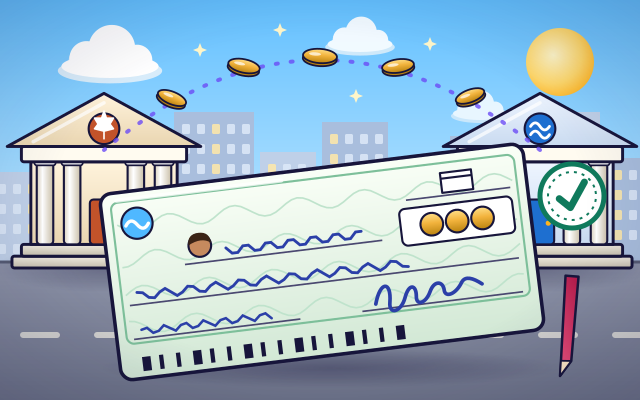
How does depositing a check work?
Trace a check through capture, verification, clearing, and settlement in a simplified model.
#486
Money, shops & services
How does depositing a check work?
Trace a check through capture, verification, clearing, and settlement in a simplified model.
 #487
Money, shops & services
What happens after an online order is placed?
Follow an order through stock checks, picking, packing, shipping, and delivery.
#487
Money, shops & services
What happens after an online order is placed?
Follow an order through stock checks, picking, packing, shipping, and delivery.
 #488
Money, shops & services
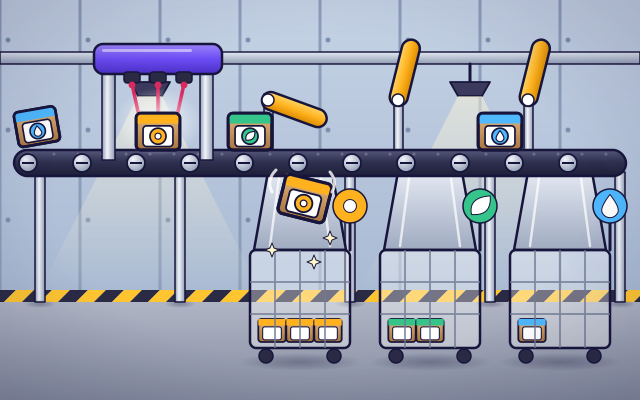
How do parcel centers sort packages?
Scan labels and route packages along conveyors toward the correct destinations.
#488
Money, shops & services
How do parcel centers sort packages?
Scan labels and route packages along conveyors toward the correct destinations.
 #489
Money, shops & services
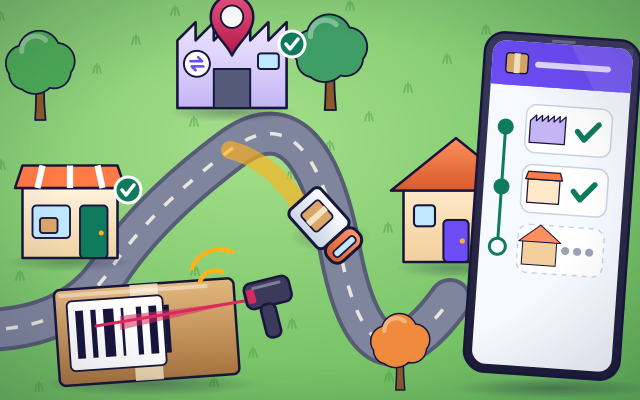
How does delivery tracking know where a package is?
Add scan events along a journey and watch the tracking history update.
#489
Money, shops & services
How does delivery tracking know where a package is?
Add scan events along a journey and watch the tracking history update.
Keep exploring
Games to play next
- Coin MarketRun a pretend market stall: pay exactly, use the fewest coins, and give the right change.
- Festival PlannerPlace the stalls, book the acts and keep the budget — make every rule true.
- Safe Message DetectiveRead made-up messages, pop-ups and posts, spot the clues, and choose the safe, kind thing to do.
Guide for grown-ups
- How to start homeschooling: a step-by-step guide for familiesA guide for parents · 7 min read