How do auroras appear in the sky?
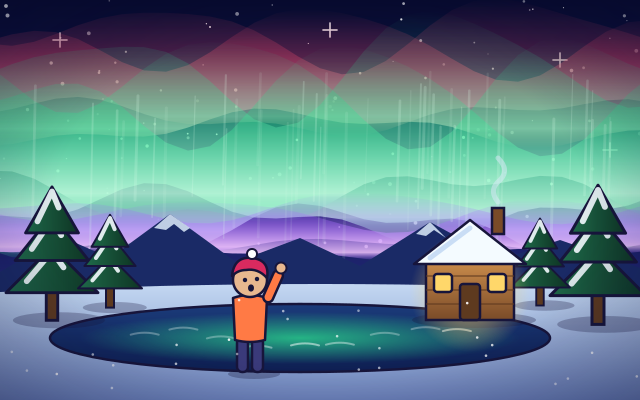
Particles from the Sun follow Earth's magnetic field to the poles, bump into the air and make it glow in colors.
The big idea: The Sun blows out charged particles. Earth's magnetic field guides some of them down near the poles, where they bump into the air and make it give off light.
It's like a neon sign: electricity bumps the gas inside the tube and the gas glows. In an aurora, particles from the Sun bump the air high above the poles.
The interactive parts didn't load. The explanations below still work; try reloading the page.
From the Sun to the northern lights
- On dark nights near the top and bottom of the world, ribbons of colored light ripple across the sky. They are called auroras, or the northern and southern lights. What switches them on?
- The Sun does not only send light. It also blows out a stream of tiny charged particles called the solar wind. A few days later, some of them reach Earth.
- Earth is like a giant magnet, and its magnetic field reaches far out into space. Charged particles cannot easily cross it, so most of the solar wind slides around our planet.
- But near the poles the field lines dip down toward the ground. Some particles follow them, like beads sliding down wires, and pour into the air in a ring around each pole.
- High above the ground, each particle bumps into an atom of the air and gives it extra energy. A moment later the atom lets that energy go as a tiny flash of light. Billions of flashes make the glow.
- The color tells you which gas was hit, and how high. Oxygen glows green, and very high up it glows red. Nitrogen adds purple and pink along the bottom edge.
The parts of an aurora
An aurora needs the Sun, a wind of particles, a magnetic shield and air. Tap each one.
- The Sun. The story starts here. The Sun's outer layer is so hot that bits of it are always streaming away into space.
- Solar wind. The solar wind is a stream of tiny charged particles. It is far too thin to feel, but it never stops blowing.
- Magnetic field. Earth's magnetic field is invisible, but it pushes the solar wind aside. Near the poles its lines curve down toward the ground.
- Auroral oval. The lights form a ring around each pole. People who live under the ring see auroras most often.
- Oxygen. When a particle bumps an oxygen atom, the atom glows. In the middle heights it glows green. Very high up it glows red.
- Nitrogen. Most of the air is nitrogen. When strong particles reach it, lower down, it glows blue, purple and pink.
Calm wind or solar storm?
Tap the Sun, or use the slider, to make the solar wind stronger. Watch the ring of light on the globe and the sky above the village.
Experiment: What happens to the ring of light when the Sun sends a stronger gust of wind?
- Set the wind to calm. Look at the ring on the globe and at the village sky.
- Tap the Sun, or slide the wind up to stormy.
- Switch the magnetic field off and on again. What changes?
What we found: A calm solar wind makes a small, faint ring close to the pole, too far away for the village to see. A strong gust pours in more particles, so the ring gets brighter and wider, and the lights reach the village. Without the magnetic field there is no ring at all, because nothing guides the particles to the poles.
Turn on JavaScript to try it yourself.
Paint the sky
Make each aurora shown in the picture. Set the particle energy so the particles stop in the right layer of air, then send them.
How the northern lights work
The Sun sends out more than light. Its outer layer is so hot that tiny charged particles are always streaming away from it in every direction. This stream is called the solar wind. It takes a few days to cross the 150 million kilometers to Earth.
Earth has a secret shield. Deep inside our planet, hot liquid iron swirls around and turns the whole Earth into a giant magnet. Its magnetic field reaches far into space and pushes most of the solar wind aside. But near the north and south poles the field curves down toward the ground, and some particles are guided along it into the air.
About 100 kilometers up and higher, those particles crash into the atoms of the air. Each bump gives an atom some extra energy, and the atom gets rid of it by giving off a tiny flash of light. Oxygen gives off green light, or red when it is very high up. Nitrogen gives off blue, purple and pink. Billions of flashes together make the glowing curtains.
A neon sign works in a similar way: electricity bumps a gas inside a glass tube and the gas glows. The big difference is that an aurora has no tube. Earth's magnetic field does the aiming instead. When the Sun has an outburst, the solar wind blows harder, the ring of light around each pole grows wider and brighter, and people much farther from the poles get to see the show.
Key words
- Aurora
- A glow in the night sky made when particles from space hit the gases of the upper air. In the north it is called the northern lights.
- Solar wind
- A stream of tiny charged particles that the Sun blows out all the time.
- Magnetic field
- The invisible region around a magnet where it pushes and pulls. Earth has one too.
- Magnetosphere
- The space around Earth that is controlled by Earth's magnetic field and shielded from most of the solar wind.
- Auroral oval
- The ring around each magnetic pole where auroras appear most often.
- Excited atom
- An atom that has been given extra energy. It soon lets the energy go as light.
Check your thinking
-
Where do the particles that cause auroras come from?
Show the answer
The Sun. The Sun blows out charged particles all the time. This stream is the solar wind.
-
Why do auroras mostly appear near the poles?
Show the answer
Earth's magnetic field guides the particles there. Charged particles follow magnetic field lines, and near the poles those lines curve down into the air.
-
A big gust of solar wind arrives. What happens to the ring of light?
Show the answer
It gets brighter and spreads farther from the pole. More particles and more energy make a brighter, wider ring, so more people can see it.
-
An aurora is red at the very top. What is glowing there?
Show the answer
Oxygen very high up, where the air is thin. Oxygen glows green in the middle heights and red at the very top, where the air is thinnest.
-
Why does each gas glow with its own colors?
Show the answer
Each kind of atom has its own energy levels, so it emits photons of particular energies. The color of a photon depends on the size of the energy step inside the atom, and every element has its own set of steps.
-
What would happen to auroras if Earth had no magnetic field?
Show the answer
There would be no bright rings near the poles, only a faint glow spread out. The field is what gathers and guides the particles to the polar rings. Without it nothing would focus them.
You're a Space & astronomy expert!
You watched, looked inside, tried it, solved the challenge and went deeper. Pick another question below, or switch the age at the top to see this topic another way.
More about space & astronomy
 #473
Space & astronomy
How do spacesuits support astronauts?
Explore pressure, oxygen, cooling, communication, and protective layers inside a suit.
#473
Space & astronomy
How do spacesuits support astronauts?
Explore pressure, oxygen, cooling, communication, and protective layers inside a suit.
 #474
Space & astronomy
How do weather satellites observe Earth?
Compare visible and infrared views and track clouds across successive images.
#474
Space & astronomy
How do weather satellites observe Earth?
Compare visible and infrared views and track clouds across successive images.
 #475
Space & astronomy
How do communication satellites relay signals?
Route a message through ground stations and a satellite to a distant receiver.
#475
Space & astronomy
How do communication satellites relay signals?
Route a message through ground stations and a satellite to a distant receiver.
 #477
Space & astronomy
How do spacecraft return through the atmosphere?
Follow heating, shielding, slowing, and landing during a simulated return.
#477
Space & astronomy
How do spacecraft return through the atmosphere?
Follow heating, shielding, slowing, and landing during a simulated return.
Keep exploring
Games to play next
- Seasons and SkiesFrom days of the week to Earth's tilt: dress for the weather, read the sky and discover why seasons happen.
- Globe ExplorerSpin a real 3D globe, flip to the flat map, and find continents, oceans and countries.
- Science QuizzesOlly's Science Quiz Show: plants, animals, the body, weather, space and more, for every grade.
Guide for grown-ups
- How to start homeschooling: a step-by-step guide for familiesA guide for parents · 7 min read
Science games by grade
Science worksheets by grade
- Preschool Science Worksheets
- Pre-K Science Worksheets
- Kindergarten Science Worksheets
- 1st Grade Science Worksheets
- 2nd Grade Science Worksheets
- 3rd Grade Science Worksheets
- 4th Grade Science Worksheets
- 5th Grade Science Worksheets
- 6th Grade Science Worksheets
- 7th Grade Science Worksheets
- 8th Grade Science Worksheets