How do communication satellites relay signals?
Radio signals travel in straight lines, so a satellite high above catches them, boosts them and sends them down beyond the horizon.
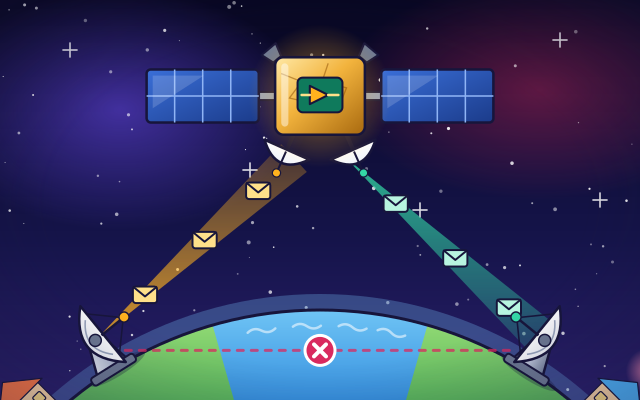
The big idea: A ground dish cannot send a signal straight to a place beyond the horizon. It sends it up to a satellite, which makes it stronger and sends it down on the other side.
It's like using a mirror to see around a corner. Light and radio travel in straight lines, so a satellite high above passes the signal on to places you cannot reach directly.
The interactive parts didn't load. The explanations below still work; try reloading the page.
How a satellite passes a message on
- You want to send a message to someone on the other side of an ocean. There is no wire in the sky and no tower tall enough. So how does it get there?
- Radio signals travel in straight lines. Aim one straight at the far dish and it runs into the curve of the Earth. The planet itself is in the way.
- The answer is to go up. A satellite sits so high that it can see both sides of the ocean at once. A big dish on the ground aims at it and sends the signal up. This is called the uplink.
- By the time the signal reaches the satellite it is very faint. The satellite catches it with one dish, makes it thousands of times stronger, and sends it out again from another dish.
- The signal comes down to a dish on the far side of the ocean. This is the downlink. The whole trip, up and down, takes about a quarter of a second.
- This kind of satellite goes around the Earth once a day, exactly as fast as the Earth turns. From the ground it seems to hang still, so dishes never have to move. Three of them can cover almost the whole world.
The parts of a communication satellite
The body of this satellite has been opened so you can see inside. Tap each part.
- Receive dish. The receive dish gathers the faint signal coming up from the ground and focuses it onto a small receiver, like a bowl catching rain.
- Transponder. The transponder is the heart of the satellite. It takes the weak signal, makes it thousands of times stronger and gets it ready to send down.
- Transmit dish. The transmit dish beams the strengthened signal back down. It is shaped to cover just the part of the Earth that needs it.
- Solar panels. The big solar panels turn sunlight into electricity. The satellite needs plenty of power to make its signals strong.
- Battery. Sometimes the Earth blocks the Sun. Then the battery keeps everything running until the sunlight comes back.
- Thrusters. Small thrusters give tiny pushes to keep the satellite in its parking place and its dishes pointing the right way.
Straight across, or up and over?
Drag the dish to aim the signal. Try pointing it straight at the far dish, then up at the satellite. Which way gets the message across?
Experiment: Can the signal go straight from one dish to the far dish across the ocean?
- Drag the dish, or use the slider, until it points flat at the far dish.
- Now swing it up toward the satellite.
- Watch the message. What route does it take?
What we found: Aimed straight at the far dish, the signal hits the curve of the Earth and is lost. Aimed at the satellite, it goes up, is caught, boosted and sent down the other side. A satellite works because it is high enough to see both dishes at once.
Turn on JavaScript to try it yourself.
Find the route
Build a route from the sender to the receiver. Tap a satellite that both can see, then tap the receiver, and press Send the message.
How satellites carry our messages
Radio signals carry television, phone calls and the internet through the air. But radio travels in straight lines, and the Earth is round. If you aim a signal at a town far beyond the horizon, it does not curve around the planet. It shoots off into space, or it runs into the ground. For a long time, the only way to send messages across an ocean was through cables on the sea floor.
A communication satellite solves the problem by being very high up. From there it can see both sides of an ocean at the same time. A ground station aims a dish at the satellite and sends its signal up. This is the uplink. The signal has a long way to go, and by the time it arrives it is very, very faint.
Inside the satellite, a device called a transponder makes the signal thousands of times stronger and sends it back down from a second dish. This is the downlink. A dish on the other side of the ocean catches it. Radio is so fast that the whole trip takes only about a quarter of a second.
Many of these satellites circle the Earth once a day, exactly in step with the turning planet. From the ground they seem to hang in one place, so a dish can be pointed once and left alone. A mirror around a corner is a good picture of this, but a mirror only bounces light. A satellite does more: it listens, strengthens the signal and sends it again.
Key words
- Uplink
- The signal sent from a ground station up to a satellite.
- Downlink
- The signal sent from a satellite down to the ground.
- Transponder
- The part of a satellite that makes a weak signal strong again and sends it back down.
- Line of sight
- A straight, clear path between two antennas with nothing, such as the Earth, in the way.
- Ground station
- A place on the ground with dishes that send signals to satellites and receive signals from them.
- Geostationary orbit
- A path around the Earth where a satellite goes around once a day, so it stays above the same place.
Check your thinking
-
Why do we need a satellite to send a signal across an ocean?
Show the answer
Radio travels in straight lines, and the curve of the Earth blocks it. A straight signal cannot follow the round Earth, so it must go up to something that can see both sides.
-
What does the satellite do to the faint signal it receives?
Show the answer
It makes it much stronger and sends it down again. The signal arrives very weak, so the transponder strengthens it before sending it down.
-
Why does a geostationary satellite seem to stay still in the sky?
Show the answer
It goes around once a day, in step with the turning Earth. It is moving very fast, but it circles exactly as quickly as the ground below it turns.
-
Sat A can see the sender but not the receiver. What can you do?
Show the answer
Use a satellite that can see both, or pass the signal on to another satellite. Every hop needs a clear straight path, so the message can only go by way of satellites that see each other.
-
A signal goes up to a satellite 35,786 kilometers high and straight back down. About how long does that take at 300,000 kilometers per second?
Show the answer
About 0.24 seconds. The path is about 71,600 kilometers, and 71,600 divided by 300,000 is about 0.24 seconds.
You're a Space & astronomy expert!
You watched, looked inside, tried it, solved the challenge and went deeper. Pick another question below, or switch the age at the top to see this topic another way.
More about space & astronomy
 #477
Space & astronomy
How do spacecraft return through the atmosphere?
Follow heating, shielding, slowing, and landing during a simulated return.
#477
Space & astronomy
How do spacecraft return through the atmosphere?
Follow heating, shielding, slowing, and landing during a simulated return.
 #478
Space & astronomy
How do reusable rockets land upright?
Adjust a model rocket's thrust and orientation to control its descent.
#478
Space & astronomy
How do reusable rockets land upright?
Adjust a model rocket's thrust and orientation to control its descent.
 #78
Space & astronomy
Why do we have day and night?
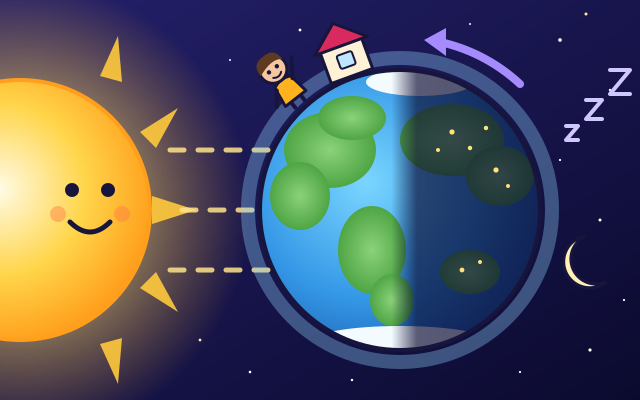
Spin a globe beside the Sun and place characters around Earth. Watch sunrise, midday, sunset, and night from different locations.
#78
Space & astronomy
Why do we have day and night?
Spin a globe beside the Sun and place characters around Earth. Watch sunrise, midday, sunset, and night from different locations.
 #79
Space & astronomy
Why do the seasons change?
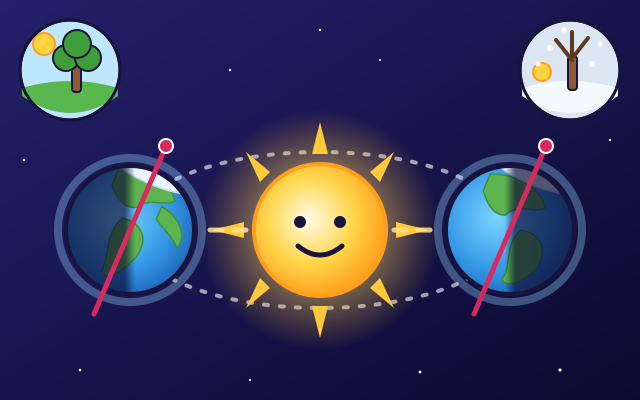
Move a tilted Earth around the Sun. Compare sunlight angle and day length in both hemispheres and follow a location through the year.
#79
Space & astronomy
Why do the seasons change?
Move a tilted Earth around the Sun. Compare sunlight angle and day length in both hemispheres and follow a location through the year.
Keep exploring
Games to play next
- Seasons and SkiesFrom days of the week to Earth's tilt: dress for the weather, read the sky and discover why seasons happen.
- Globe ExplorerSpin a real 3D globe, flip to the flat map, and find continents, oceans and countries.
- Science QuizzesOlly's Science Quiz Show: plants, animals, the body, weather, space and more, for every grade.
Guide for grown-ups
- How to start homeschooling: a step-by-step guide for familiesA guide for parents · 7 min read
Science games by grade
Science worksheets by grade
- Preschool Science Worksheets
- Pre-K Science Worksheets
- Kindergarten Science Worksheets
- 1st Grade Science Worksheets
- 2nd Grade Science Worksheets
- 3rd Grade Science Worksheets
- 4th Grade Science Worksheets
- 5th Grade Science Worksheets
- 6th Grade Science Worksheets
- 7th Grade Science Worksheets
- 8th Grade Science Worksheets