How do weather satellites observe Earth?
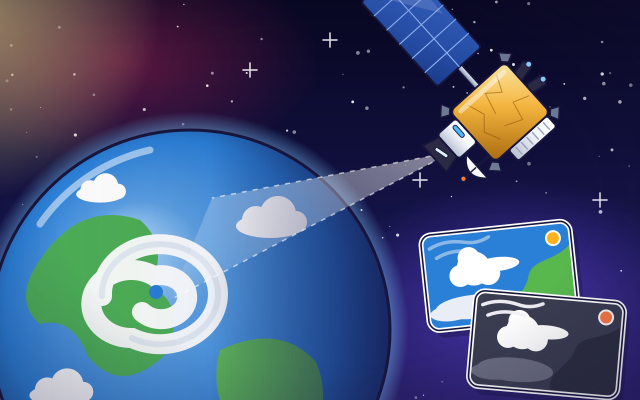
Weather satellites photograph the clouds in sunlight and in heat, again and again, so we can see where the weather is going.
The big idea: A weather satellite looks down from space with two kinds of camera: one sees sunlight bouncing off clouds, the other sees heat. A string of pictures shows how the clouds move.
It's like making a flip book. Each page is one photo of the clouds from space. Flip the pages and the clouds move, so you can guess where they go next.
The interactive parts didn't load. The explanations below still work; try reloading the page.
How satellites watch the weather
- The weather report shows swirls of cloud drifting across the map. Those pictures were not taken from a plane or a mountain. They come from much, much higher up.
- A weather satellite circles the Earth so high that it can see almost half the planet at once. This kind goes around exactly as fast as the Earth turns, so it always watches the same place.
- One camera sees the same light your eyes do. Sunlight bounces off the clouds and back up to the satellite, so thick clouds look bright white. At night there is no sunlight, and this picture goes dark.
- So the satellite has a second kind of camera that sees heat instead of light. Everything gives off heat, day and night. High clouds are very cold, and the picture shows cold things as bright white.
- The satellite takes a new picture every few minutes. Play them one after another, like a flip book, and you can see which way the clouds are moving and how fast.
- The pictures are beamed down by radio to big dishes on the ground. Forecasters study them, add measurements from the ground, and tell us what is coming. Umbrella tomorrow!
The parts of a weather satellite
This satellite looks down at the Earth below. Tap each part to see its job.
- Imager (the camera). The imager is the satellite's camera. A mirror inside rocks back and forth to sweep across the Earth, strip by strip, building up each picture.
- Solar panel. The solar panel turns sunlight into electricity to run the cameras, computers and radio. It keeps turning to face the Sun.
- Dish antenna. The dish antenna sends every picture down to Earth as radio signals, and listens for commands from the ground.
- Cooler. A heat camera cannot see well if it is warm itself. This cooler faces dark, cold space and chills the camera's sensors far below freezing.
- Thrusters. Small thrusters give gentle puffs to keep the satellite in exactly the right spot and pointing the right way.
- Star trackers. Star trackers are small cameras that look up at the stars. By matching star patterns, the satellite knows exactly which way it is pointing.
Visible or infrared?
Switch between the two cameras, by day and by night. Tap each cloud to find out why it looks the way it does. Then take more pictures and watch the clouds move.
Experiment: It is night. Which camera can still see the clouds?
- Switch on Night time and look with the visible camera.
- Now choose the infrared camera.
- Tap each cloud. Which is brightest in the heat picture, and why?
What we found: At night the visible camera sees nothing, because there is no sunlight to bounce off the clouds. The infrared camera still works, because everything gives off heat all the time. It shows cold things as bright, so the tall storm cloud and the high, wispy cloud stand out, while the low cloud almost disappears.
Turn on JavaScript to try it yourself.
Track the storm
The dotted clouds show the storm in the earlier pictures. Tap the square where it will be in the next picture, then take the picture to check.
How weather satellites see the clouds
From the ground you can see only the clouds above your own town. A weather satellite looks down from space and sees the clouds over a whole ocean or continent in one picture. Some weather satellites sit about 36,000 kilometers up and go around exactly as fast as the Earth turns, so they stay over the same place and watch it all day and all night.
The satellite carries two kinds of camera. The visible camera sees sunlight that bounces off the clouds, just as your eyes would. Thick clouds bounce back a lot of light, so they look bright white. This camera gives sharp, clear pictures, but only while the Sun is shining on the clouds. At night its pictures are dark.
The infrared camera sees heat instead of light. Everything gives off heat all the time, so this camera works at night too. Its pictures show cold things as bright and warm things as dark. The higher you go, the colder the air gets, so a very bright cloud in a heat picture is a very tall one. Tall clouds often bring the heaviest rain and storms.
The satellite takes a new picture every few minutes. Put the pictures one after another, like the pages of a flip book, and the clouds seem to move. Forecasters measure how far and how fast a storm has traveled and work out where it will be in a few hours. A flip book is not a perfect comparison, though: its pages are drawn by hand, while the satellite's pictures are careful measurements.
Key words
- Satellite
- An object that travels around a planet. Weather satellites are machines that people have put into orbit around the Earth.
- Orbit
- The path a satellite follows around the Earth.
- Geostationary
- Going around once a day, in step with the Earth, so the satellite stays above the same place.
- Visible light
- The light our eyes can see. A visible picture shows sunlight that has bounced off clouds, land and sea.
- Infrared
- Heat rays that our eyes cannot see. Everything gives them off, day and night.
- Channel
- One band of wavelengths that the imager records, such as a visible band or an infrared band.
Check your thinking
-
What does a weather satellite do?
Show the answer
It takes pictures of the clouds from space, again and again. A satellite only watches. Its pictures show forecasters where the clouds are and where they are heading.
-
Why is the visible picture dark at night?
Show the answer
There is no sunlight to bounce off the clouds. The visible camera needs sunlight. The clouds are still there, and the infrared camera can see them.
-
A storm moved two squares east between each pair of pictures. Where will it be in the next picture?
Show the answer
Two more squares to the east. A storm usually keeps going the same way at the same speed for a while, so it takes the same step again.
-
In a heat (infrared) picture, one cloud looks very bright. What does that tell you?
Show the answer
Its top is very cold, so it is very high. Heat pictures show cold things as bright, and the air is colder the higher you go.
-
A low cloud sheet is easy to see in visible light but hard to see in infrared. Why?
Show the answer
Its top is nearly as warm as the surface below it. Infrared shows temperature differences. A low cloud is almost the same temperature as the sea or land under it, so it hardly stands out.
You're a Space & astronomy expert!
You watched, looked inside, tried it, solved the challenge and went deeper. Pick another question below, or switch the age at the top to see this topic another way.
More about space & astronomy
 #475
Space & astronomy
How do communication satellites relay signals?
Route a message through ground stations and a satellite to a distant receiver.
#475
Space & astronomy
How do communication satellites relay signals?
Route a message through ground stations and a satellite to a distant receiver.
 #477
Space & astronomy
How do spacecraft return through the atmosphere?
Follow heating, shielding, slowing, and landing during a simulated return.
#477
Space & astronomy
How do spacecraft return through the atmosphere?
Follow heating, shielding, slowing, and landing during a simulated return.
 #478
Space & astronomy
How do reusable rockets land upright?
Adjust a model rocket's thrust and orientation to control its descent.
#478
Space & astronomy
How do reusable rockets land upright?
Adjust a model rocket's thrust and orientation to control its descent.
 #78
Space & astronomy
Why do we have day and night?
Spin a globe beside the Sun and place characters around Earth. Watch sunrise, midday, sunset, and night from different locations.
#78
Space & astronomy
Why do we have day and night?
Spin a globe beside the Sun and place characters around Earth. Watch sunrise, midday, sunset, and night from different locations.
Keep exploring
Games to play next
- Seasons and SkiesFrom days of the week to Earth's tilt: dress for the weather, read the sky and discover why seasons happen.
- Globe ExplorerSpin a real 3D globe, flip to the flat map, and find continents, oceans and countries.
- Science QuizzesOlly's Science Quiz Show: plants, animals, the body, weather, space and more, for every grade.
Guide for grown-ups
- How to start homeschooling: a step-by-step guide for familiesA guide for parents · 7 min read
Science games by grade
Science worksheets by grade
- Preschool Science Worksheets
- Pre-K Science Worksheets
- Kindergarten Science Worksheets
- 1st Grade Science Worksheets
- 2nd Grade Science Worksheets
- 3rd Grade Science Worksheets
- 4th Grade Science Worksheets
- 5th Grade Science Worksheets
- 6th Grade Science Worksheets
- 7th Grade Science Worksheets
- 8th Grade Science Worksheets