How do objects stay balanced without tipping?
Every object has a balance point. Keep it over the base and the object stands. Let it pass the edge and over it goes.
The big idea: An object stays standing while its balance point, called the center of mass, is above its base. If the balance point moves past the edge of the base, the object tips over.
It's like standing on one foot: you stay up while your middle is over your foot. Lean until your middle passes the edge of your foot and you start to fall.
The interactive parts didn't load. The explanations below still work; try reloading the page.
Why do some things tip over?
- A tall, thin tower of blocks wobbles at the lightest touch. A low, wide pile of the same blocks hardly moves. What makes one steady and the other tippy?
- Every object has a balance point. Put a finger under that one spot and the whole ruler stays level. Scientists call it the center of mass.
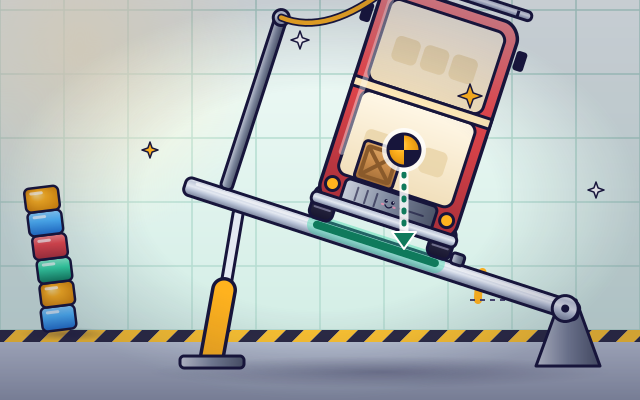
- A toy bus stands on a test table. The space between its wheels is its base. Gravity pulls straight down from the balance point, and that line lands inside the base, so the bus stands.
- Tilt the table. The pull of gravity still points straight down, so the line slides toward the lower wheels. It is still inside the base, so the bus would rock back if you let go.
- Tilt further and the line passes the lower wheels. Now gravity turns the bus the other way, and it tips. A safety strap catches it.
- A low, wide race car can lean a long way, because its balance point is low and its wheels are far apart. Put a heavy box on the roof of the bus and it tips much sooner.
Look inside a tilt test
Real buses are tested on a tilting table. Tap each part of this model test to see what it does.
- Balance point. This mark shows the balance point, or center of mass. The bus behaves as if all its weight were packed into this one spot.
- Line of gravity. Gravity always pulls straight down from the balance point, no matter how the bus leans. This line shows where that pull lands.
- Base. The base is the area between the wheels. While the line of gravity lands inside it, the bus is safe.
- Tipping edge. The downhill wheels are the edge the bus would tip over. When the line of gravity passes them, the uphill wheels lift off.
- Heavy parts, down low. Engineers put the heaviest parts, like the engine, the batteries and the frame, as low as they can. That pulls the balance point down.
- Light top deck. The upper deck is built from light materials. For the real test it is loaded with weights for passengers upstairs, the tippiest way to load a bus.
- Tilt table. A strong jack lifts one side of the table very slowly. A scale shows the angle, and a rail stops the wheels from sliding.
- Safety strap. A loose strap catches the bus as soon as its wheels lift, so the test never ends in a crash.
Tilt table test
Tap a spot in the bus to put the heavy box there. Then drag the handle to tilt the table. Watch the balance point and its line.
Experiment: Where should the heavy box go so the bus can lean the furthest without tipping?
- Put the box on the roof. Tilt the table slowly until the bus tips. Note the angle.
- Lower the table and put the box on the bottom deck. Tilt again.
- Which one leaned further? Try the race car too.
What we found: With the heavy box down low, the balance point is low and the bus can lean much further. With the box on the roof the balance point is high, so its line passes the wheels at a small angle and the bus tips early. The low, wide race car hardly tips at all.
Turn on JavaScript to try it yourself.
Pass the tilt test
Load all three boxes into the bus, then run the tilt test. The bus must lean to 28 degrees without tipping. Lean further for more stars.
Balance points and bases
Every object, from a pencil to a bus, has a balance point. If you could hold the object up at exactly that spot, it would not tip either way. Scientists call it the center of mass. For a ruler it is in the middle. For a hammer it is close to the heavy head.
Gravity pulls on every part of an object, but the result is the same as one pull, straight down, from the balance point. Now think about the base, the area between the points where the object touches the ground. For you, it is the space under and between your feet. For a bus, it is the space between its wheels.
Here is the rule. If the pull of gravity lands inside the base, the object stays standing or rocks back. If it lands outside the base, the object tips over. Tilting an object slides the landing spot toward the edge. The angle at which it reaches the edge is called the tipping angle.
That gives two ways to make something hard to tip. Keep the balance point low by putting heavy parts at the bottom, and make the base wide. A race car does both. Standing on one foot is the same idea, with one difference: you can move your arms and bend to shift your balance point, but a bus cannot.
Key words
- Center of mass
- The balance point of an object, where all its weight seems to act.
- Base of support
- The area between the places where an object touches the ground.
- Line of gravity
- An imaginary line straight down from the center of mass.
- Tipping angle
- How far something can lean before it falls over.
- Stable
- Able to return to its position after a small push.
Check your thinking
-
Where is the best place for heavy luggage on a bus?
Show the answer
Down low, under the floor. Weight down low keeps the balance point low, so the bus can lean further before it tips.
-
Which of these is hardest to tip over?
Show the answer
A low, wide race car. The race car has a low balance point and wheels far apart, so it has to lean a very long way before it tips.
-
You tilt a toy bus. When exactly does it start to tip over?
Show the answer
When the line straight down from its balance point passes its lowest wheels. While the line lands between the wheels the bus rocks back. Once it passes the edge, gravity pulls the bus over.
-
A model's center of mass is 40 cm above the table and 40 cm sideways from its tipping edge. What is its tipping angle?
Show the answer
About 45 degrees. tan(angle) = d / h = 40 / 40 = 1, and the angle whose tangent is 1 is 45 degrees.
-
Why do you spread your feet apart on a bumpy bus ride?
Show the answer
A wider base makes you harder to tip. With your feet apart your base is wider, so your balance point has further to go before it passes the edge.
You're a Forces & mechanisms expert!
You watched, looked inside, tried it, solved the challenge and went deeper. Pick another question below, or switch the age at the top to see this topic another way.
More about forces & mechanisms
 #178
Forces & mechanisms
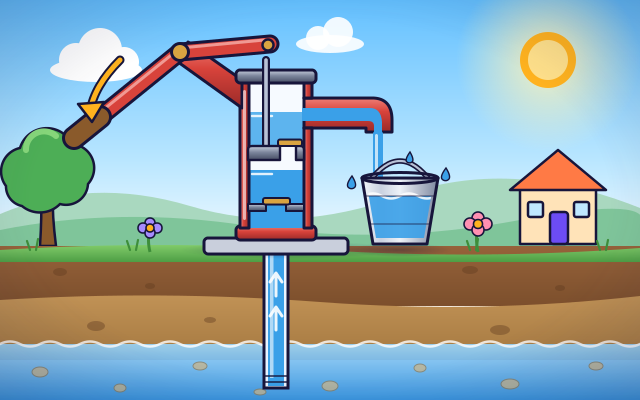
How does a hand pump raise water?
Move a handle and follow water through a cylinder and one-way valves.
#178
Forces & mechanisms
How does a hand pump raise water?
Move a handle and follow water through a cylinder and one-way valves.
 #179
Forces & mechanisms
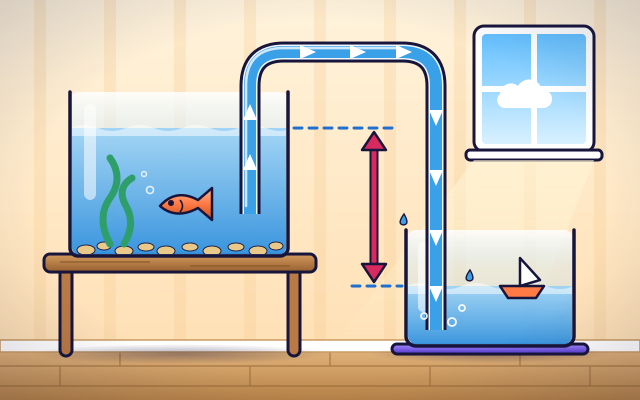
How does a siphon move water between containers?
Connect virtual containers and investigate how differences in water level drive flow.
#179
Forces & mechanisms
How does a siphon move water between containers?
Connect virtual containers and investigate how differences in water level drive flow.
 #197
Forces & mechanisms
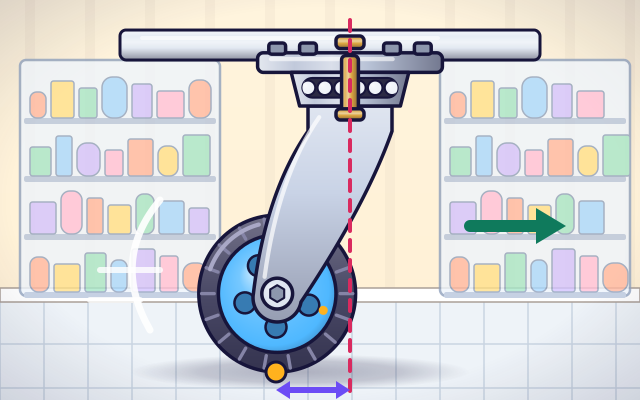
How do shopping-cart wheels swivel into position?
Push a model cart and watch offset caster wheels follow changes in direction.
#197
Forces & mechanisms
How do shopping-cart wheels swivel into position?
Push a model cart and watch offset caster wheels follow changes in direction.
 #103
Forces & mechanisms
How do levers help us lift heavy objects?
Move the pivot point and compare the effort needed to lift different loads.
#103
Forces & mechanisms
How do levers help us lift heavy objects?
Move the pivot point and compare the effort needed to lift different loads.
Keep exploring
Games to play next
- Marble MountainLay straights, curves, drops and splitters to roll marbles down the mountain.
- Machine RepairFix levers, pulleys, gears and ramps so every contraption works.
- Bridge LabBuild a bridge from beams, brace it with triangles, and stay on budget.
Guide for grown-ups
- How to start homeschooling: a step-by-step guide for familiesA guide for parents · 7 min read
Science games by grade
Science worksheets by grade
- Preschool Science Worksheets
- Pre-K Science Worksheets
- Kindergarten Science Worksheets
- 1st Grade Science Worksheets
- 2nd Grade Science Worksheets
- 3rd Grade Science Worksheets
- 4th Grade Science Worksheets
- 5th Grade Science Worksheets
- 6th Grade Science Worksheets
- 7th Grade Science Worksheets
- 8th Grade Science Worksheets