How do shopping-cart wheels swivel into position?
A shopping-cart wheel is not steered by anyone. A small offset makes it swing round and follow all by itself.
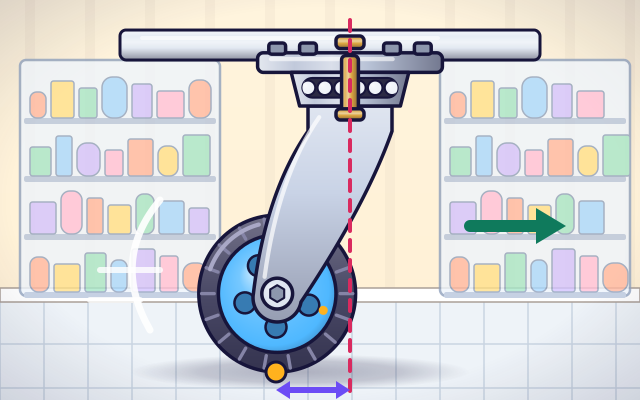
The big idea: A caster wheel touches the floor a little behind the pin it swivels on. When you push the cart, the floor drags the wheel back, so it swings round and trails behind the pin, pointing the way you are going.
It's like pulling a toy on a string: whichever way you walk, the toy swings round and follows behind your hand.
The interactive parts didn't load. The explanations below still work; try reloading the page.
Why cart wheels swivel
- Sam pushes a shopping cart down the aisle. Nobody steers its little wheels, yet they always point the right way. How do they do it?
- Look closely. The fork swivels on an upright pin. But the wheel is not straight under the pin. It touches the floor a little way behind it. That gap is the secret.
- From above: the cart pushes the pin forward. The floor grips the wheel and holds it back. So the wheel swings round until it trails behind the pin.
- When the cart changes direction, the same thing happens again. Each wheel is dragged round behind its pin, and all four line up with the new path.
- Have you met a cart with one wobbly wheel? A loose or worn caster swings past the middle, then back, again and again. That fast wobble is called shimmy.
- Casters are everywhere: office chairs, suitcases, hospital beds and pianos. Each one has a wheel that sits behind its pin, so it follows wherever you push.
Look inside a caster
Tap each part of the caster. Watch what it does when you find it.
- Top plate. The top plate is bolted to the bottom of the cart. Everything else hangs from it.
- Swivel bearing. A ring of small steel balls sits between the plate and the fork. The balls roll, so the fork can swivel easily, even with a heavy load on top.
- Kingpin (swivel pin). The kingpin is the upright pin in the middle. The whole fork turns around it, like a door turning on its hinge.
- Fork. The fork holds the wheel on both sides. It leans backward from the pin. That lean is what puts the wheel behind the pin.
- Axle. The axle is a bolt through the middle of the wheel. The wheel spins on it so the cart can roll.
- Wheel. The wheel has a grippy rim. It rolls easily forward but does not like sliding sideways. That sideways grip is what swings it round.
- Offset (trail). This gap is the offset. Because the wheel touches the floor behind the pin, the floor can drag it round. No offset, no following!
Does the offset matter?
Push the cart in different directions and watch the wheels in the magnifier. Then change the offset. What happens with no offset at all?
Experiment: What happens if the wheel sits right under its pin, with no offset?
- With the offset in the middle, push the cart forward, then sideways. Watch the wheels swing.
- Slide the offset down to zero and push sideways again.
- Look in the magnifier. Did the wheel turn?
What we found: With an offset, the floor drags the wheel round behind its pin every time the cart changes direction. With no offset, there is nothing for the floor to pull on, so the wheel stays where it is and skids sideways.
Turn on JavaScript to try it yourself.
Fix the wobbly cart
Set up the casters so the cart glides round every corner to the checkout without skidding.
How a caster finds its way
A caster is a wheel that steers itself. It has two ways of turning. The wheel spins on its axle so the cart can roll. And the whole fork swivels on an upright pin, called the kingpin, so the wheel can point in any direction.
The trick is where the wheel touches the floor. It is not straight under the pin. It is a little way behind it. That gap is called the offset. When you push the cart, the pin moves forward, but the floor grips the bottom of the wheel. Because the grip is behind the pin, it pulls the wheel round, just as a toy on a string swings round to follow your hand.
Once the wheel is trailing straight behind the pin, the floor is not pulling it to either side any more, so it stays there. Change direction and the wheel is dragged round again. This is why you can push a shopping cart forward, sideways or in a circle, and the wheels always follow. The toy-on-a-string picture is not perfect: a string can only pull, while the fork is stiff, so a caster also works when the cart is pushed.
Casters do go wrong. If the swivel is rusty or tangled with thread, the wheel cannot turn, so it skids and the cart pulls to one side. If the swivel is worn and loose, the wheel can flap quickly from side to side. Engineers call that wobble shimmy.
Key words
- Caster
- A wheel mounted on a fork that can swivel freely, so it follows the direction it is pushed.
- Kingpin
- The upright pin that the caster's fork swivels around.
- Offset (trail)
- The gap between the swivel pin and the spot where the wheel touches the floor.
- Friction
- The grip between the wheel and the floor that resists sliding.
- Torque
- A turning effect: a force multiplied by its distance from the pivot.
- Shimmy
- A fast side-to-side wobble of a loose or worn caster.
Check your thinking
-
Where does a caster wheel touch the floor?
Show the answer
A little behind the swivel pin. The fork leans back, so the wheel meets the floor behind the pin.
-
You push the cart in a new direction. What makes the wheels swing round?
Show the answer
The floor drags each wheel round behind its pin. The floor grips the wheel behind the pin, and that grip pulls the wheel into line.
-
What would happen if the wheel sat exactly under its pin?
Show the answer
It would not swing round, so it would skid sideways. With no gap, the floor has nothing to pull on, so the wheel is not turned.
-
A cart keeps pulling to one side. What is the most likely reason?
Show the answer
One wheel's swivel is stuck, so it cannot turn to follow. A stuck swivel holds the wheel crooked, so it drags the cart sideways.
-
A designer doubles the trail of a caster. In the simplified model, how does the distance needed to line up change?
Show the answer
It roughly doubles. The misalignment shrinks according to distance rolled divided by trail, so twice the trail needs about twice the distance.
-
Which of these usually rolls on casters?
Show the answer
An office chair. An office chair must roll in any direction, so it uses swivel casters.
You're a Forces & mechanisms expert!
You watched, looked inside, tried it, solved the challenge and went deeper. Pick another question below, or switch the age at the top to see this topic another way.
More about forces & mechanisms
 #103
Forces & mechanisms
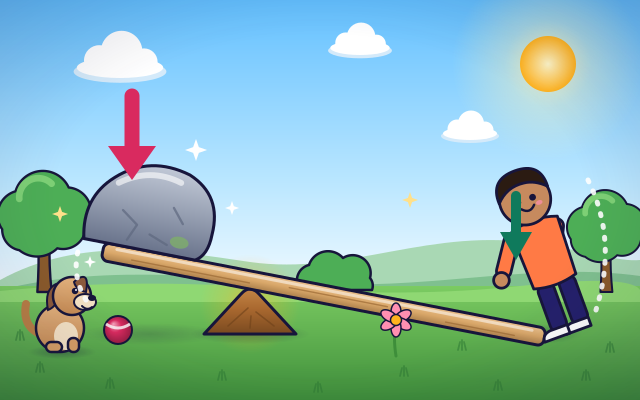
How do levers help us lift heavy objects?
Move the pivot point and compare the effort needed to lift different loads.
#103
Forces & mechanisms
How do levers help us lift heavy objects?
Move the pivot point and compare the effort needed to lift different loads.
 #104
Forces & mechanisms
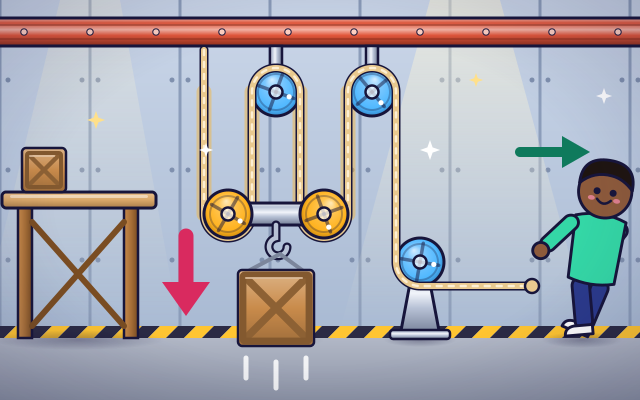
How do pulleys make lifting easier?
Thread ropes through virtual pulleys and compare pulling distance with lifting effort.
#104
Forces & mechanisms
How do pulleys make lifting easier?
Thread ropes through virtual pulleys and compare pulling distance with lifting effort.
 #105
Forces & mechanisms
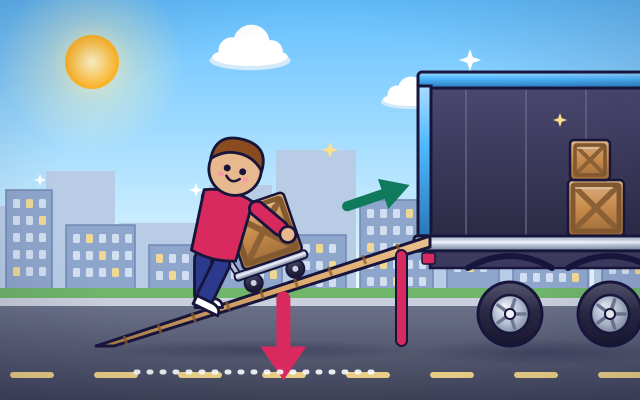
How do ramps reduce lifting effort?
Change a ramp's slope and compare pushing force, travel distance, and height gained.
#105
Forces & mechanisms
How do ramps reduce lifting effort?
Change a ramp's slope and compare pushing force, travel distance, and height gained.
 #106
Forces & mechanisms
How do wedges split or separate materials?
Push different wedge shapes into model materials and watch forces move the sides apart.
#106
Forces & mechanisms
How do wedges split or separate materials?
Push different wedge shapes into model materials and watch forces move the sides apart.
Keep exploring
Games to play next
- Machine RepairFix levers, pulleys, gears and ramps so every contraption works.
- Marble MountainLay straights, curves, drops and splitters to roll marbles down the mountain.
- Bridge LabBuild a bridge from beams, brace it with triangles, and stay on budget.
Guide for grown-ups
- How to start homeschooling: a step-by-step guide for familiesA guide for parents · 7 min read
Science games by grade
Science worksheets by grade
- Preschool Science Worksheets
- Pre-K Science Worksheets
- Kindergarten Science Worksheets
- 1st Grade Science Worksheets
- 2nd Grade Science Worksheets
- 3rd Grade Science Worksheets
- 4th Grade Science Worksheets
- 5th Grade Science Worksheets
- 6th Grade Science Worksheets
- 7th Grade Science Worksheets
- 8th Grade Science Worksheets