How do ball bearings help wheels turn smoothly?
Hidden in the middle of a wheel, a ring of steel balls swaps hard rubbing for easy rolling.
The big idea: When two things rub, they grip and slow each other down. A ball bearing puts rolling balls between the wheel and its axle, so almost nothing rubs.
It's like sliding a heavy box across the floor, then resting it on a tray of marbles: the marbles roll, so the box glides with a gentle push.
The interactive parts didn't load. The explanations below still work; try reloading the page.
The balls inside a wheel
- One push, and a skateboard glides a long way. Its wheels spin so freely! The secret is a small metal ring hidden in the middle of each wheel.
- Try sliding a heavy load across the floor. The two surfaces rub and grip each other. That grip is called friction, and it fights your push all the way.
- Put the same load on wheels and the same push sends it gliding. Rolling things do not drag across the floor. They step over the bumps instead of scraping through them.
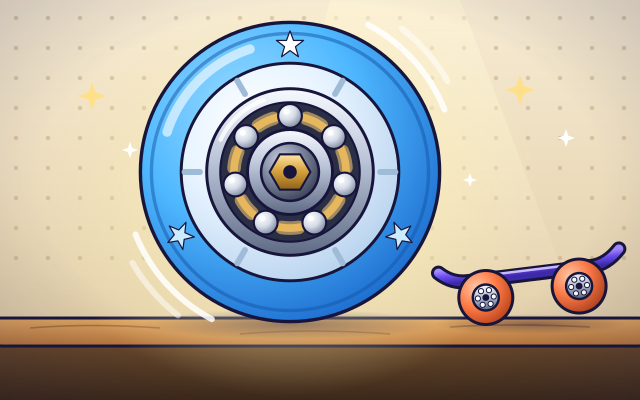
- But a wheel still rubs where it meets its axle. So engineers put rolling balls there too, lined up in a circle between two smooth steel rings.
- The inner ring grips the axle and stays still. The outer ring turns with the wheel. The balls roll between them, and a cage keeps the balls evenly spaced.
- Give two wheels the same spin. The wheel that rubs on its axle soon stops. The wheel with a ball bearing keeps spinning for a long, long time.
Look inside a skateboard wheel
Tap each part of the wheel and its bearing. Watch what moves and what stays still!
- Wheel. The wheel itself is tough, slightly squishy plastic. It rolls on the ground and turns around the axle.
- Outer ring. The outer ring is fixed inside the wheel, so it spins with it. Its inside is a smooth groove for the balls to roll in.
- Steel balls. These hard steel balls do the clever part. They roll between the two rings, so the wheel rolls around the axle instead of rubbing on it.
- Cage. The cage is a thin ring with a pocket for each ball. It keeps the balls evenly spaced so they never bump and rub against each other.
- Inner ring. The inner ring fits tightly on the axle and does not turn. Its outside has a groove for the balls, just like the outer ring.
- Axle. The axle is the steel rod the wheel sits on. A nut on the end stops the wheel from sliding off. The axle does not spin.
- Grease. A little slippery grease or oil coats the balls. It keeps metal from scraping metal and stops rust.
- Shield. A thin cover called a shield sits over the balls. It keeps sand and dirt out, and keeps the grease in.
Slide it or roll it?
Give both loads the same push. One slides on the floor and one rolls on wheels with ball bearings. Then make the load heavier and push again.
Experiment: You add more boxes to both loads. Which one gets much harder to move?
- Start with 1 box on each. Press Push! and watch how far each goes.
- Now choose 3 boxes and press Push! again.
- Look at the red rubbing arrows. Which one grew bigger than the push?
What we found: More weight presses the sled harder onto the floor, so rubbing grows until the sled will not budge. The cart's wheels roll on ball bearings, so its rubbing stays tiny and it still rolls away.
Turn on JavaScript to try it yourself.
Skateboard tune-up
Two wheels have a problem. Spin each wheel, look closely, and choose the right fix for each one.
Why rolling beats rubbing
Rub your hands together quickly. They get warm! Whenever two things slide against each other, they grip a little, and the grip is called friction. Friction slows moving things and turns their movement into heat.
Even surfaces that look smooth are covered in tiny bumps. When one slides over another, the bumps catch. The harder the surfaces are pressed together, the more they catch. That is why a heavy box is harder to slide than a light one.
A ball does something different. It does not scrape over the bumps. It rolls onto them and off again. A ball bearing uses that trick where a wheel meets its axle. The wheel sits on the outer ring, the axle holds the inner ring, and hard steel balls roll between them.
Bearings need care. A little oil or grease keeps them slippery, and a shield keeps out sand. Our marble comparison is not perfect: loose marbles roll away, but the balls in a bearing are trapped in grooves and held apart by a cage, so they stay exactly where they are needed.
Key words
- Friction
- The grip between two things that are touching. It slows sliding and makes heat.
- Ball bearing
- Two steel rings with hard balls rolling between them, so a wheel can turn around an axle with very little friction.
- Race
- One of the grooved rings in a bearing that the balls roll on.
- Load
- The weight pressing down on something.
- Lubricant
- Oil or grease that keeps moving parts from scraping against each other.
Check your thinking
-
Why is a load on wheels easier to push than a load on a sled?
Show the answer
Rolling does not drag the surfaces across each other. The weight is the same. Rolling just avoids the scraping that makes friction.
-
In a skateboard wheel, which part of the bearing stays still?
Show the answer
The inner ring, on the axle. The inner ring grips the axle. The outer ring turns with the wheel, and the balls roll between.
-
You pile more boxes onto a sliding sled. What happens to the rubbing?
Show the answer
It gets stronger, because the sled presses harder on the floor. More weight squeezes the surfaces together, so their bumps catch more.
-
What is the cage in a ball bearing for?
Show the answer
To keep the balls evenly spaced so they do not rub each other. Balls that touch would scrape against each other. The cage gives each one its own pocket.
-
A 400 N load rides on a ball-bearing cart with an effective friction coefficient of 0.02. About what force keeps it moving?
Show the answer
About 8 N. F = μN = 0.02 × 400 N = 8 N. Sliding the same load at μ = 0.4 would take 160 N.
-
Sand gets inside a bearing. What happens?
Show the answer
It scratches the balls and rings, so the wheel no longer spins smoothly. Hard grains act like sandpaper on the smooth steel. That is why bearings have shields.
You're a Forces & mechanisms expert!
You watched, looked inside, tried it, solved the challenge and went deeper. Pick another question below, or switch the age at the top to see this topic another way.
More about forces & mechanisms
 #113
Forces & mechanisms
How do flywheels keep machines running smoothly?
Add a flywheel to a jerky mechanism and observe changes in rotational speed.
#113
Forces & mechanisms
How do flywheels keep machines running smoothly?
Add a flywheel to a jerky mechanism and observe changes in rotational speed.
 #114
Forces & mechanisms
How do mechanical linkages transfer movement?
Connect pivoting bars and change their lengths to create different movements.
#114
Forces & mechanisms
How do mechanical linkages transfer movement?
Connect pivoting bars and change their lengths to create different movements.
 #115
Forces & mechanisms
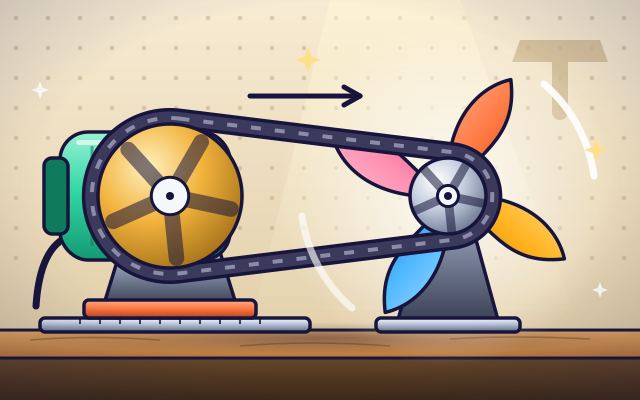
How do belts transfer power between wheels?
Link rotating wheels with belts and investigate speed changes, tension, and slipping.
#115
Forces & mechanisms
How do belts transfer power between wheels?
Link rotating wheels with belts and investigate speed changes, tension, and slipping.
 #116
Forces & mechanisms
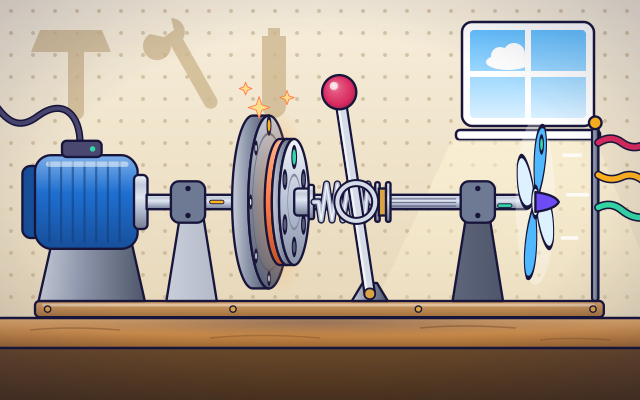
How do clutches connect and disconnect moving parts?
Engage model friction plates to connect a spinning shaft to another mechanism.
#116
Forces & mechanisms
How do clutches connect and disconnect moving parts?
Engage model friction plates to connect a spinning shaft to another mechanism.
Keep exploring
Games to play next
- Marble MountainLay straights, curves, drops and splitters to roll marbles down the mountain.
- Machine RepairFix levers, pulleys, gears and ramps so every contraption works.
- Bridge LabBuild a bridge from beams, brace it with triangles, and stay on budget.
Guide for grown-ups
- How to start homeschooling: a step-by-step guide for familiesA guide for parents · 7 min read
Science games by grade
Science worksheets by grade
- Preschool Science Worksheets
- Pre-K Science Worksheets
- Kindergarten Science Worksheets
- 1st Grade Science Worksheets
- 2nd Grade Science Worksheets
- 3rd Grade Science Worksheets
- 4th Grade Science Worksheets
- 5th Grade Science Worksheets
- 6th Grade Science Worksheets
- 7th Grade Science Worksheets
- 8th Grade Science Worksheets