How do mechanical linkages transfer movement?
Join stiff bars with pins and one kind of movement turns into another: round and round becomes back and forth.
The big idea: A linkage is a set of stiff bars joined by pins called pivots. Moving one bar makes the others move, and the lengths of the bars decide what kind of movement comes out.
It's like your arm: stiff bones joined at your shoulder and elbow. Move one bone and the next one has to follow.
The interactive parts didn't load. The explanations below still work; try reloading the page.
Bars and pins that pass on a movement
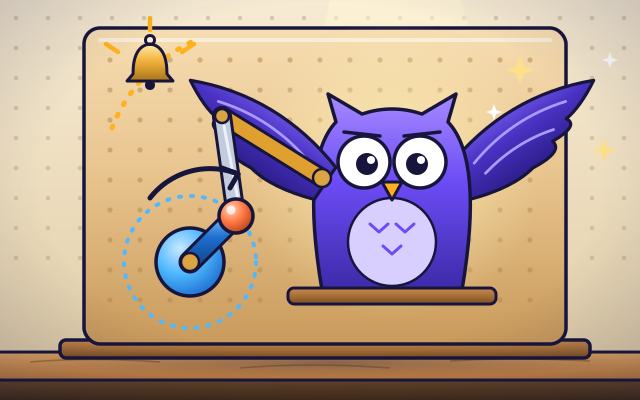
- Turn the handle of this wooden toy and the owl flaps its wings. The handle goes round and round, but the wings go up and down. How?
- Start with one stiff bar held to the board by a pin. The pin is called a pivot. The bar cannot leave it, but it can swing around it.
- A short bar that can turn all the way round its pivot is called a crank. Its free end travels in a circle.
- Now join the crank to the long bar with a third bar. As the crank's end goes round, this link pushes the long bar up and pulls it back down.
- The long bar is pinned too, so it cannot go round. It can only rock back and forth. Turning has become rocking. Count the bars: three that move, plus the board that holds the pins.
- Now change one length. A short crank makes a small circle and a small flap. A longer crank makes a bigger circle and a much bigger flap.
Look at the parts of a linkage
Tap each part of the owl toy and watch how it moves.
- Handle. The handle is where you put the movement in. Your hand turns it round and round.
- Crank. The crank is the shortest bar. One end is pinned to the board and the other end swings round in a full circle.
- Connecting link. The connecting link joins the moving end of the crank to the wing bar. It is not pinned to the board, so it both slides and tilts as it pushes and pulls.
- Wing bar. The wing bar is called a rocker. It is pinned at the owl's shoulder, so it cannot go round. It can only rock up and down.
- Pivots. Every joint is a pin called a pivot. A pivot keeps two bars joined at one spot but lets them turn freely.
- Board (frame). The board holds the crank's pin and the wing's pin in place. It never moves, but it counts as one of the four bars!
- Wing. The wing is fixed to the wing bar, so it flaps with it. A long wing makes the small rocking of the bar look big at the tip.
Change the bars, change the flap
Drag the handle or let it turn. Change the length of the crank and the wing bar, and watch how the flap changes.
Experiment: What happens to the flap if you make the crank longer?
- Set the crank to its shortest. Watch how far the wing tip moves.
- Make the crank longer, a step at a time.
- Keep going. What happens when the crank is very long?
What we found: A longer crank carries its pin around a bigger circle, so the link pushes and pulls the wing bar farther: a bigger flap. But if the crank is too long, the bars cannot reach, and the toy jams.
Turn on JavaScript to try it yourself.
Ring both bells
Make the wing tip reach the top bell and the bottom bell. The crank must still turn all the way round.
How linkages change movement
A linkage is made of stiff bars joined by pins. Because the bars cannot bend or stretch, moving one of them forces the others to move too. The pins, called pivots, let the bars turn but keep them joined.
The most useful linkage has four bars. In the owl toy, the crank is one, the connecting link is two, the wing bar is three, and the board that holds the two fixed pins is the fourth. Turn the crank, and there is only one way the other bars can move.
The lengths decide everything. A longer crank gives a bigger flap. A longer wing bar gives a smaller one. A longer link moves the whole flap higher. If the lengths do not fit together, the bars pull into a straight line and the crank jams.
Linkages are everywhere: windshield wipers, folding chairs, scissor lifts, bicycle brakes, desk lamps and the legs of walking toys. Your arm is a good comparison, but not a perfect one. Your muscles can steer your arm along many paths, while a four-bar linkage can only ever follow one.
Key words
- Linkage
- Stiff bars joined by pivots so that moving one bar moves the others.
- Pivot
- A pin that joins two parts and lets them turn.
- Crank
- A link that turns all the way round its fixed pivot.
- Rocker
- A link that can only swing back and forth about its fixed pivot.
- Grashof condition
- A link can rotate fully only if the shortest plus the longest link is no longer than the other two added together.
Check your thinking
-
What does a pivot do?
Show the answer
It joins two bars but lets them turn. A pivot is a pin: the bars stay joined at that spot and are free to turn around it.
-
How can you make the owl's wings flap farther?
Show the answer
Use a longer crank. A longer crank moves its pin in a bigger circle, so it pushes and pulls the wing bar farther. Turning faster only makes the same flap happen more often.
-
The crank goes round and round. Why does the wing bar only rock back and forth?
Show the answer
It is pinned to the board, and the link cannot carry it all the way round. The wing bar must stay on its own pin, and the bars are the wrong lengths for it to swing right round. So it rocks.
-
You make the crank much too long. What happens?
Show the answer
The bars cannot reach, so the toy jams. The bars are stiff. If the crank pulls farther than the other bars can stretch, everything locks.
-
Why is the frame counted as one of the four links?
Show the answer
The distance between its two fixed pivots constrains the motion like any other link length. The loop is closed by the fixed distance between the two frame pivots. Change that distance and the motion changes.
You're a Forces & mechanisms expert!
You watched, looked inside, tried it, solved the challenge and went deeper. Pick another question below, or switch the age at the top to see this topic another way.
More about forces & mechanisms
 #115
Forces & mechanisms
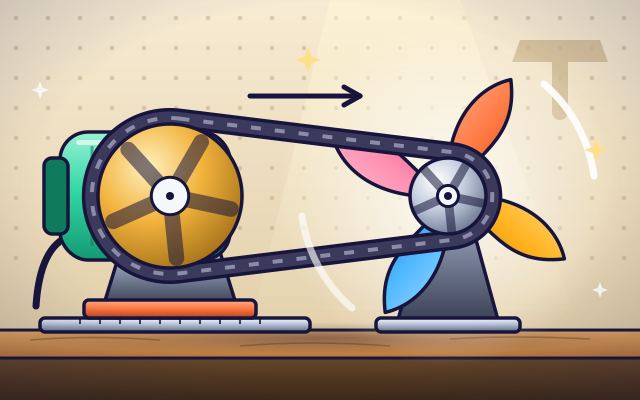
How do belts transfer power between wheels?
Link rotating wheels with belts and investigate speed changes, tension, and slipping.
#115
Forces & mechanisms
How do belts transfer power between wheels?
Link rotating wheels with belts and investigate speed changes, tension, and slipping.
 #116
Forces & mechanisms
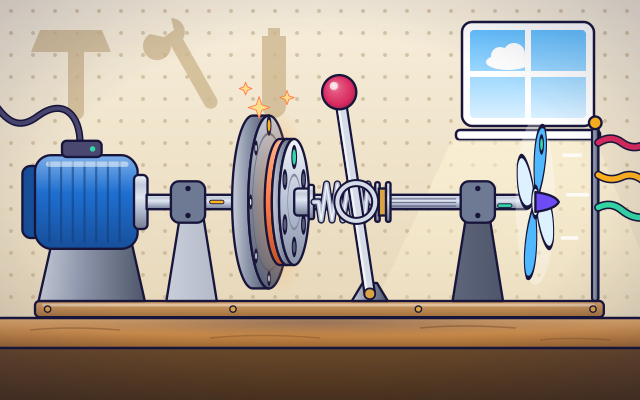
How do clutches connect and disconnect moving parts?
Engage model friction plates to connect a spinning shaft to another mechanism.
#116
Forces & mechanisms
How do clutches connect and disconnect moving parts?
Engage model friction plates to connect a spinning shaft to another mechanism.
 #117
Forces & mechanisms
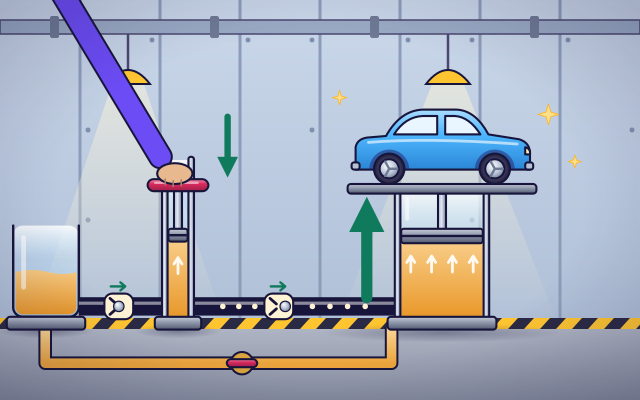
How do hydraulic systems multiply force?
Connect different-sized pistons with liquid and compare force with distance traveled.
#117
Forces & mechanisms
How do hydraulic systems multiply force?
Connect different-sized pistons with liquid and compare force with distance traveled.
 #118
Forces & mechanisms
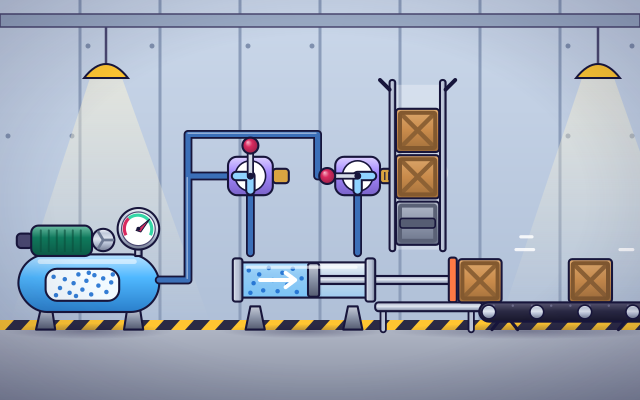
How do pneumatic machines use compressed air?
Route air through valves to extend and retract a model machine's piston.
#118
Forces & mechanisms
How do pneumatic machines use compressed air?
Route air through valves to extend and retract a model machine's piston.
Keep exploring
Games to play next
- Machine RepairFix levers, pulleys, gears and ramps so every contraption works.
- Marble MountainLay straights, curves, drops and splitters to roll marbles down the mountain.
- Bridge LabBuild a bridge from beams, brace it with triangles, and stay on budget.
Guide for grown-ups
- How to start homeschooling: a step-by-step guide for familiesA guide for parents · 7 min read
Science games by grade
Science worksheets by grade
- Preschool Science Worksheets
- Pre-K Science Worksheets
- Kindergarten Science Worksheets
- 1st Grade Science Worksheets
- 2nd Grade Science Worksheets
- 3rd Grade Science Worksheets
- 4th Grade Science Worksheets
- 5th Grade Science Worksheets
- 6th Grade Science Worksheets
- 7th Grade Science Worksheets
- 8th Grade Science Worksheets