How do flywheels keep machines running smoothly?
A heavy spinning wheel soaks up each push and gives the energy back between pushes, so the machine runs smoothly.
The big idea: A flywheel is a heavy wheel that is hard to speed up and hard to slow down. It stores energy from each push and shares it out, so the speed stays steady.
It's like a heavy playground merry-go-round: a few pushes get it going, and then it keeps turning smoothly even between pushes.
The interactive parts didn't load. The explanations below still work; try reloading the page.
Smoothing a jerky machine
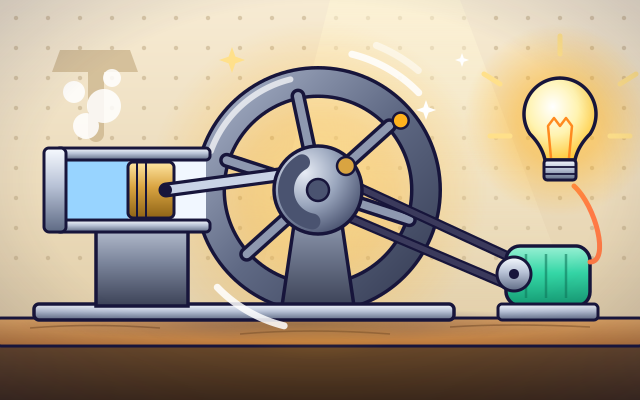
- This little engine turns a generator to light a lamp. But it speeds up and slows down on every turn, so the lamp flickers. Why is it so jerky?
- A puff of air pushes the piston, and the piston turns the crank. But the push only lasts for half a turn. For the other half, nothing pushes at all.
- The fix is a heavy wheel on the same shaft, called a flywheel. Most of its weight is out at the rim, far from the middle.
- During each push the flywheel soaks up energy and speeds up just a tiny bit. Between pushes it gives that energy back, and it hardly slows down at all.
- Now the speed barely changes. The wobbly line on the recorder becomes almost flat, and the lamp shines steadily.
- Even when the pushes stop, the flywheel keeps the machine turning for a while. All that stored energy runs out slowly.
Look inside the engine and its flywheel
Tap each part. Follow the push from the piston all the way to the lamp!
- Cylinder. The cylinder is a tube. A puff of squeezed air rushes in and pushes on the piston inside.
- Piston. The piston is a plug that slides in the cylinder. The air shoves it along, then it has to come all the way back.
- Connecting rod. The connecting rod links the sliding piston to the turning crank. It swings up and down as it pushes.
- Crank. The crank is like a bicycle pedal arm. It changes the piston's back-and-forth push into round-and-round turning.
- Flywheel. The flywheel is heavy, with most of its weight out in the rim. It soaks up energy on each push and keeps the shaft turning between pushes.
- Shaft. The shaft is the turning rod in the middle. The crank, the flywheel and the belt wheel are all fixed to it, so they always turn together.
- Belt. A rubber belt carries the turning from the shaft to the generator, like a bicycle chain carries your pedaling to the back wheel.
- Generator and lamp. The generator turns spinning into electricity for the lamp. A steady speed gives a steady light. A jerky speed makes it flicker.
Fit a flywheel
Watch the speed line and the lamp. Then fit a flywheel and watch again. Try stopping the pushes too.
Experiment: What will a heavy flywheel do to the engine's speed?
- Watch the engine with no flywheel. Look at the speed line on the recorder.
- Fit the small flywheel, then the big one. Watch the line and the lamp.
- Switch the pushes off. How long does it keep turning each time?
What we found: The flywheel does not make the engine faster. It makes it steadier. The heavy wheel soaks up each push and keeps turning between pushes, so the speed line goes almost flat and the lamp stops flickering.
Turn on JavaScript to try it yourself.
Steady, but quick to start
Choose a flywheel that keeps the lamp steady and still gets the engine up to speed within 8 seconds.
How a flywheel smooths things out
Many machines get their power in bursts. A piston engine pushes for only part of each turn. Your legs push a bicycle pedal mostly on the way down. Between the bursts, the machine wants to slow down.
A flywheel fixes this. It is a heavy wheel on the turning shaft. Heavy spinning things are stubborn: they are hard to speed up and hard to slow down. So when a push comes, the flywheel speeds up only a little and stores the extra energy. When there is no push, it gives that energy back and slows down only a little.
Where the weight sits matters. Weight far from the middle is much harder to spin up or slow down than weight near the middle. That is why flywheels have thick, heavy rims and thin middles.
A flywheel does not add any power. The engine still does all the work. And there is a cost: a heavy flywheel takes longer to get going and longer to stop. A merry-go-round is a good comparison, except that a merry-go-round is only for fun, while a flywheel shares its stored energy with a machine that is working.
Key words
- Flywheel
- A heavy wheel on a turning shaft that stores energy and keeps the speed steady.
- Moment of inertia
- How hard it is to speed up or slow down something that spins.
- Rotational kinetic energy
- The movement energy stored in something that is spinning.
- Power stroke
- The part of an engine's turn when the piston is being pushed.
- Torque
- A twisting push that makes something turn.
Check your thinking
-
What does a flywheel do for a jerky engine?
Show the answer
It keeps the speed steady between pushes. A flywheel adds no power. It stores energy from each push and gives it back in between.
-
Why does a machine with a flywheel keep turning after the pushes stop?
Show the answer
The flywheel has movement energy stored in it. A spinning flywheel stores energy. It takes time for the load and friction to use it up.
-
Where should a flywheel's weight be, to work best?
Show the answer
Out at the rim, far from the middle. Weight far from the middle is much harder to speed up or slow down, so it smooths the speed more.
-
What is the downside of a very heavy flywheel?
Show the answer
The machine takes a long time to get up to speed. Something that is hard to slow down is also hard to speed up.
-
A flywheel stores 40 J at a certain speed. How much does it store at twice that speed?
Show the answer
160 J. E = ½Iω². Energy depends on the square of the speed, so twice the speed stores four times the energy.
You're a Forces & mechanisms expert!
You watched, looked inside, tried it, solved the challenge and went deeper. Pick another question below, or switch the age at the top to see this topic another way.
More about forces & mechanisms
 #114
Forces & mechanisms
How do mechanical linkages transfer movement?
Connect pivoting bars and change their lengths to create different movements.
#114
Forces & mechanisms
How do mechanical linkages transfer movement?
Connect pivoting bars and change their lengths to create different movements.
 #115
Forces & mechanisms
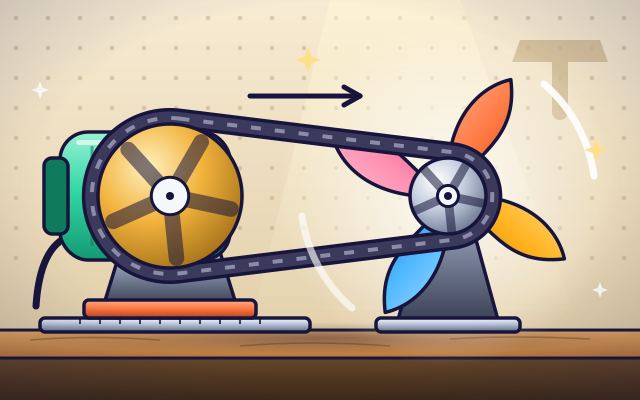
How do belts transfer power between wheels?
Link rotating wheels with belts and investigate speed changes, tension, and slipping.
#115
Forces & mechanisms
How do belts transfer power between wheels?
Link rotating wheels with belts and investigate speed changes, tension, and slipping.
 #116
Forces & mechanisms
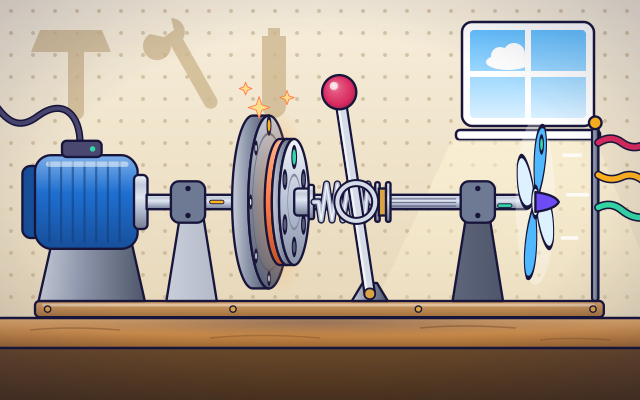
How do clutches connect and disconnect moving parts?
Engage model friction plates to connect a spinning shaft to another mechanism.
#116
Forces & mechanisms
How do clutches connect and disconnect moving parts?
Engage model friction plates to connect a spinning shaft to another mechanism.
 #117
Forces & mechanisms
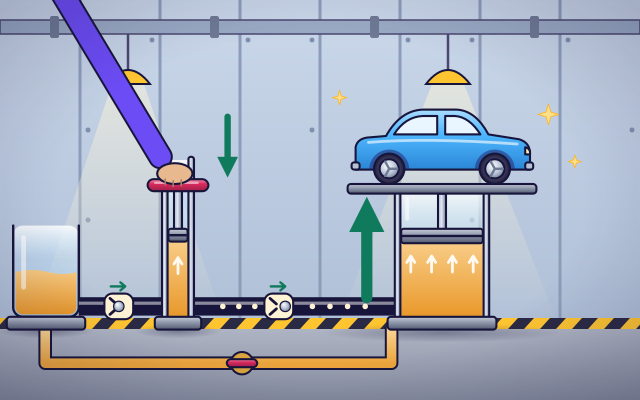
How do hydraulic systems multiply force?
Connect different-sized pistons with liquid and compare force with distance traveled.
#117
Forces & mechanisms
How do hydraulic systems multiply force?
Connect different-sized pistons with liquid and compare force with distance traveled.
Keep exploring
Games to play next
- Marble MountainLay straights, curves, drops and splitters to roll marbles down the mountain.
- Machine RepairFix levers, pulleys, gears and ramps so every contraption works.
- Bridge LabBuild a bridge from beams, brace it with triangles, and stay on budget.
Guide for grown-ups
- How to start homeschooling: a step-by-step guide for familiesA guide for parents · 7 min read
Science games by grade
Science worksheets by grade
- Preschool Science Worksheets
- Pre-K Science Worksheets
- Kindergarten Science Worksheets
- 1st Grade Science Worksheets
- 2nd Grade Science Worksheets
- 3rd Grade Science Worksheets
- 4th Grade Science Worksheets
- 5th Grade Science Worksheets
- 6th Grade Science Worksheets
- 7th Grade Science Worksheets
- 8th Grade Science Worksheets