How does depositing a check work?
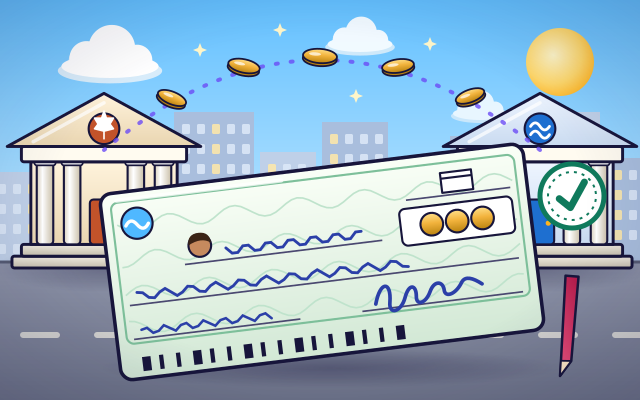
A check is a signed note to a bank. Follow one pretend check through four stops until the money lands in a new account.
The big idea: A check is an instruction, not money. Banks take its picture, test it, ask the writer's bank if it can be paid, and only then move the money.
It's like a permission slip for money: Grandma signs it, your bank passes it to her bank, and only when her bank agrees does the money move.
The interactive parts didn't load. The explanations below still work; try reloading the page.
The four stops of a check
- Grandma writes Mia a pretend check for her birthday. A check is a signed note to Grandma's bank. It says: pay Mia 25 dollars from my account. The paper is not money. It is an instruction.
- Mia signs the back and pays the check in at her bank. A scanner takes a picture of both sides and reads the row of numbers along the bottom. Those numbers say which bank and which account must pay.
- Next, Mia's bank checks the check. Is it signed? Is the date all right? Do the amount in numbers and the amount in words agree? If something is wrong, the check stops right here.
- Now the picture travels to Grandma's bank. It passes through a clearing house, which works like a post office for banks. Grandma's bank looks at her account. Is there enough money? It answers: yes, pay it.
- Last comes settlement, when the money really moves. Grandma's bank takes 25 dollars out of her account and pays Mia's bank. Mia's bank adds 25 dollars to Mia's account. One balance goes down, and another goes up by the same amount.
- So a check makes four stops: capture the picture, verify it, clear it with the writer's bank, and settle the money. That is why a check can take a day or two before you may spend it.
What is written on a check?
Every line on a check answers a question for the bank. Tap each part of this pretend check to see what it tells the bank.
- Date. The date shows the day the check was written. A bank can refuse a check that is very old, or one dated for a day that has not come yet.
- Pay to. This line names the person who should get the money. Only Mia, the person named here, may pay this check into her account.
- Amount in numbers. The box shows the amount in numbers, so it is quick to read. A scanner can read it too.
- Amount in words. Here the amount is written out in words. The bank compares it with the number in the box. If they do not agree, the check is stopped.
- Signature. Grandma's signature is her way of saying "yes, I agree to pay this". A check with no signature is just a piece of paper, and the bank will not pay it.
- Code line. The row of numbers along the bottom tells machines which bank to ask, which account to take the money from, and which check this is.
- Back of the check. Before paying the check in, Mia signs the back. This is called endorsing. It shows that the person named on the front is the one depositing it.
Follow the check, stop by stop
Tap the glowing stop to move the check along. Then choose "Too little" for Grandma's account and send a new check. What is different?
Experiment: Grandma's account holds less money than the check says. What will happen?
- Send a check while Grandma's account has plenty. Watch all four stops.
- Choose "Too little" and send a new check.
- Find the stop where the check is turned back.
What we found: With enough money, the check passes all four stops and 25 dollars moves from Grandma's account to Mia's. With too little, Grandma's bank says no at clearing. The check comes back unpaid, and no money moves.
Turn on JavaScript to try it yourself.
Pay it or send it back?
Five pretend checks arrive. Look for a signature, amounts that match, and enough money in the account. Tap Pay or Send back for each one.
How a check becomes money
A check is a note written to a bank. When Grandma writes "Pay Mia 25 dollars" and signs it, she is telling her own bank to take 25 dollars out of her account and give it to Mia. The paper is not money. It is an instruction, and it does nothing until a bank acts on it.
When Mia pays the check in, her bank captures it: a scanner takes a picture of the front and the back and reads the numbers along the bottom. Then the bank verifies it. Is it signed? Is the date sensible? Do the amount in numbers and the amount in words agree? A check that fails any of these tests stops right there.
Mia's bank still does not know one important thing: does Grandma's account have enough money? Only Grandma's bank can see that. So the picture is sent to Grandma's bank, usually through a clearing house that passes checks between many banks. This step is called clearing. Grandma's bank looks at her account and answers: pay it, or send it back.
If the answer is yes, the banks settle. Grandma's balance goes down by 25 dollars and Mia's goes up by 25 dollars. No money is made or lost; it only changes place. All of this takes time, often a day or two. That is why a bank may show a deposit as "pending" at first. The model on this page is simplified, but real checks make the same four stops.
Key words
- Check
- A signed note that tells a bank to pay someone a certain amount from the writer's account.
- Deposit
- To pay money, or a check, into a bank account.
- Endorse
- To sign the back of a check before paying it in.
- Clearing
- Sending the check's details to the writer's bank and getting back the answer: pay it or return it.
- Settlement
- The step when the money really moves from one bank to the other.
- Pending
- Recorded but not finished. A pending deposit is shown in the account, but it can still be taken away if the check does not clear.
Check your thinking
-
Why is a paper check not the same as money?
Show the answer
It is only an instruction; the money moves later, if the banks agree. A check tells a bank what to do. Until the banks have checked it and settled, no money has moved.
-
Which bank can tell whether there is enough money to pay the check?
Show the answer
Grandma's bank, because it keeps her account. Only the bank that keeps an account can see how much is in it. That is why the check has to travel to Grandma's bank.
-
A check for 25 dollars settles. What happens to the total amount of money in the two accounts?
Show the answer
It stays the same: one account goes down 25 and the other goes up 25. Settlement only moves money. What leaves Grandma's account arrives in Mia's.
-
Right after Mia pays in her check, her bank shows the 25 dollars as "pending". Why?
Show the answer
It has not yet heard from Grandma's bank whether the check will be paid. Until Grandma's bank says yes, Mia's bank cannot be sure the money is coming.
-
Bank A owes Bank B 500 dollars for today's checks, and Bank B owes Bank A 420 dollars. With net settlement, what is paid?
Show the answer
Bank A pays Bank B 80 dollars. Netting subtracts what the banks owe each other. 500 minus 420 leaves 80 dollars for Bank A to pay, and both end up exactly where two full payments would have left them.
You're a Money, shops & services expert!
You watched, looked inside, tried it, solved the challenge and went deeper. Pick another question below, or switch the age at the top to see this topic another way.
More about money, shops & services
 #487
Money, shops & services
What happens after an online order is placed?
Follow an order through stock checks, picking, packing, shipping, and delivery.
#487
Money, shops & services
What happens after an online order is placed?
Follow an order through stock checks, picking, packing, shipping, and delivery.
 #488
Money, shops & services
How do parcel centers sort packages?
Scan labels and route packages along conveyors toward the correct destinations.
#488
Money, shops & services
How do parcel centers sort packages?
Scan labels and route packages along conveyors toward the correct destinations.
 #489
Money, shops & services
How does delivery tracking know where a package is?
Add scan events along a journey and watch the tracking history update.
#489
Money, shops & services
How does delivery tracking know where a package is?
Add scan events along a journey and watch the tracking history update.
 #490
Money, shops & services
How do supermarkets keep shelves stocked?
Balance sales, inventory, reorder points, deliveries, and shelf space in a model store.
#490
Money, shops & services
How do supermarkets keep shelves stocked?
Balance sales, inventory, reorder points, deliveries, and shelf space in a model store.
Keep exploring
Games to play next
- Coin MarketRun a pretend market stall: pay exactly, use the fewest coins, and give the right change.
- Festival PlannerPlace the stalls, book the acts and keep the budget — make every rule true.
- Supermarket StockerRoll out your cart and make every shelf ready for the day.
Guide for grown-ups
- How to start homeschooling: a step-by-step guide for familiesA guide for parents · 7 min read