How are bricks made?
Clay is mixed, shaped, dried and fired into hard bricks. Then the way you stack them makes a wall strong.
The big idea: Bricks are clay that is shaped, dried and fired in a kiln until it becomes hard ceramic. Laying bricks so they overlap, instead of stacking them in straight piles, lets each brick share its load with the bricks below.
It's like
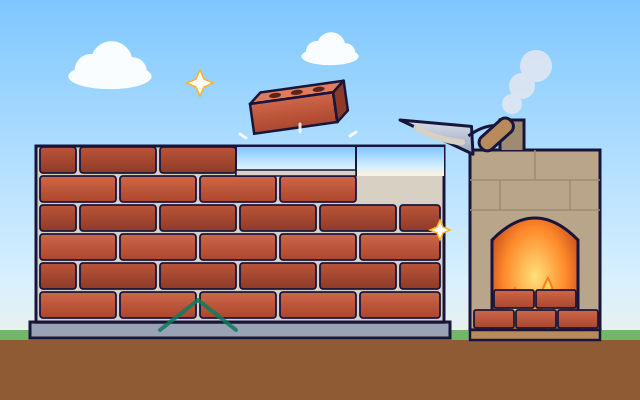
The interactive parts didn't load. The explanations below still work; try reloading the page.
How a brick is born
- Bricks start in a clay pit. Diggers scoop up clay and soft rock called shale, and a conveyor carries it to the brickworks.
- The clay is ground up and mixed with water, and sometimes sand, until it is smooth and stiff, like thick dough. This is called tempering.
- A machine squeezes the clay through a shaped hole, like toothpaste, making a long clay bar. Thin wires slice it into bricks. Rods in the hole make holes in the bricks.
- Fresh bricks are soft and wet. They dry for a day or two in warm rooms. As water leaves, they shrink a little and turn paler.
- The bricks ride slowly through a long tunnel kiln. In the hottest part, about 1,000 degrees Celsius, the clay changes forever and becomes hard. Iron in the clay turns it red.
- Builders spread mortar and lay the bricks in overlapping rows called courses. Each brick sits across the joint between two bricks below, so the wall holds together.
Inside a brick wall
Tap each part of the wall to find out its job. One brick is pulled out so you can see inside it.
- Stretcher brick. A brick laid with its long side showing is called a stretcher. A brick is about twice as long as it is wide, so the pieces fit together neatly.
- Header brick. A brick turned so its short end shows is a header. Headers reach through thick walls and tie the front and back layers together.
- Bed joint. Mortar is a paste of sand, cement or lime, and water. The flat layer under each row is called a bed joint. It spreads the weight evenly and glues the rows together.
- Head joint. The small upright joints between brick ends are head joints. In a strong wall they are staggered, so they never line up into one long crack line.
- Holes in the brick. Many bricks have holes, made when they are squeezed out of the machine. Holes make bricks lighter, help them dry and bake evenly, and let mortar grip them.
- Course. A course is one horizontal row of bricks. Builders check every course is level, so the wall grows straight and strong.
- Lintel over the window. Bricks can't float over a hole, so a strong beam called a lintel, or an arch, carries the bricks above a window or door.
- Foundation. All the weight of the wall goes down into the foundation, a strong base of concrete under the ground that spreads it out.
Brick bond lab
Choose a bond pattern and a weight, then press the weight onto the wall. Watch the colors show which bricks carry the load.
Experiment: A heavy weight presses on one spot at the top of a wall. Which wall holds best?
- Choose Stack bond and the heavy weight. Press.
- Now choose Running bond and press again.
- Compare how many bottom bricks share the load, and whether the wall cracked.
What we found: In stacked piles, the weight goes straight down one pile, and the straight mortar line beside it splits. When bricks overlap, each brick passes its load to two bricks below, so the weight spreads out over many bricks, like a fan. Overlapping walls are much stronger.
Turn on JavaScript to try it yourself.
From clay to a strong wall
Mix the clay, shape the bricks, dry and fire them, then lay them in a pattern that will hold Ellie the elephant.
Making bricks and building walls
People have made bricks for thousands of years. The first ones were mud dried in the sun, but they could soften in the rain. Fired bricks, baked in a kiln, last far longer because the heat changes the clay forever into hard, waterproof-enough ceramic.
Today most bricks are made from clay or shale mixed with water. A machine squeezes the clay into a long bar, and wires cut it into bricks. The bricks are dried slowly, so they don't crack, and then fired at about 1,000 degrees Celsius. Iron in the clay turns them red.
A brick is about twice as long as it is wide. That lets builders lay bricks in many patterns, called bonds. In running bond, each brick sits across the joint between two bricks below it, a bit like a pyramid of cups.
Overlapping is the secret of a strong wall. If you press on one brick, it pushes on the two bricks under it, which push on three or four more, so the weight spreads out like a fan. Bricks stacked in straight piles can't share like that, and the straight mortar lines between the piles can split.
Key words
- Kiln
- A very hot oven or tunnel where bricks are fired.
- Mortar
- A paste of sand, cement or lime, and water that beds and joins bricks.
- Course
- One horizontal row of bricks in a wall.
- Bond
- The pattern bricks are laid in, such as running bond or Flemish bond.
- Stretcher and header
- A brick showing its long side (stretcher) or its short end (header).
- Extrusion
- Squeezing clay through a shaped hole to make a long bar that is cut into bricks.
- Sintering
- Particles fusing where they touch when heated, which makes fired clay hard.
Check your thinking
-
Why are fired bricks stronger than mud bricks dried in the sun?
Show the answer
The kiln's heat changes the clay forever into hard ceramic. Firing at about 1,000 degrees Celsius changes the clay so it can't turn back into mud.
-
Why do builders overlap bricks instead of stacking them in straight piles?
Show the answer
Each brick shares its load with two bricks below, so the weight spreads out. Overlapping bricks pass the weight on to more and more bricks below, so no brick has to carry it all.
-
Why do many bricks have holes?
Show the answer
To make them lighter and help them dry and bake evenly. Holes save clay and weight, and no part of the brick is far from the air, so it dries and fires evenly.
-
A new brick is dried very fast in a hot oven. What is most likely to happen?
Show the answer
It cracks because the outside shrinks before the inside. Clay shrinks as it dries. If the surface dries and shrinks first, the strain between outside and inside can crack it.
-
Where does all the weight of a brick wall go in the end?
Show the answer
Down into the foundation and the ground. Each brick passes its load to the bricks below, all the way down to the foundation, which spreads it into the ground.
You're a Making everyday things expert!
You watched, looked inside, tried it, solved the challenge and went deeper. Pick another question below, or switch the age at the top to see this topic another way.
More about making everyday things
 #19
Making everyday things
How is pottery made?
Shape clay on a virtual pottery wheel. Explore drying, kiln firing, and glazing, and see how each stage changes the object.
#19
Making everyday things
How is pottery made?
Shape clay on a virtual pottery wheel. Explore drying, kiln firing, and glazing, and see how each stage changes the object.
 #20
Making everyday things
How does a 3D printer make an object?
Turn a simple digital design into layers. Watch a filament printer build it layer by layer and explore why some shapes need temporary supports.
#20
Making everyday things
How does a 3D printer make an object?
Turn a simple digital design into layers. Watch a filament printer build it layer by layer and explore why some shapes need temporary supports.
 #301
Making everyday things
How is steel made?
Follow iron through a simplified steelworks and shape finished steel into useful products.
#301
Making everyday things
How is steel made?
Follow iron through a simplified steelworks and shape finished steel into useful products.
 #302
Making everyday things
How are aluminum drink cans made?
Form a metal disc into a can, then trim, coat, decorate, and attach a lid.
#302
Making everyday things
How are aluminum drink cans made?
Form a metal disc into a can, then trim, coat, decorate, and attach a lid.
Keep exploring
Games to play next
- Geometry Architect 3DCount, build and fold solids like a real architect.
- Machine RepairFix levers, pulleys, gears and ramps so every contraption works.
- Sorting FactoryTurn a work order into if/else rules and watch the conveyor sort every item.
Guide for grown-ups
- How to start homeschooling: a step-by-step guide for familiesA guide for parents · 7 min read
Science games by grade
Science worksheets by grade
- Preschool Science Worksheets
- Pre-K Science Worksheets
- Kindergarten Science Worksheets
- 1st Grade Science Worksheets
- 2nd Grade Science Worksheets
- 3rd Grade Science Worksheets
- 4th Grade Science Worksheets
- 5th Grade Science Worksheets
- 6th Grade Science Worksheets
- 7th Grade Science Worksheets
- 8th Grade Science Worksheets