How does a can opener cut around a lid?
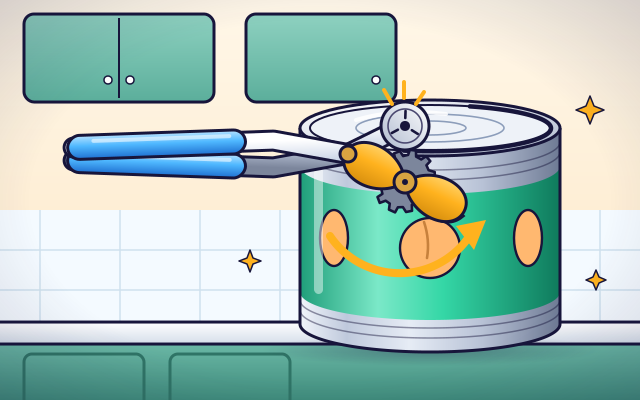
One wheel with teeth grips the rim of the can. A sharp wheel cuts the lid. Turn the crank and they roll all the way around.
The big idea: Squeezing the handles pushes a sharp wheel through the lid. Turning the crank spins a toothed wheel that grips the rim and rolls along it, pulling the lid past the sharp wheel.
It's like a pizza cutter that drives itself: one wheel rolls along and slices, and a second wheel with teeth grips the edge and pulls it around the can.
The interactive parts didn't load. The explanations below still work; try reloading the page.
How a can opener cuts a lid
- A can of peaches is sealed with a thin steel lid, joined to the can by a rolled edge called the rim. Fingers cannot open it. We need a can opener.
- Squeeze the two handles together. They work like pliers and push a sharp metal wheel down through the lid. Pop! Now the rim is pinched between two wheels.
- Under the rim sits a wheel with teeth. When you turn the crank, this wheel turns. Its teeth dig into the rim and roll along it, so the can turns.
- Two small gears join the wheels, so when one turns, the other turns the opposite way. Together they pull the rim through, like rollers squeezing out dough.
- Keep turning. Each turn of the crank rolls the toothed wheel a little farther along the rim, and the cut grows longer, until it goes all the way around.
- The lid is cut free and lifts off. Peaches! Squeeze, grip, turn: that is how a can opener works. The cut edge is sharp, so let a grown-up lift the lid.
Look closely at a can opener
Tap each part. The circle shows a slice through the rim of the can. The card shows the two gears.
- Handles. Two long handles that you squeeze. They cross over like scissors, so squeezing them closes the two wheels on the rim.
- Pivot. The pin that joins the two handles. They swing around it, like the screw in a pair of scissors.
- Crank. The part you turn with your fingers. Its wide wings make it easy to turn the small toothed wheel behind it.
- Gears. Two small gears whose teeth fit together. When the crank turns one, it turns the other the opposite way.
- Toothed wheel. A wheel with sharp little teeth that sits under the rim. The teeth grip the rim so the wheel can roll along it without slipping.
- Cutting wheel. A hard metal wheel with a sharp edge. It sits on top of the lid, just inside the rim, and slices the thin metal as it rolls.
- Rim. The thick rolled edge where the lid joins the can. The toothed wheel grips under it, and it acts like a track for the opener.
- Lid. A thin disc of steel. The cutting wheel slices through it just inside the rim, all the way around, until the middle comes free.
Follow the cut around the lid
Try turning the crank before you squeeze the handles. Then squeeze and turn again. Follow the cut around the lid and look at the close-up of the rim.
Experiment: What happens if you turn the crank without squeezing the handles?
- Tap the crank, or slide Turn the crank, without squeezing.
- Now tap the handles to squeeze them, and look at the close-up.
- Turn the crank all the way around.
What we found: Nothing is cut until you squeeze. Squeezing pushes the sharp wheel through the lid and presses the toothed wheel against the rim. Only then can the teeth grip, roll along the rim and carry the cut around.
Turn on JavaScript to try it yourself.
How many turns?
Each turn of the crank rolls the toothed wheel 5 cm along the rim. Work out how many turns the can needs, choose your answer, then open the can to check.
Squeeze, grip and roll
A food can is a little steel box with no door. Its lid is joined to the can by a thick rolled edge called the rim. To get in, something has to cut through the thin lid all the way around, just inside that rim.
A can opener has two wheels. One is smooth and very sharp: the cutting wheel. The other has tiny teeth: the toothed wheel. When you squeeze the handles, they close like pliers. The sharp wheel pokes down through the lid, and the toothed wheel presses up under the rim, so the rim is pinched between them.
Now you turn the crank. The crank is joined to the toothed wheel, so that wheel turns. Its teeth grip the rim, and it rolls along the rim like a train wheel on a track. Two small gears make the sharp wheel turn at the same time. As the rim is pulled along, the sharp wheel slices the lid, just as a pizza cutter slices a pizza.
Every turn of the crank moves the cut a little farther. A wide can is farther around than a narrow one, so it needs more turns. When the cut reaches the place where it started, the lid is free. Its edge is sharp, so let a grown-up lift it out.
Key words
- Rim
- The thick rolled edge where the lid joins the can.
- Wedge
- A shape with a thin, sharp edge that pushes things apart or cuts them.
- Lever
- A bar that turns around a fixed point. A push far from that point makes a bigger push close to it.
- Wheel and axle
- A big wheel or handle fixed to a thin rod. Turning the big part easily turns the small part with a lot of force.
- Circumference
- The distance all the way around a circle.
Check your thinking
-
Which part slices through the lid?
Show the answer
The sharp cutting wheel. The smooth, sharp wheel does the cutting. The toothed wheel only grips and rolls.
-
You turn the crank, but the opener does not move along the can. What is the most likely reason?
Show the answer
The handles are not squeezed, so the teeth are not gripping the rim. The toothed wheel can only roll along the rim if it is pressed hard against it. That is what squeezing the handles does.
-
A wide can and a narrow can are opened with the same opener. Which needs more turns of the crank?
Show the answer
The wide can. The wide can is farther around, and each turn only rolls the wheel a fixed distance, so it takes more turns.
-
Why does the crank have wide wings instead of a tiny knob?
Show the answer
Wide wings make the small wheel easier to turn. Pushing far from the middle turns the wheel with less effort, like a long door handle.
-
A designer swaps a 16 mm feed wheel for a 24 mm one and keeps the same crank. What changes?
Show the answer
Fewer turns, but more force on each turn. A larger wheel rolls farther per turn, so fewer turns are needed, but the same force at the rim acts at a larger radius, so the torque and the finger force go up.
You're a Everyday objects expert!
You watched, looked inside, tried it, solved the challenge and went deeper. Pick another question below, or switch the age at the top to see this topic another way.
More about everyday objects
 #156
Everyday objects
How does an umbrella open and fold?
Move the runner and watch linked supports spread or collapse the canopy.
#156
Everyday objects
How does an umbrella open and fold?
Move the runner and watch linked supports spread or collapse the canopy.
 #157
Everyday objects
How do window blinds raise, lower, and tilt?
Operate controls and trace how their mechanisms move the slats together.
#157
Everyday objects
How do window blinds raise, lower, and tilt?
Operate controls and trace how their mechanisms move the slats together.
 #159
Everyday objects
How does a drinking straw lift liquid?
Change pressure inside a straw and observe surrounding air pressure pushing liquid upward.
#159
Everyday objects
How does a drinking straw lift liquid?
Change pressure inside a straw and observe surrounding air pressure pushing liquid upward.
 #160
Everyday objects
How do hook-and-loop fasteners stick together?
Zoom into hooks and loops, then compare peeling with pulling sideways.
#160
Everyday objects
How do hook-and-loop fasteners stick together?
Zoom into hooks and loops, then compare peeling with pulling sideways.
Keep exploring
Games to play next
- Machine RepairFix levers, pulleys, gears and ramps so every contraption works.
- Science QuizzesOlly's Science Quiz Show: plants, animals, the body, weather, space and more, for every grade.
Guide for grown-ups
- How to start homeschooling: a step-by-step guide for familiesA guide for parents · 7 min read
Science games by grade
Science worksheets by grade
- Preschool Science Worksheets
- Pre-K Science Worksheets
- Kindergarten Science Worksheets
- 1st Grade Science Worksheets
- 2nd Grade Science Worksheets
- 3rd Grade Science Worksheets
- 4th Grade Science Worksheets
- 5th Grade Science Worksheets
- 6th Grade Science Worksheets
- 7th Grade Science Worksheets
- 8th Grade Science Worksheets