How do window blinds raise, lower, and tilt?
A twisting wand and a pull cord move dozens of slats at once. See how strings inside the blind do it.
The big idea: Every slat rests on two string ladders. Twisting the wand pulls one side of the ladders up and lets the other side down, so all the slats tilt together. A separate cord lifts them.
It's like a rope ladder: pull one rope up and let the other down, and every step tips the same way at once.
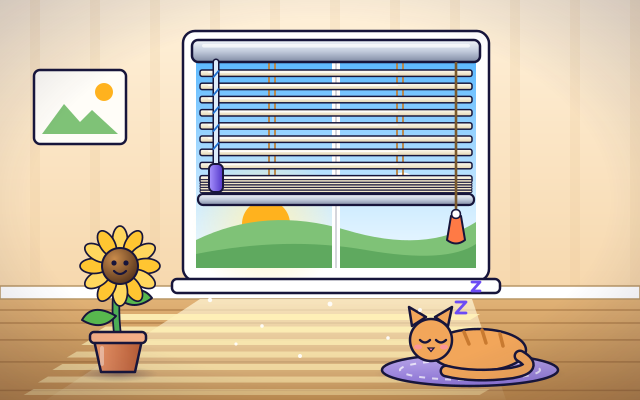
The interactive parts didn't load. The explanations below still work; try reloading the page.
One wand, one cord, many slats
- Leo wants to read, but bright sun pours through the window. The blind is pulled up to the top. How can one cord and one wand control so many slats?
- A lift cord runs from the bottom bar up through holes in every slat. Let the cord out, and the bar sinks. The slats drop off the pile one at a time.
- Now look from the side. Each slat rests on a rung of a string ladder. One ladder string hangs at the front of the slats and one at the back.
- Twisting the wand turns a drum at the top. The drum pulls the back string up and lets the front string down. Every rung tips, so every slat tilts by the same amount.
- The tilt decides where sunlight goes. When the slats overlap, they block the sun. When they line up with the sunbeams, the light slips between them and lands on the floor.
- With the blind down and the slats tilted a little, soft striped light fills the room. One wand and one cord moved every slat, because every slat hangs on the same strings.
Look inside a slatted blind
The box at the top is cut open. Tap each part to see what it does.
- Slats. The slats are thin strips of metal, wood or plastic. Flat, they let you see out. Tilted, they overlap like roof tiles and block the light.
- Ladder cords. A ladder cord has two long strings joined by short rungs. Each slat sits on a rung. When one string rises and the other drops, every rung tips together.
- Tilt wand. You twist the wand between your fingers. It turns a small gear in the box at the top.
- Tilter gear and rod. The wand turns a gear, and the gear turns a long rod that runs along the top box. Drums on the rod hold the tops of the ladder cords.
- Lift cords. The lift cords are tied to the bottom bar. They run up through a hole in every slat, across the top box and down to your hand. Pull, and the bottom bar rises.
- Cord lock. The cord lock grips the lift cords so the blind stays where you leave it. Pull the cords to one side and the lock lets go.
- Bottom rail. The bottom rail is a heavier bar. Its weight keeps the blind hanging straight. As it rises, it collects the slats in a stack, starting with the lowest.
- Headrail. The headrail is the box across the top of the window. It hides the gear, the rod, the drums and the cord lock, and it holds the whole blind up.
Tilt and lift
Drag the wand to tilt the slats and pull the cord to raise the blind. On the left you see the same blind from the side, with the sunbeams.
Experiment: When you twist the wand, which slats move?
- Drag the wand slowly one way, then the other.
- Watch the side view: follow the two ladder strings.
- Now pull the cord. Which slats lift first?
What we found: Every slat tilts together and by the same amount, because every slat sits on rungs of the same ladder cords. The lift cord is different: it raises the bottom rail, which picks up the lowest slats first.
Turn on JavaScript to try it yourself.
Sun for the flower, shade for the cat
Give the sunflower plenty of sun, but keep the sunbeams off the sleeping cat. Then press Check.
Strings that move every slat
A slatted blind (often called a Venetian blind) looks simple, but it has two separate machines inside. One tilts the slats. The other lifts them. Both are worked by strings.
The tilting machine uses ladder cords. Each ladder cord has a front string and a back string, joined by short rungs, and every slat rests on a rung. At the top, the two strings hang from opposite sides of a small drum. When you twist the wand, a gear turns a rod, and the rod turns the drums. One string goes up and the other goes down, so every rung tips. That is why all the slats tilt together, by exactly the same amount.
The lifting machine uses lift cords. They are tied to the bottom rail and run straight up through a hole in each slat. When you pull the cord, the bottom rail rises and scoops up the slats one at a time, starting at the bottom. A cord lock in the top box grips the cord so the blind stays put.
Tilting the slats steers the sunlight. Slats that overlap block the sun. Slats lined up with the sunbeams let the light slip between them. A small tilt bounces light up to the ceiling, which fills the room with soft light and no glare. The rope ladder comparison is not perfect: a real rope ladder's ropes are fixed at the top, but a blind's strings wind around a drum.
Key words
- Slat
- One of the long, thin strips of a blind.
- Ladder cord
- Two strings joined by rungs. Each slat sits on a rung.
- Lift cord
- A cord tied to the bottom rail that raises the blind when you pull it.
- Headrail
- The box at the top that holds the gear, the rod and the cord lock.
- Worm gear
- A screw-shaped gear that turns another gear slowly and cannot be pushed backward.
- Elevation
- How high the sun is in the sky.
Check your thinking
-
Why do all the slats tilt by the same amount?
Show the answer
Each one sits on a rung of the same ladder cords. One string goes up and the other goes down, so every rung tips the same way.
-
When you pull the lift cord, which slats are picked up first?
Show the answer
The bottom ones. The cord lifts the bottom rail, and the rail scoops up the slats from below.
-
The sun is high. Which slats let the most sunbeams reach the floor?
Show the answer
Slats tilted to line up with the sunbeams. When the slats point the same way as the sunbeams, the beams slip between them.
-
You raise the blind halfway. Which part of the window is uncovered?
Show the answer
The bottom half. The bottom rail rises and gathers the slats from below, so the bottom of the window opens first.
-
A window's lower half is uncovered. Compared with rays through the top half, where do rays through the lower half land?
Show the answer
Closer to the window wall. All the rays slope down at the same angle, so a ray that enters lower reaches the floor sooner, nearer the wall.
You're a Everyday objects expert!
You watched, looked inside, tried it, solved the challenge and went deeper. Pick another question below, or switch the age at the top to see this topic another way.
More about everyday objects
 #159
Everyday objects
How does a drinking straw lift liquid?
Change pressure inside a straw and observe surrounding air pressure pushing liquid upward.
#159
Everyday objects
How does a drinking straw lift liquid?
Change pressure inside a straw and observe surrounding air pressure pushing liquid upward.
 #160
Everyday objects
How do hook-and-loop fasteners stick together?
Zoom into hooks and loops, then compare peeling with pulling sideways.
#160
Everyday objects
How do hook-and-loop fasteners stick together?
Zoom into hooks and loops, then compare peeling with pulling sideways.
 #161
Everyday objects
How do knots hold ropes and shoelaces together?
Tie virtual strands and explore how loops, tension, and friction affect holding.
#161
Everyday objects
How do knots hold ropes and shoelaces together?
Tie virtual strands and explore how loops, tension, and friction affect holding.
 #150
Everyday objects
How does a trigger spray bottle work?
Pull the trigger and follow liquid through a pump, valves, and nozzle.
#150
Everyday objects
How does a trigger spray bottle work?
Pull the trigger and follow liquid through a pump, valves, and nozzle.
Keep exploring
Games to play next
- Machine RepairFix levers, pulleys, gears and ramps so every contraption works.
- Science QuizzesOlly's Science Quiz Show: plants, animals, the body, weather, space and more, for every grade.
Guide for grown-ups
- How to start homeschooling: a step-by-step guide for familiesA guide for parents · 7 min read
Science games by grade
Science worksheets by grade
- Preschool Science Worksheets
- Pre-K Science Worksheets
- Kindergarten Science Worksheets
- 1st Grade Science Worksheets
- 2nd Grade Science Worksheets
- 3rd Grade Science Worksheets
- 4th Grade Science Worksheets
- 5th Grade Science Worksheets
- 6th Grade Science Worksheets
- 7th Grade Science Worksheets
- 8th Grade Science Worksheets