How does a drinking straw lift liquid?
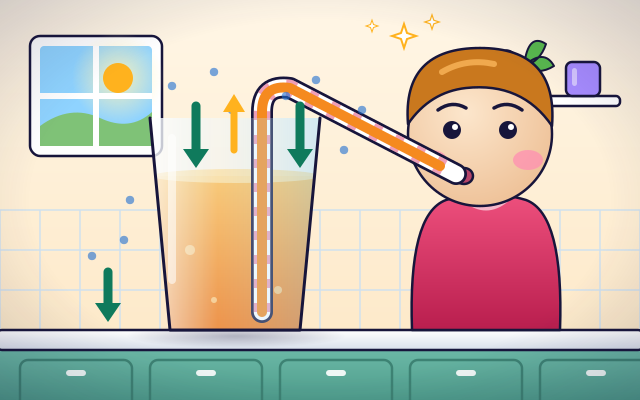
When you sip, you take away some of the air's push inside the straw. The air outside does the rest and pushes your drink up.
The big idea: Air presses on everything, all the time. Sucking makes the air inside the straw press less. The air outside presses just as hard as before, so it pushes the drink up the straw.
It's like two children pushing on a door from opposite sides: if one eases off, the door moves toward that child, pushed by the other.
The interactive parts didn't load. The explanations below still work; try reloading the page.
The push that fills your straw
- Sam takes a sip, and juice climbs up the straw. But Sam's mouth cannot reach down and pull the juice. So what makes it go up?
- Air is all around us, and it presses on everything. It presses down on the juice in the glass. It presses down inside the straw just as hard. The two pushes match, so the juice stays level.
- This pump is a model of your mouth. When you suck, your mouth gets bigger inside. The air in the straw spreads out into the extra room, and spread-out air pushes less.
- The air outside still presses just as hard on the juice in the glass. Now it presses harder than the air inside the straw, so it pushes the juice up the straw.
- What if the straw has a hole? Air rushes in through it. The push inside goes back to normal, the two pushes match again, and the juice slides back down.
- So a sip is teamwork. You make the push inside the straw smaller. The air all around does the real work and pushes your drink up to your mouth.
What happens in a straw
The pump on the right is a model of your mouth. Tap each part to see what it does.
- Air outside. The air around us presses down on the surface of the drink. You cannot feel it, because it has pressed on you all your life.
- Air inside the straw. Before you sip, the air inside the straw presses as hard as the air outside. When you suck, it spreads out and presses less.
- Mouth (the pump). The pump stands in for your mouth. Pulling the handle makes more room, just as your cheeks and tongue do when you suck.
- Drink in the straw. The drink in the straw is pushed up from below. It stops rising when its own weight makes up for the smaller push above it.
- Drink in the glass. The surface of the drink in the glass is where the outside air does its pushing. As drink goes up the straw, the level in the glass goes down.
- Straw. The straw is a tube that keeps the inside air apart from the outside air. If it has a hole, outside air leaks in and the sip fails.
Pull the pump
Drag the pump handle to lower the push inside the straw. Then switch on the hole in the straw and try again.
Experiment: The straw has a hole above the drink. What happens when you suck?
- Pull the handle until the drink reaches the pump.
- Push it back, then switch on the hole in the straw.
- Pull the handle again and watch the air dots.
What we found: With a hole, the drink hardly moves. Outside air rushes in through the hole, so the push inside the straw never gets smaller than the push outside. No difference in push, no lift.
Turn on JavaScript to try it yourself.
Stop at the green band
Pull the pump so the drink stops inside the green band and stays there. Three drinks to get right!
Pushed, not pulled
It feels as if you pull a drink up a straw. But liquids cannot be pulled. If you tried to pull water with your fingers, it would just slip away. Something has to push the drink up from below, and that something is the air.
We live at the bottom of a deep ocean of air. All that air has weight, and it presses on everything: on you, on the table, and on the surface of your drink. Before you sip, the air inside the straw presses down on the drink just as hard as the air outside. The pushes are equal, so the drink in the straw sits level with the drink in the glass.
When you suck, your mouth gets bigger inside. The air in the straw spreads out into the extra room, and spread-out air presses less. Now the outside air is pressing harder than the inside air, so it pushes the drink up the straw and into your mouth. The harder you suck, the bigger the difference and the higher the drink goes.
This explains some odd things. A straw with a hole in it does not work, because outside air leaks in and the pushes stay equal. And if you put your finger over the top of a full straw and lift it out, the drink stays inside: the air below pushes up on it, and no air can get in at the top to push it down.
Key words
- Air pressure
- The push of the air on everything it touches.
- Atmosphere
- The thick layer of air all around the Earth. Its weight is what makes air pressure.
- Suction
- Making the push in one place smaller, so the air pushes things toward it.
- Density
- How heavy a liquid is for its size. Syrup is denser than water.
- Vacuum
- A space with no air in it at all, so nothing pushes.
Check your thinking
-
What really pushes a drink up a straw?
Show the answer
The air pressing on the drink in the glass. Your mouth only makes the push inside smaller. The outside air does the pushing.
-
Why does a straw with a hole above the drink not work?
Show the answer
Air leaks in, so the push inside stays as big as the push outside. With no difference between the two pushes, nothing moves the drink.
-
You fill a straw, put your finger over the top and lift it out. Why does the drink stay in?
Show the answer
Air pushes up from below, and no air can get in at the top to push down. The outside air holds the drink up until you lift your finger and let air in at the top.
-
Could an astronaut drink through an open straw from an open cup out in space, where there is no air?
Show the answer
No: there is no air to push the drink up. A straw needs outside air to do the pushing. Astronauts drink from squeezable pouches instead.
-
On a mountain where the air pressure is 70 kPa, how does the greatest height a pump can lift water compare with sea level?
Show the answer
It is lower, about 7 m. The limit is atmospheric pressure ÷ (ρg). With 70 kPa instead of 101 kPa the limit falls to about 7.1 m.
You're a Everyday objects expert!
You watched, looked inside, tried it, solved the challenge and went deeper. Pick another question below, or switch the age at the top to see this topic another way.
More about everyday objects
 #160
Everyday objects
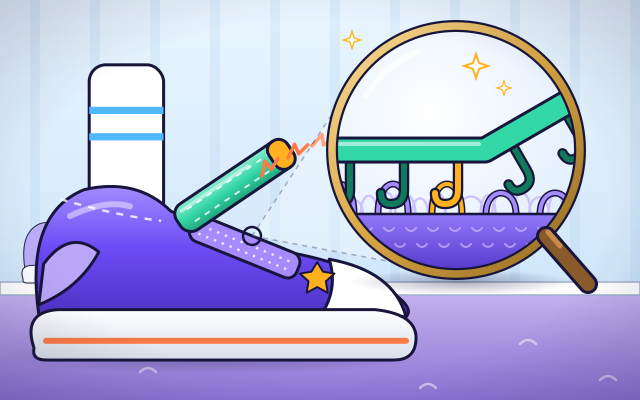
How do hook-and-loop fasteners stick together?
Zoom into hooks and loops, then compare peeling with pulling sideways.
#160
Everyday objects
How do hook-and-loop fasteners stick together?
Zoom into hooks and loops, then compare peeling with pulling sideways.
 #161
Everyday objects
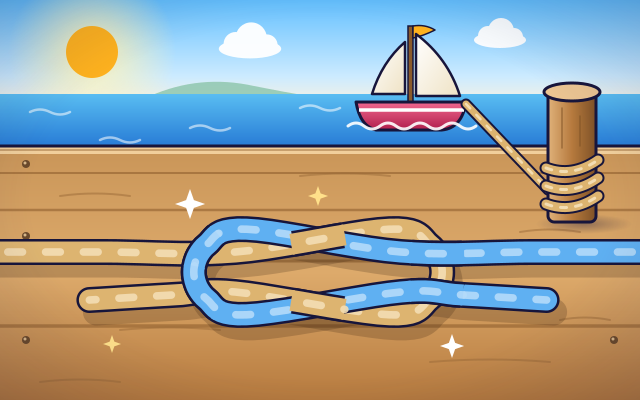
How do knots hold ropes and shoelaces together?
Tie virtual strands and explore how loops, tension, and friction affect holding.
#161
Everyday objects
How do knots hold ropes and shoelaces together?
Tie virtual strands and explore how loops, tension, and friction affect holding.
 #150
Everyday objects
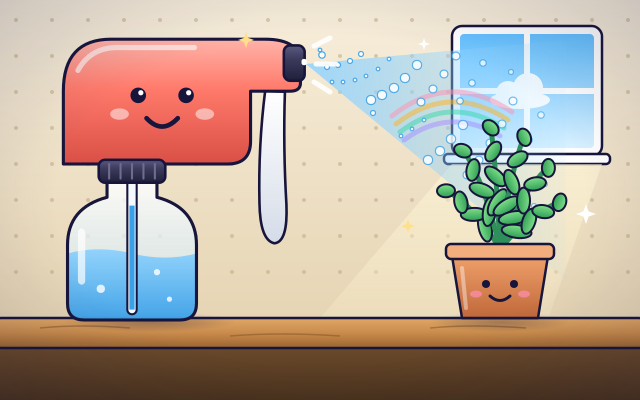
How does a trigger spray bottle work?
Pull the trigger and follow liquid through a pump, valves, and nozzle.
#150
Everyday objects
How does a trigger spray bottle work?
Pull the trigger and follow liquid through a pump, valves, and nozzle.
 #151
Everyday objects
How do foaming soap dispensers make foam?
Watch liquid soap and air combine and pass through a fine mesh.
#151
Everyday objects
How do foaming soap dispensers make foam?
Watch liquid soap and air combine and pass through a fine mesh.
Keep exploring
Games to play next
- Machine RepairFix levers, pulleys, gears and ramps so every contraption works.
- Science QuizzesOlly's Science Quiz Show: plants, animals, the body, weather, space and more, for every grade.
Guide for grown-ups
- How to start homeschooling: a step-by-step guide for familiesA guide for parents · 7 min read
Science games by grade
Science worksheets by grade
- Preschool Science Worksheets
- Pre-K Science Worksheets
- Kindergarten Science Worksheets
- 1st Grade Science Worksheets
- 2nd Grade Science Worksheets
- 3rd Grade Science Worksheets
- 4th Grade Science Worksheets
- 5th Grade Science Worksheets
- 6th Grade Science Worksheets
- 7th Grade Science Worksheets
- 8th Grade Science Worksheets