How does an umbrella open and fold?
One sliding ring, eight ribs and eight little pushing rods turn a thin stick into a roof you can carry.
The big idea: The runner slides up the pole. It pushes short rods called stretchers, and the stretchers swing the ribs outward so the cloth spreads into a roof.
It's like a pop-up tent: push one sliding part and thin poles swing out and pull the cloth into shape.
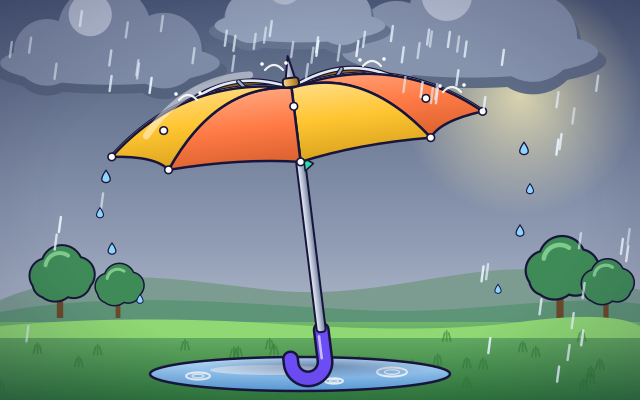
The interactive parts didn't load. The explanations below still work; try reloading the page.
From thin stick to rain roof
- Rain is on the way. Maya's umbrella is folded as thin as a stick. How does it turn into a roof wide enough to keep her dry?
- Let's look through the cloth. A ring called the runner slides on the pole. Your hand pushes the runner up.
- Short rods called stretchers join the runner to the ribs. As the runner rises, each stretcher pushes its rib outward, so all the ribs swing out together.
- The cloth is sewn to the rib tips. As the ribs swing out, they stretch the cloth until it is tight. The tight cloth bends the ribs into a dome.
- When the runner passes a small spring catch, the catch pops out underneath it. Now the runner rests on the catch and cannot slide back down.
- Raindrops land on the tight, sloping cloth and roll off its edge. One push of the runner made a roof, and one press of the catch folds it away again.
Look inside an umbrella
Tap each part. The cloth is see-through so you can watch the parts move.
- Canopy. The canopy is the cloth roof. It is made of triangle-shaped panels sewn together, and it is treated so water rolls off instead of soaking in.
- Ribs. The ribs are long, springy arms hinged at the top of the pole. They swing outward and hold the cloth in a dome shape.
- Stretchers. A stretcher is a short rod with a hinge at each end. One end joins the runner and the other joins a rib. When the runner rises, the stretchers push the ribs out.
- Runner. The runner is the ring that slides along the pole. Every stretcher is hinged to it, so moving this one part moves all the ribs at once.
- Spring catch. The top spring is a small springy catch in the pole. It pops out under the runner to hold the umbrella open. Press it in and the runner can slide down.
- Pole. The pole, or shaft, is the straight tube in the middle. The runner slides on it, and the ribs are hinged at its top.
- Handle. The curved handle gives you a good grip, even with wet hands, and lets you hang the umbrella up to dry.
Slide the runner
Drag the gold runner up and down the pole. Watch the stretchers, the ribs and the two bars that show how far each part moved.
Experiment: The runner slides only a short way up the pole. How far do the rib tips move?
- Slide the runner all the way down so the umbrella is folded.
- Now slide it all the way up until it clicks.
- Compare the two bars: runner moved, and rib tip moved.
What we found: The rib tips move more than twice as far as the runner. The stretchers push on the ribs close to their hinge, so a small push near the hinge makes a big swing at the far tip.
Turn on JavaScript to try it yourself.
Just the right width
Set the runner so the canopy covers everyone but still fits between the posts. Then press Go.
Why one push opens eight ribs
An umbrella has to do two opposite jobs. Open, it must be a wide, stiff roof. Closed, it must be thin enough to carry. The trick is a set of rods joined by hinges, which engineers call a linkage.
At the top of the pole, eight long ribs are hinged like the spokes of a wheel. Lower down, a ring called the runner slides on the pole. Eight short rods, the stretchers, join the runner to the ribs. When you push the runner up, each stretcher pushes its rib outward. Because every stretcher is joined to the same runner, all eight ribs move together.
The stretchers push on the ribs close to the hinge, not out at the tips. So when the runner moves a short way, the tips swing a long way, more than twice as far. That is why a small push opens a big roof. The cloth is sewn to the tips, so it stretches tight as the ribs spread. The tight cloth and the springy ribs pull against each other, and that makes the dome firm.
The tight cloth also tries to push the runner back down. A small spring catch pops out of the pole under the runner and holds it. To fold the umbrella, you press the catch in and the runner slides down again. Our comparison with a hug is not perfect: your arms are moved by muscles, but umbrella ribs are pushed by rods.
Key words
- Runner
- The ring that slides along the pole and moves all the stretchers at once.
- Stretcher
- A short rod, hinged at both ends, that pushes a rib outward.
- Rib
- A long, springy arm hinged at the top of the pole that holds the cloth.
- Linkage
- Rods joined by hinges so that moving one part moves the others.
- Tension
- A pulling force, like the pull in a tight string or tight cloth.
Check your thinking
-
Which part do you move to open all the ribs at once?
Show the answer
The runner. Every stretcher is joined to the runner, so sliding it moves every rib.
-
Why does the umbrella stay open when you let go of the runner?
Show the answer
A spring catch pops out under the runner. The catch blocks the runner from sliding down until you press it in.
-
The runner moves a short way. Why do the rib tips move so much farther?
Show the answer
The stretchers push near the hinge, so the far tip swings a long way. A small move close to a hinge becomes a big move far from it, like the end of a swinging door.
-
What would happen if one stretcher snapped?
Show the answer
That one rib would flop down. Each rib is pushed by its own stretcher. The other seven still have theirs.
-
At what rib angle (measured from the pole) is the canopy widest?
Show the answer
90°, when the ribs are level. Width is 2 × rib length × sin θ, and sin θ is largest at 90°. Designers stop at about 75° so that rain still runs off.
You're a Everyday objects expert!
You watched, looked inside, tried it, solved the challenge and went deeper. Pick another question below, or switch the age at the top to see this topic another way.
More about everyday objects
 #157
Everyday objects
How do window blinds raise, lower, and tilt?
Operate controls and trace how their mechanisms move the slats together.
#157
Everyday objects
How do window blinds raise, lower, and tilt?
Operate controls and trace how their mechanisms move the slats together.
 #159
Everyday objects
How does a drinking straw lift liquid?
Change pressure inside a straw and observe surrounding air pressure pushing liquid upward.
#159
Everyday objects
How does a drinking straw lift liquid?
Change pressure inside a straw and observe surrounding air pressure pushing liquid upward.
 #160
Everyday objects
How do hook-and-loop fasteners stick together?
Zoom into hooks and loops, then compare peeling with pulling sideways.
#160
Everyday objects
How do hook-and-loop fasteners stick together?
Zoom into hooks and loops, then compare peeling with pulling sideways.
 #161
Everyday objects
How do knots hold ropes and shoelaces together?
Tie virtual strands and explore how loops, tension, and friction affect holding.
#161
Everyday objects
How do knots hold ropes and shoelaces together?
Tie virtual strands and explore how loops, tension, and friction affect holding.
Keep exploring
Games to play next
- Machine RepairFix levers, pulleys, gears and ramps so every contraption works.
- Science QuizzesOlly's Science Quiz Show: plants, animals, the body, weather, space and more, for every grade.
Guide for grown-ups
- How to start homeschooling: a step-by-step guide for familiesA guide for parents · 7 min read
Science games by grade
Science worksheets by grade
- Preschool Science Worksheets
- Pre-K Science Worksheets
- Kindergarten Science Worksheets
- 1st Grade Science Worksheets
- 2nd Grade Science Worksheets
- 3rd Grade Science Worksheets
- 4th Grade Science Worksheets
- 5th Grade Science Worksheets
- 6th Grade Science Worksheets
- 7th Grade Science Worksheets
- 8th Grade Science Worksheets