How do hook-and-loop fasteners stick together?
One strip is covered in tiny hooks and the other in tiny loops. Find out why they are easy to peel apart but so hard to slide apart.
The big idea: Each tiny hook is weak, but hundreds working together are strong. Pulling sideways makes them all work at once. Peeling makes them let go one row at a time.
It's like a tug of war with a hundred small children on the rope: together they are very strong, but you could lead them away one at a time.
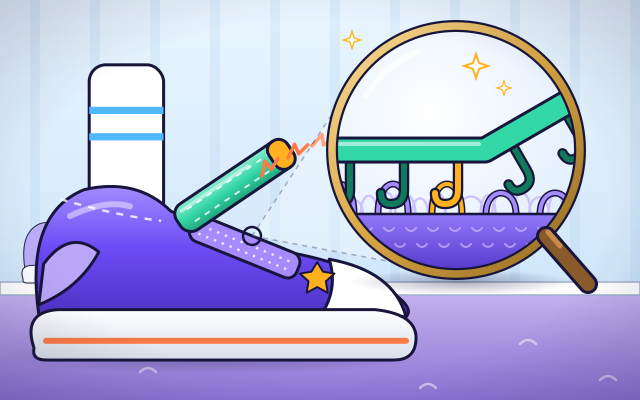
The interactive parts didn't load. The explanations below still work; try reloading the page.
Tiny hooks, tiny loops
- Rrrip! Ava's shoe strap peels open, and with a press it sticks shut again. There is no glue and no button. So what is holding it?
- Zoom in close. One strip is covered with tiny stiff hooks, like little walking sticks. The other is a tangle of soft thread loops.
- Press the strips together. The hooks push in among the loops, and many of them catch a loop. Each catch is tiny, but there are hundreds of them.
- Now pull the strips sideways. Every caught hook pulls on its loop at the same moment. They share the pull, so each one feels only a little. Together they are very strong.
- Peel one strip up from its end. Now only the row of hooks at the edge feels the pull. They let go, then the next row, then the next. A small pull is enough.
- That is the trick. When Ava runs and jumps, her foot pulls the strap sideways, and all the hooks hold together. To open it, she peels, and they let go row by row.
Hooks and loops, close up
This is a strap magnified many times. Tap each part.
- Hooks. The hooks are tiny and stiff, shaped like walking sticks or mushrooms. They are springy enough to bend open and let a loop go when you peel.
- Loops. The loops are soft threads that stand up in little arches. There are far more loops than hooks, so a hook nearly always finds one.
- A hook in a loop. Here a hook has caught a loop. One catch can hold only a tiny weight, about as much as a few paper clips.
- Hook strip. All the hooks are fixed to a tough strip. The strip is sewn or stuck to one side of the thing you want to fasten.
- Loop strip. The loops are part of a soft fabric strip. It goes on the other side of the thing you want to fasten.
- Peel edge. The free end is where you start to peel. Lifting it pulls on just the first row of hooks.
Peel or slide?
Drag the handle up to peel, or to the side to slide. The spring shows how hard you are pulling. Watch the hooks in the magnifier.
Experiment: Which needs a bigger pull: peeling the strips apart, or sliding them apart sideways?
- Drag the handle straight up and watch the hooks let go.
- Let go so the strips stick again.
- Now drag the handle sideways as far as you can.
What we found: Sliding sideways needs a far bigger pull. Sideways, every caught hook holds on together and shares the pull. Peeling pulls on only the row of hooks at the edge, so they let go one row at a time.
Turn on JavaScript to try it yourself.
The smallest patch that holds
Hang a 3 kg bucket with hook-and-loop. Choose where to fix it and how big the patch is. For 3 stars, use the smallest patch that holds.
Why peeling is easy and sliding is hard
Hook-and-loop fasteners were invented by an engineer who went for a walk and came home with prickly seed heads, called burrs, stuck to his clothes and his dog. Under a microscope, he saw that each burr was covered in tiny hooks that had caught in the loops of the cloth. He copied the idea with two strips: one of hooks and one of loops.
One tiny hook holding one tiny loop is very weak. It can carry about as much as a few paper clips. But a strap has hundreds of them. When you pull the two strips sideways, every caught hook pulls at the same time. They share the load, like many hands on a rope, so together they can hold a lot.
Peeling is different. When you lift one end, only the hooks right at the edge are pulled. Those few let go easily. Then the next row is at the edge, and it lets go too. You never fight all the hooks at once. That is why you can open a shoe with two fingers.
This is why straps are fitted so that the load pulls along them, not away from them. And it is why an old strap gets weak: fluff fills the hooks and some loops break, so fewer hooks can catch. Cleaning out the fluff helps. The burr comparison is not perfect: a burr's hooks grab anything fuzzy, but a hook strip is made to fit its own loop strip.
Key words
- Hook
- A tiny stiff, curved piece of plastic that can catch a loop.
- Loop
- A tiny soft arch of thread that a hook can catch.
- Shear
- A pull that tries to slide two things past each other.
- Peel
- Lifting one strip away from the other, starting at an end.
- Safety factor
- Making something stronger than it needs to be, just in case.
Check your thinking
-
What holds a hook-and-loop strap shut?
Show the answer
Hundreds of tiny hooks caught in tiny loops. There is no glue. Each hook catches a loop, and there are hundreds of them.
-
Why is peeling the strap so easy?
Show the answer
Only the hooks at the edge are pulled, one row at a time. You only ever fight one row of hooks, never all of them together.
-
You want a strap to hold a heavy bag. Which way should the bag pull on it?
Show the answer
Along the strap, so all the hooks share the pull. Pulling along the strap is the strong direction. Pulling away from it peels it off.
-
Why does an old, fluffy strap not hold as well as a new one?
Show the answer
Fluff fills the hooks, so fewer of them can catch a loop. Fewer hooks catching means fewer hooks sharing the pull.
-
Why does the peel force not depend on the length of the strip?
Show the answer
Only the row of hooks at the peel front carries the load at any moment. However long the strip, the pull acts on one row at a time. A longer strip just takes longer to peel.
You're a Everyday objects expert!
You watched, looked inside, tried it, solved the challenge and went deeper. Pick another question below, or switch the age at the top to see this topic another way.
More about everyday objects
 #161
Everyday objects
How do knots hold ropes and shoelaces together?
Tie virtual strands and explore how loops, tension, and friction affect holding.
#161
Everyday objects
How do knots hold ropes and shoelaces together?
Tie virtual strands and explore how loops, tension, and friction affect holding.
 #150
Everyday objects
How does a trigger spray bottle work?
Pull the trigger and follow liquid through a pump, valves, and nozzle.
#150
Everyday objects
How does a trigger spray bottle work?
Pull the trigger and follow liquid through a pump, valves, and nozzle.
 #151
Everyday objects
How do foaming soap dispensers make foam?
Watch liquid soap and air combine and pass through a fine mesh.
#151
Everyday objects
How do foaming soap dispensers make foam?
Watch liquid soap and air combine and pass through a fine mesh.
 #152
Everyday objects
How does a click pen extend and retract?
Inspect the spring and rotating mechanism inside a transparent retractable pen.
#152
Everyday objects
How does a click pen extend and retract?
Inspect the spring and rotating mechanism inside a transparent retractable pen.
Keep exploring
Games to play next
- Machine RepairFix levers, pulleys, gears and ramps so every contraption works.
- Science QuizzesOlly's Science Quiz Show: plants, animals, the body, weather, space and more, for every grade.
Guide for grown-ups
- How to start homeschooling: a step-by-step guide for familiesA guide for parents · 7 min read
Science games by grade
Science worksheets by grade
- Preschool Science Worksheets
- Pre-K Science Worksheets
- Kindergarten Science Worksheets
- 1st Grade Science Worksheets
- 2nd Grade Science Worksheets
- 3rd Grade Science Worksheets
- 4th Grade Science Worksheets
- 5th Grade Science Worksheets
- 6th Grade Science Worksheets
- 7th Grade Science Worksheets
- 8th Grade Science Worksheets