How does a car's steering system work?
Follow a turn of the steering wheel down the column, through a gear and a sliding bar, and out to the two front wheels.
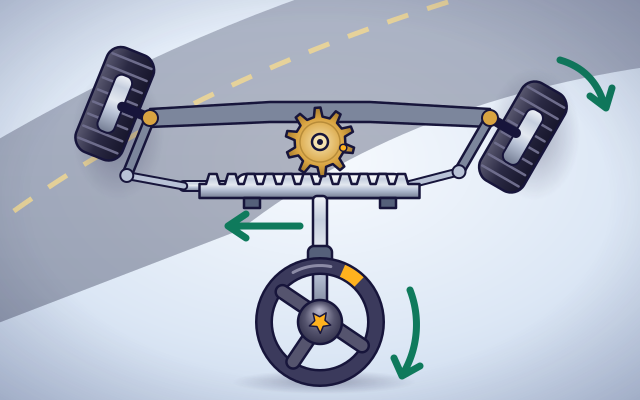
The big idea: The steering wheel turns a small gear called the pinion. The pinion slides a toothed bar called the rack left or right. Rods at the ends of the rack push and pull the front wheels so they point the same way.
It's like bicycle handlebars with a helper: a small gear on the steering wheel's shaft pushes a toothed bar sideways, and the bar turns both front wheels together.
The interactive parts didn't load. The explanations below still work; try reloading the page.
From your hands to the road
- The road bends, so the driver turns the steering wheel and the car follows the curve. But the steering wheel is inside the car. How does it reach the wheels on the road?
- The steering wheel is fixed to a long rod called the steering column. Turn the wheel and the whole column turns with it, carrying the twist down toward the front of the car.
- At the bottom of the column is a small gear, the pinion. Its teeth fit into the teeth of a straight bar, the rack. When the pinion turns, the rack slides sideways.
- A rod joins each end of the rack to a short lever on the wheel. When the rack slides, it pushes one lever and pulls the other, and both front wheels swing to point the same way.
- In a turn the inside wheel follows a smaller circle than the outside wheel. So the linkage is shaped to turn the inside wheel a little more. Then no tire has to scrub sideways.
- The steering wheel turns round more than once to swing the road wheels just a little. That trade makes steering light enough for your hands, and exact enough to park in a tight spot.
Look inside the steering
Tap each part, from the steering wheel to the road wheels. The round window shows the gear up close.
- Steering wheel. The driver turns the steering wheel to say where the car should go. Its big rim makes turning easy.
- Steering column. The steering column is the rod that joins the steering wheel to the steering gear at the front of the car.
- Pinion. The pinion is a small gear at the end of the column. Its teeth push on the teeth of the rack.
- Rack. The rack is a straight bar with teeth along it. When the pinion turns, the rack slides left or right inside a tube.
- Tie rod. A tie rod joins each end of the rack to a front wheel. It pushes or pulls the wheel as the rack slides.
- Steering arm. The steering arm is a short lever fixed to the wheel hub. The tie rod pushes on it, and the wheel swings round its pivot.
- Front wheel. Each front wheel swings on its own pivot near the wheel. The back wheels just follow along.
Follow the turn to the wheels
Drag the steering wheel round. Follow the motion through the pinion, the rack and the rods. Then look closely: do both front wheels turn by the same amount?
Experiment: In a turn, do both front wheels turn by the same angle?
- Turn the steering wheel all the way to the right.
- Look at the two wheel angles. Which wheel is on the inside of the turn?
- Now turn all the way to the left and compare again.
What we found: The inside wheel turns more than the outside wheel. In a right turn that is the right wheel, and in a left turn the left wheel. The inside wheel follows a smaller circle, so it needs a sharper angle.
Turn on JavaScript to try it yourself.
Stay on the winding road
Drive along the winding road to the garage without leaving the road.
From hands to tires
Steering has to turn a small twist of your hands into a swing of two heavy wheels. It does this with a few simple parts in a row.
First, the steering wheel turns a long rod called the steering column. At the bottom of the column is a small gear, the pinion. The pinion's teeth mesh with a straight bar that also has teeth, the rack. When the gear turns, it walks along the bar's teeth, so the bar slides sideways.
Next, a tie rod at each end of the rack joins it to a short lever on each front wheel. When the rack slides to one side, it pushes one lever and pulls the other. Both front wheels swing on their pivots and point the same way. It is like scooter handlebars, but with a gear in the middle to make the job easier.
The steering wheel turns a long way to move the road wheels a little. That makes steering light and careful. There is one more clever detail. In a bend the inside wheel travels a smaller circle than the outside wheel, so the linkage turns the inside wheel slightly more. Most cars also have power steering, which adds a helping push.
Key words
- Pinion
- The small round gear at the end of the steering column.
- Rack
- A straight bar with teeth that the pinion slides from side to side.
- Tie rod
- The rod that joins an end of the rack to a front wheel's steering arm.
- Steering ratio
- How far the steering wheel turns compared with how far the road wheels turn.
- Ackermann geometry
- A linkage shape that turns the inside wheel a little more than the outside wheel.
- Wheelbase
- The distance between a vehicle's front and rear axles.
Check your thinking
-
What does the pinion do when the steering wheel turns?
Show the answer
It turns too, and its teeth slide the rack sideways. The pinion is fixed to the column, so it turns with the steering wheel and pushes the rack along.
-
The rack slides to one side. What happens at the two front wheels?
Show the answer
One is pushed and the other is pulled, so both point the same way. The rack pushes one steering arm and pulls the other, so the wheels swing together.
-
Why does the inside wheel turn more than the outside wheel in a bend?
Show the answer
It follows a smaller circle, so it needs a sharper angle. Both wheels circle the same center, but the inside one is closer to it, so its circle is tighter.
-
Why does the steering wheel turn a long way to move the road wheels only a little?
Show the answer
It makes steering light for your hands and easy to do exactly. Trading a long turn for a small swing gives more force and finer control, like using a long lever.
-
Two vehicles steer their front wheels to the same angle. One has twice the wheelbase. How do their turning circles compare?
Show the answer
The longer one turns in a circle about twice as large. Turning radius is about wheelbase divided by the tangent of the steering angle, so it grows in step with wheelbase.
-
Which part joins the rack to a front wheel?
Show the answer
The tie rod. A tie rod runs from each end of the rack to the steering arm on the wheel.
You're a Flight & transportation expert!
You watched, looked inside, tried it, solved the challenge and went deeper. Pick another question below, or switch the age at the top to see this topic another way.
More about flight & transportation
 #131
Flight & transportation
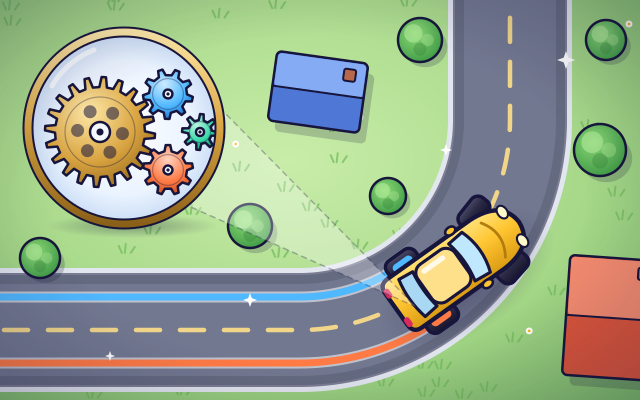
How does a differential help a car turn?
Drive around corners and compare the speeds of the inner and outer wheels.
#131
Flight & transportation
How does a differential help a car turn?
Drive around corners and compare the speeds of the inner and outer wheels.
 #132
Flight & transportation
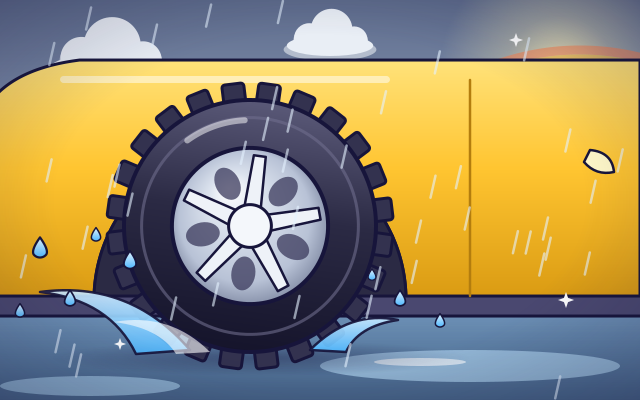
How do tires grip the road?
Compare tread, road conditions, and tire pressure in a driving and braking simulation.
#132
Flight & transportation
How do tires grip the road?
Compare tread, road conditions, and tire pressure in a driving and braking simulation.
 #133
Flight & transportation
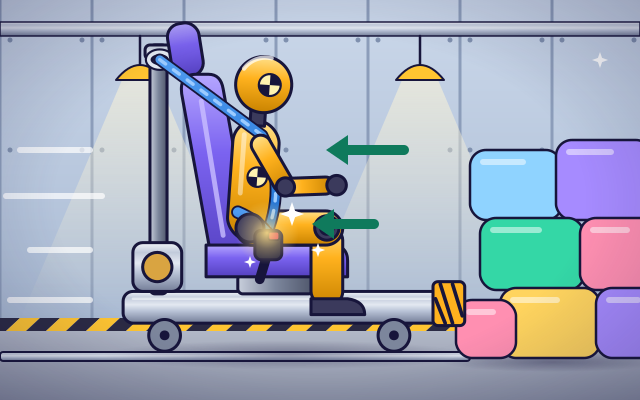
How do seat belts protect passengers?
Stop a model vehicle and observe how a belt restrains a passenger's continued motion.
#133
Flight & transportation
How do seat belts protect passengers?
Stop a model vehicle and observe how a belt restrains a passenger's continued motion.
 #134
Flight & transportation
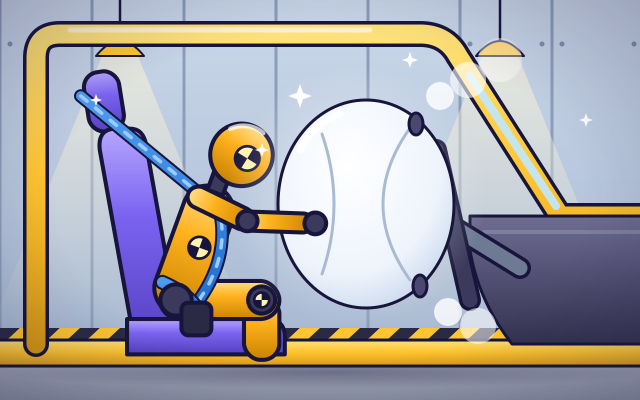
How do airbags cushion passengers?
Watch a simulated collision and explore inflation, cushioning, and passenger movement.
#134
Flight & transportation
How do airbags cushion passengers?
Watch a simulated collision and explore inflation, cushioning, and passenger movement.
Keep exploring
Games to play next
- City Driving AdventureExplore the city behind the wheel, park safely and collect roadside deliveries.
- Machine RepairFix levers, pulleys, gears and ramps so every contraption works.
- Plane Flight SimulatorTake off from the runway and thread numbered sky hoops in order. Every clean flight is a new personal best.
Guide for grown-ups
- How to start homeschooling: a step-by-step guide for familiesA guide for parents · 7 min read
Science games by grade
Science worksheets by grade
- Preschool Science Worksheets
- Pre-K Science Worksheets
- Kindergarten Science Worksheets
- 1st Grade Science Worksheets
- 2nd Grade Science Worksheets
- 3rd Grade Science Worksheets
- 4th Grade Science Worksheets
- 5th Grade Science Worksheets
- 6th Grade Science Worksheets
- 7th Grade Science Worksheets
- 8th Grade Science Worksheets