How do seat belts protect passengers?
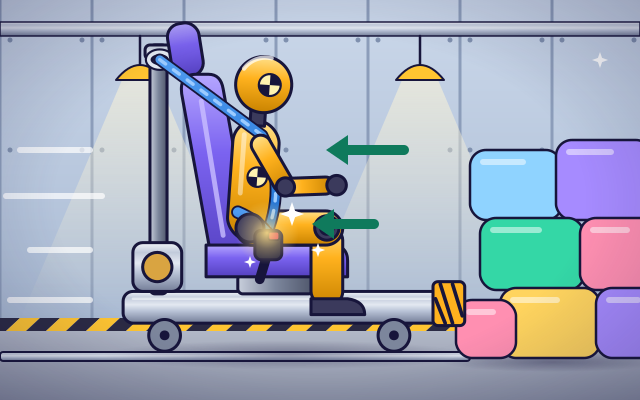
Things that are moving keep moving. See how a seat belt holds a passenger when the car stops suddenly, using a test dummy on a lab sled.
The big idea: When a car stops suddenly, the people inside keep moving forward until something stops them. A seat belt stops them gently, by holding the strong parts of the body.
It's like carrying a ball on a tray: stop walking suddenly and the ball rolls on by itself. A seat belt is like a hand holding the ball on the tray.
The interactive parts didn't load. The explanations below still work; try reloading the page.
Why we buckle up
- In a safety lab, engineers put a test dummy on a sled and stop it suddenly. They want to know: what happens to a passenger when a car stops fast?
- A ball rides on a cart. When a string pulls the cart to a stop, the ball rolls on. Moving things keep moving until something pushes back on them. This is called inertia.
- Now the sled, with no belt. The sled stops, but the dummy keeps moving at the same speed. It slides off the seat and lands in the soft foam.
- With the belt clicked in, the belt pushes back on the dummy's hips and chest as soon as the sled slows down. The dummy slows down together with the sled and stays in the seat.
- The belt winds onto a spring-loaded reel. Pull it slowly and it unrolls, so you can lean forward. In a sudden stop, a small catch drops into the reel's teeth and locks it.
- A belt works best low across the hips, across the middle of the chest, and snug. Buckle up on every ride, even a short one.
Look inside a seat belt
Here is a test seat with its belt, and a magnifier on the hidden reel. Tap each part to see what it does.
- Webbing. The belt itself is called webbing. It is woven from very strong threads and is wide and flat, so it spreads its push over your body instead of digging in.
- Shoulder guide. The shoulder guide is a smooth loop fixed high on the car's frame. The belt slides through it and comes down across your shoulder and chest.
- Retractor reel. The spare belt is rolled up on a reel. A spring inside keeps a gentle pull on it, so the belt stays snug and rolls away when you unbuckle.
- Locking catch. Next to the reel is a toothed wheel and a small catch. In a sudden stop a little weight swings forward and tips the catch into the teeth, so no more belt can come out.
- Latch plate. The latch plate is the metal tongue that slides along the belt. You push it into the buckle until it clicks.
- Buckle. Inside the buckle, a spring-loaded latch snaps into a hole in the tongue and holds it. Pressing the red button lifts the latch to let you out.
- Pretensioner. Modern belts have a pretensioner. When sensors feel a crash begin, it winds the reel back in an instant and pulls out any slack before you have moved.
Sled test: belt or no belt?
Click the belt on or off, change the speed and make the belt snug or loose. Each change runs the sled test. Watch the dummy and the force gauge.
Experiment: The sled stops suddenly. What happens to a dummy with no belt?
- Run the test with the belt off. Where does the dummy go?
- Click the belt on and run it again.
- Now make the belt loose, and then try a faster sled.
What we found: With no belt the dummy keeps moving forward at the sled's speed, because nothing pushes back on it. With a snug belt, the belt pushes back at once and the dummy stops with the sled. A loose belt lets the dummy move first and then catches it with a bigger jolt.
Turn on JavaScript to try it yourself.
Safety check
Get the dummy ready for the test. Set all four belt checks the safe way, then run the sled. For 3 stars, pass on the very first run.
How seat belts work
When you ride in a car, you are moving just as fast as the car is. If the car stops suddenly, the brakes and the road stop the car, but they do not stop you. Your body keeps moving forward until something pushes back on it. Scientists call this inertia: moving things keep moving until a force stops them.
A seat belt is that force. As soon as the car slows down, the belt pushes back on you, so you slow down together with the car. The belt is wide and flat, and it crosses your hips and your chest. Those are strong, bony parts of your body, so they can take the push.
The belt has some clever parts. It winds onto a reel with a spring, so it stays snug but lets you lean forward slowly. In a sudden stop, a little catch locks the reel so no more belt can come out. The webbing also stretches a tiny bit, like a very stiff rubber band, which makes the stop a little gentler.
The ball on a tray is a good picture of inertia, but a person is not a ball. A belt has to fit the person: low on the hips, across the chest and snug. That is why children ride in car seats or booster seats until the grown-up belt fits them properly.
Key words
- Inertia
- The way a moving thing keeps moving, and a still thing stays still, until a force changes it.
- Force
- A push or a pull. A seat belt pulls back on a passenger to slow them down.
- Retractor
- The spring-loaded reel that stores the belt, keeps it snug and locks in a sudden stop.
- Slack
- Looseness in a belt. Slack lets the body move before the belt starts to hold it.
- Kinetic energy
- The energy something has because it is moving. Faster things have much more of it.
- Crash-test dummy
- A model person full of sensors that engineers use to test how well cars protect people.
Check your thinking
-
A car stops suddenly. Why does a passenger keep moving forward?
Show the answer
Moving things keep moving until a force stops them. This is inertia. Nothing is pushing the passenger forward; nothing has stopped them yet.
-
Where should the lap part of the belt sit?
Show the answer
Low across the hip bones. Hip bones are strong and can take the belt's push. The tummy is soft, so the belt must not sit there.
-
Why is a loose belt worse than a snug one?
Show the answer
You move forward first, and then the belt has to stop you with a bigger jolt. With slack you keep moving while the car slows, so when the belt finally catches you it has less distance to stop you in.
-
A belted dummy needs 3 kN of average force to stop from 20 km/h. About how much from 40 km/h, over the same distance?
Show the answer
About 12 kN. Kinetic energy depends on speed squared. Twice the speed is four times the energy, so four times the force over the same distance.
-
Why is a seat belt wide and flat instead of thin like a rope?
Show the answer
A wide strap spreads the push over more of your body. The same push spread over a bigger area presses less hard on any one spot.
-
What does the reel do in a sudden stop?
Show the answer
A catch locks it so no more belt comes out. A small catch drops into the reel's teeth, so the belt holds you instead of unrolling.
You're a Flight & transportation expert!
You watched, looked inside, tried it, solved the challenge and went deeper. Pick another question below, or switch the age at the top to see this topic another way.
More about flight & transportation
 #134
Flight & transportation
How do airbags cushion passengers?
Watch a simulated collision and explore inflation, cushioning, and passenger movement.
#134
Flight & transportation
How do airbags cushion passengers?
Watch a simulated collision and explore inflation, cushioning, and passenger movement.
 #135
Flight & transportation
How do windshield wipers move back and forth?
Follow a rotating motor's movement through the linkage that sweeps the wiper blades.
#135
Flight & transportation
How do windshield wipers move back and forth?
Follow a rotating motor's movement through the linkage that sweeps the wiper blades.
 #136
Flight & transportation
How do tracked vehicles cross soft ground?
Compare wheels and tracks while moving the same load across simulated mud or sand.
#136
Flight & transportation
How do tracked vehicles cross soft ground?
Compare wheels and tracks while moving the same load across simulated mud or sand.
 #137
Flight & transportation
How do snowmobiles move over snow?
Explore the driving track and steering skis while navigating a snowy course.
#137
Flight & transportation
How do snowmobiles move over snow?
Explore the driving track and steering skis while navigating a snowy course.
Keep exploring
Games to play next
- City Driving AdventureExplore the city behind the wheel, park safely and collect roadside deliveries.
- Machine RepairFix levers, pulleys, gears and ramps so every contraption works.
- Plane Flight SimulatorTake off from the runway and thread numbered sky hoops in order. Every clean flight is a new personal best.
Guide for grown-ups
- How to start homeschooling: a step-by-step guide for familiesA guide for parents · 7 min read
Science games by grade
Science worksheets by grade
- Preschool Science Worksheets
- Pre-K Science Worksheets
- Kindergarten Science Worksheets
- 1st Grade Science Worksheets
- 2nd Grade Science Worksheets
- 3rd Grade Science Worksheets
- 4th Grade Science Worksheets
- 5th Grade Science Worksheets
- 6th Grade Science Worksheets
- 7th Grade Science Worksheets
- 8th Grade Science Worksheets