How does a differential help a car turn?
On a bend the outside wheel travels farther than the inside wheel. A box of gears called a differential lets each wheel turn at its own speed.
The big idea: In a turn the outside wheel has a longer path than the inside wheel, so it must spin faster. The differential's gears let the two wheels share the engine's push at different speeds.
It's like a marching band turning a corner: the marchers on the outside take long quick steps while the ones on the inside almost march in place.
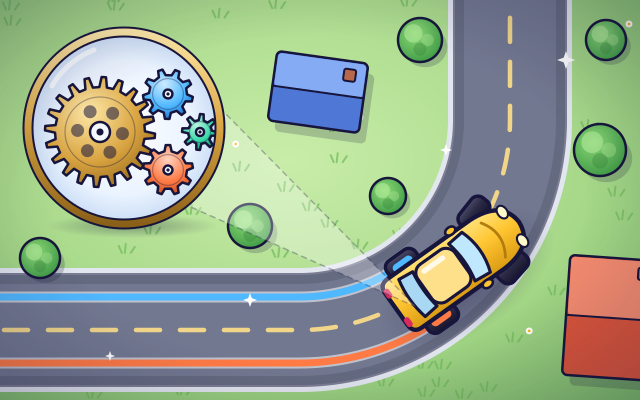
The interactive parts didn't load. The explanations below still work; try reloading the page.
Two wheels, two speeds
- A car drives up to a bend and turns. Here is a puzzle: do the wheels on both sides roll the same distance?
- Paint on the tires shows the answer. The outside wheel draws a big curve and the inside wheel a small one. A longer path in the same time means spinning faster.
- If one stiff bar joined both wheels, they would have to spin at the same speed. In a bend one tire would be dragged sideways and scrub on the road.
- Under the car, the engine turns a big ring gear. The ring gear carries a cage with small spider gears in it, and they push a gear on each wheel's shaft.
- In a bend the spider gears begin to roll on their pin. That lets one side gear run ahead while the other falls behind by the same amount.
- With a differential, both wheels keep pushing the car while each rolls at the speed its own path needs. The car turns smoothly, with no scrubbing.
Look inside a rear axle
This is a cutaway model of the back axle of a car, on a stand in a workshop. Tap each part to see what it does.
- Drive shaft. The drive shaft is a long spinning tube. It carries the engine's turning from the front of the car to the back axle.
- Pinion gear. The small pinion gear sits on the end of the drive shaft. Its slanted teeth push the teeth of the big ring gear.
- Ring gear. The big ring gear is pushed by the pinion. It turns the spinning around a corner, so now it points along the axle toward the wheels.
- Carrier. The carrier is a strong cage bolted to the ring gear. As the ring gear turns, the cage tumbles around with it, carrying the spider gears along.
- Spider gears. The spider gears ride inside the carrier. Going straight, they do not roll: they just push both side gears. In a bend they roll, letting one wheel go faster and the other slower.
- Side gears. There are two side gears, one for the left wheel and one for the right. The spider gears touch both, so both get pushed.
- Axle shafts. Instead of one bar joining both wheels, there are two separate axle shafts. That is the secret: each wheel has its own shaft, so each can spin at its own speed.
- Drive wheels. The two drive wheels push the car along. In a bend the outside one turns faster because it has farther to go.
Test pad: wide turns and tight turns
Drag the car closer to the cone or farther away to change the turn. Each wheel leaves a paint dot every time it turns once. Count the dots!
Experiment: What happens to the two wheel speeds when you make the turn tighter?
- Start with a wide turn. Look at the paint dots from each wheel.
- Drag the car close to the cone for a tight turn.
- Compare the two wheel-speed bars. Then switch the gears to Stuck and watch the tires.
What we found: The tighter the turn, the bigger the gap between the wheels. The outside wheel has a much longer way to go than the inside wheel, so it has to spin much faster. With the gears stuck, the wheels cannot do that, and a tire scrubs.
Turn on JavaScript to try it yourself.
Be the differential
You are the gears. For each bend, give more speed to the wheel that needs it, the right amount, then press Drive. Clear four bends without scrubbing a tire.
How a differential works
When a car goes around a bend, its wheels do not all travel the same distance. The wheels on the outside of the bend follow a big curve, and the wheels on the inside follow a smaller one. Both sides take the same time to get around, so the outside wheels must roll faster.
The front wheels of many cars are not joined to each other, so that is easy for them. But the two wheels that the engine drives both need power from the same engine. If a single stiff bar joined them, they would be forced to spin at the same speed, and in every bend one tire would scrub and squeal.
The differential fixes this. The engine turns a big ring gear, and the ring gear carries a cage with small spider gears inside. The spider gears touch a side gear on each wheel's shaft. On a straight road the spider gears just push both side gears along together. In a bend they roll, so one wheel can run ahead while the other falls behind.
The marching band comparison is not perfect: marchers choose their own step, but the gears do it without any thinking. The road itself slows the inside wheel, and the gears pass the leftover speed to the outside wheel. There is one weakness. If one wheel sits on ice, it can spin uselessly while the other does nothing, which is why some cars can lock the differential.
Key words
- Differential
- A set of gears that lets two wheels driven by one engine turn at different speeds.
- Ring gear
- The big gear that the engine turns. It carries the cage of small gears around with it.
- Spider gears
- Small gears inside the cage that roll only when the wheels need different speeds.
- Track width
- The distance between the left and right wheels on the same axle.
- Torque
- A turning push, like the push of your hand on a door handle.
- Axle shaft
- The bar that joins the differential to one wheel. A driven axle has two, one for each wheel.
Check your thinking
-
A car turns left. Which back wheel has to spin faster?
Show the answer
The right wheel, because it is on the outside of the bend. In a left turn the right wheel is on the outside. It has a longer path, so it must spin faster.
-
When do the spider gears roll on their pin?
Show the answer
Only when the two wheels need different speeds. Going straight, the spider gears just push both side gears. They roll only when one wheel must go faster than the other.
-
What would happen in a bend if one stiff bar joined both drive wheels?
Show the answer
A tire would scrub and slide on the road. Both wheels would be forced to the same speed, but their paths are different lengths, so one tire has to slide.
-
A car's carrier turns at 200 turns a minute and the inner wheel at 150. How fast is the outer wheel turning?
Show the answer
250 turns a minute. The carrier speed is the average of the two wheels: (150 + 250) / 2 = 200.
-
You make a turn tighter. What happens to the gap between the two wheel speeds?
Show the answer
The gap gets bigger. On a tight turn the outside path is much longer than the inside path, so the speeds differ more.
-
Why can a car with an open differential get stuck with one wheel on ice?
Show the answer
Both wheels get equal torque, so the gripping wheel gets only the tiny push the icy wheel can take. An open differential always shares torque equally. The slipping wheel can take very little, so the other wheel gets very little too.
You're a Flight & transportation expert!
You watched, looked inside, tried it, solved the challenge and went deeper. Pick another question below, or switch the age at the top to see this topic another way.
More about flight & transportation
 #132
Flight & transportation
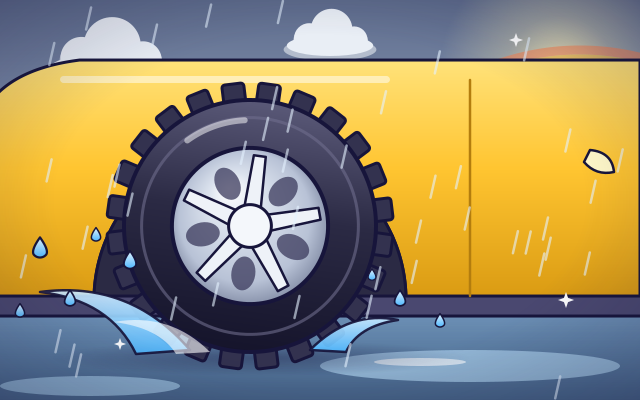
How do tires grip the road?
Compare tread, road conditions, and tire pressure in a driving and braking simulation.
#132
Flight & transportation
How do tires grip the road?
Compare tread, road conditions, and tire pressure in a driving and braking simulation.
 #133
Flight & transportation
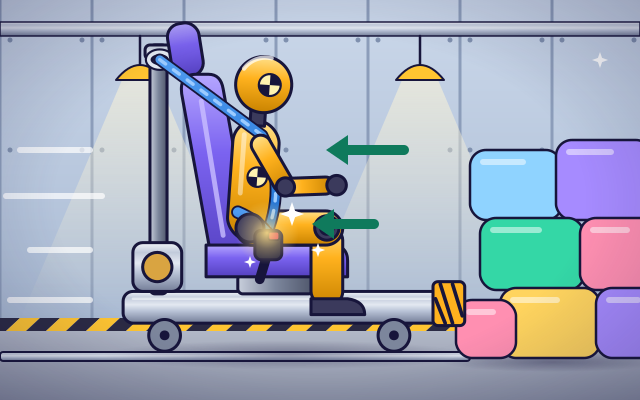
How do seat belts protect passengers?
Stop a model vehicle and observe how a belt restrains a passenger's continued motion.
#133
Flight & transportation
How do seat belts protect passengers?
Stop a model vehicle and observe how a belt restrains a passenger's continued motion.
 #134
Flight & transportation
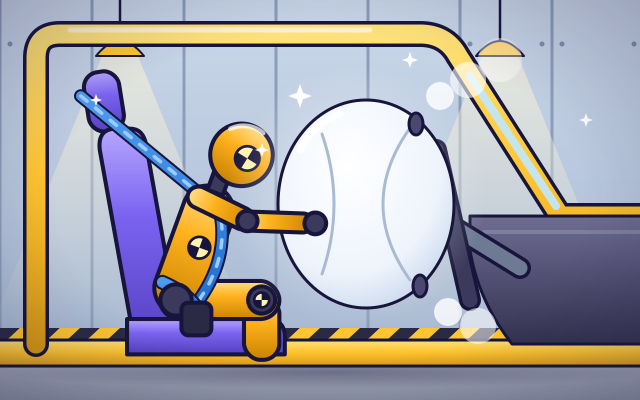
How do airbags cushion passengers?
Watch a simulated collision and explore inflation, cushioning, and passenger movement.
#134
Flight & transportation
How do airbags cushion passengers?
Watch a simulated collision and explore inflation, cushioning, and passenger movement.
 #135
Flight & transportation
How do windshield wipers move back and forth?
Follow a rotating motor's movement through the linkage that sweeps the wiper blades.
#135
Flight & transportation
How do windshield wipers move back and forth?
Follow a rotating motor's movement through the linkage that sweeps the wiper blades.
Keep exploring
Games to play next
- Machine RepairFix levers, pulleys, gears and ramps so every contraption works.
- City Driving AdventureExplore the city behind the wheel, park safely and collect roadside deliveries.
- Plane Flight SimulatorTake off from the runway and thread numbered sky hoops in order. Every clean flight is a new personal best.
Guide for grown-ups
- How to start homeschooling: a step-by-step guide for familiesA guide for parents · 7 min read
Science games by grade
Science worksheets by grade
- Preschool Science Worksheets
- Pre-K Science Worksheets
- Kindergarten Science Worksheets
- 1st Grade Science Worksheets
- 2nd Grade Science Worksheets
- 3rd Grade Science Worksheets
- 4th Grade Science Worksheets
- 5th Grade Science Worksheets
- 6th Grade Science Worksheets
- 7th Grade Science Worksheets
- 8th Grade Science Worksheets