How do tires grip the road?
A car touches the road in just four small patches of rubber. See how soft rubber, deep grooves and the right amount of air help those patches hold on.
The big idea: Tires grip because soft rubber presses into the road's tiny bumps. Grooves in the tread carry water away so the rubber can still touch the road in the rain.
It's like the soles of your sneakers: soft rubber holds a dry gym floor, and the grooves give water a way out on a wet sidewalk.
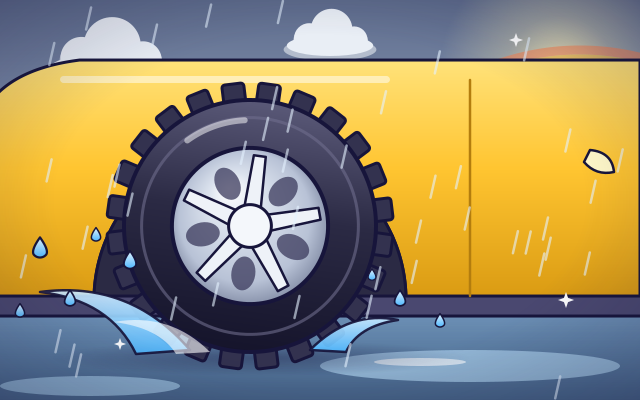
The interactive parts didn't load. The explanations below still work; try reloading the page.
Four patches of rubber
- A car is driving on a rainy day when the traffic light turns red. To stop in time, its tires have to hold on to the wet road. How do they do that?
- Each tire is squashed a little flat where it meets the road. That flat spot, called the contact patch, is only about the size of your hand. Four of them hold the whole car.
- Up close, a road is rough, like sandpaper. Soft rubber squashes into the tiny bumps and hooks on to them. That holding force is called friction, or grip.
- On a wet road, water gets between the rubber and the bumps. A smooth, worn-out tire cannot push it away. It rides up on a thin layer of water and slides.
- A good tire has a pattern of blocks and grooves called tread. The grooves are drains. Water rushes into them and out to the sides, so the rubber blocks can touch the road.
- With deep tread and the right amount of air, the four patches hold the wet road. The car slows down smoothly and stops at the line.
Slice through a tire
This tire has been sliced open to show its layers. Tap each part to see what it does.
- Tread blocks. The tread is the thick, bumpy rubber on the outside. Its blocks are the only part of the car that touches the road.
- Grooves. Grooves are the channels between the tread blocks. On a wet road they carry water out of the way so the blocks can touch the road.
- Sipes. Sipes are tiny slits cut into the tread blocks. They open as the tire rolls, making extra edges that hold on to wet, snowy or icy roads.
- Steel belts. Under the tread are belts woven from thin steel wires. They keep the tread flat and firm so it presses evenly on the road, and they help stop nails from poking through.
- Body plies. Layers of strong fabric cords run from one edge of the tire to the other. They are the tire's skeleton, holding its shape against the push of the air inside.
- Sidewall. The sidewall is the smooth side of the tire. It bends as the tire rolls over bumps, like a cushion, and it has the tire's size printed on it.
- Bead. The bead is a hoop of steel wire hidden in each inner edge of the tire. It grips the metal wheel tightly so the tire stays on and the air stays in.
- Air inside. The tire is filled with squeezed air. The air, not the rubber, holds up the car. Too little air or too much air changes the shape of the patch on the road.
Brake test: tread, road and air
Change the tire, the road and the air pressure. Each change sends the car on a brake test. Look in the magnifier to see what happens under the tire.
Experiment: On a wet road, which tire stops the car in the shortest distance?
- Keep the road wet and fit the new tire. Watch where the car stops.
- Now fit the worn tire, and then the bald one.
- Look in the magnifier: where does the water go? Then try a dry road.
What we found: On a wet road the new tire stops in the shortest distance. Its grooves give the water somewhere to go, so the rubber blocks can touch the road. The bald tire rides on a thin layer of water and slides much farther. On a dry road all three tires grip well.
Turn on JavaScript to try it yourself.
As fast as is safe
Three test roads: dry, wet and icy. Choose your tire, air pressure and speed. Stop before the soft foam blocks each time, going as fast as you safely can.
How tires grip
A car weighs as much as about twenty grown-ups, but it touches the ground in only four places. Each tire is pressed a little flat where it meets the road. That flat spot is called the contact patch, and it is only about as big as your hand. Starting, turning and stopping all have to happen through those four patches.
The patches hold on because of friction. A road looks smooth, but up close it is rough, like sandpaper. Tire rubber is soft, so it squashes into the tiny bumps and hooks on to them. The softer and warmer the rubber, and the harder it is pressed down, the better it holds.
Rain changes things. Water gets between the rubber and the road, and water is slippery. That is why tires have tread: a pattern of blocks with grooves between them. The grooves are like drains. Water rushes into them and out to the sides, so the blocks can still reach the road. A worn tire with shallow grooves cannot drain enough water, and it can float and slide.
Air matters too. Too little air and the middle of the tread lifts, so only the edges press down. Too much and the tire bulges, so only the middle touches. The boot comparison helps, but a tire also rolls very fast, so it has only a split second to push the water away. That is why drivers slow down in the rain.
Key words
- Friction
- The holding force between two surfaces that touch, such as rubber and road.
- Contact patch
- The small, flattened part of a tire that touches the road at any moment. It is about the size of a hand.
- Tread
- The pattern of rubber blocks and grooves around the outside of a tire.
- Hydroplaning
- When a tire rides up on a layer of water and loses touch with the road. It is also called aquaplaning.
- Tire pressure
- How hard the air inside a tire pushes outward. It is measured in bar or in pounds per square inch (psi).
- Friction coefficient
- A number, written μ, that says how well two surfaces grip. Dry road and rubber: about 0.8 to 0.9. Ice and rubber: about 0.1.
Check your thinking
-
What is the main job of the grooves in a tire's tread?
Show the answer
To carry water away so the rubber can touch the road. Grooves are drains. They give the water somewhere to go, so the tread blocks reach the road.
-
About how big is each tire's contact patch?
Show the answer
About the size of your hand. Only a hand-sized patch of each tire touches the road at one time, so four small patches hold the whole car.
-
On a dry road, how does a smooth tire's grip compare with a new tire's?
Show the answer
About the same: with no water to move, smooth rubber holds well. Grip comes from rubber touching the road. Grooves do not add grip on a dry road; their job is to move water. A bald tire is still unsafe, because rain can come at any time.
-
A car needs 16 m to brake from 50 km/h on a wet road. About how far does it need from 100 km/h on the same road?
Show the answer
About 64 m, four times as far. Braking distance is d = v² / (2μg). Doubling v makes v² four times as big, so the distance is four times as long.
-
A tire has too little air in it. What happens to its patch on the road?
Show the answer
The edges press down but the middle lifts, so it grips less well. With too little air the tire sags. Its edges carry the load, the middle lifts and the grooves pinch shut, so it holds the road less well.
-
Why do tires grip better than hard plastic wheels would?
Show the answer
Rubber is soft, so it squashes into the road's tiny bumps. Soft rubber molds itself around the rough road and hooks on. Hard plastic would only touch the tips of the bumps.
You're a Flight & transportation expert!
You watched, looked inside, tried it, solved the challenge and went deeper. Pick another question below, or switch the age at the top to see this topic another way.
More about flight & transportation
 #133
Flight & transportation
How do seat belts protect passengers?
Stop a model vehicle and observe how a belt restrains a passenger's continued motion.
#133
Flight & transportation
How do seat belts protect passengers?
Stop a model vehicle and observe how a belt restrains a passenger's continued motion.
 #134
Flight & transportation
How do airbags cushion passengers?
Watch a simulated collision and explore inflation, cushioning, and passenger movement.
#134
Flight & transportation
How do airbags cushion passengers?
Watch a simulated collision and explore inflation, cushioning, and passenger movement.
 #135
Flight & transportation
How do windshield wipers move back and forth?
Follow a rotating motor's movement through the linkage that sweeps the wiper blades.
#135
Flight & transportation
How do windshield wipers move back and forth?
Follow a rotating motor's movement through the linkage that sweeps the wiper blades.
 #136
Flight & transportation
How do tracked vehicles cross soft ground?
Compare wheels and tracks while moving the same load across simulated mud or sand.
#136
Flight & transportation
How do tracked vehicles cross soft ground?
Compare wheels and tracks while moving the same load across simulated mud or sand.
Keep exploring
Games to play next
- City Driving AdventureExplore the city behind the wheel, park safely and collect roadside deliveries.
- Plane Flight SimulatorTake off from the runway and thread numbered sky hoops in order. Every clean flight is a new personal best.
- Machine RepairFix levers, pulleys, gears and ramps so every contraption works.
Guide for grown-ups
- How to start homeschooling: a step-by-step guide for familiesA guide for parents · 7 min read
Science games by grade
Science worksheets by grade
- Preschool Science Worksheets
- Pre-K Science Worksheets
- Kindergarten Science Worksheets
- 1st Grade Science Worksheets
- 2nd Grade Science Worksheets
- 3rd Grade Science Worksheets
- 4th Grade Science Worksheets
- 5th Grade Science Worksheets
- 6th Grade Science Worksheets
- 7th Grade Science Worksheets
- 8th Grade Science Worksheets