How does sugar turn into caramel?
Heat sugar and watch it melt, turn gold, then amber, and fill the air with new smells. See what is happening to its molecules.
The big idea: When sugar gets very hot, about 160 degrees Celsius, heat breaks its molecules apart. The pieces join up in new ways. Some new molecules are brown, which gives caramel its color. Others float into the air, which gives caramel its smell. It is a chemical change, so it cannot be undone.
It's like toasting bread: heat turns it golden, then brown, with a smell that grows stronger. Leave it too long and it burns black, and you cannot un-toast it.
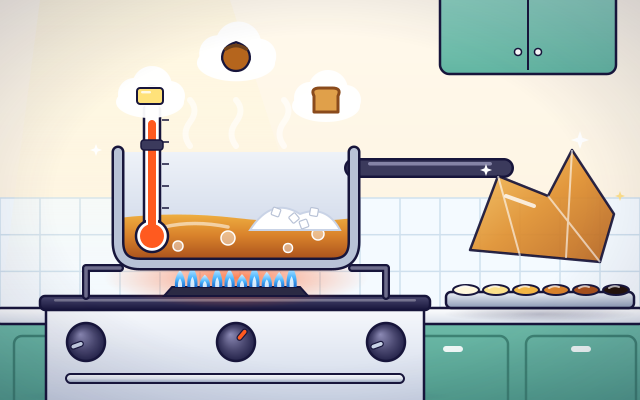
The interactive parts didn't load. The explanations below still work; try reloading the page.
How sugar becomes caramel
- Sugar is made of tiny, hard crystals. Inside each crystal, sugar molecules are stacked in neat rows. A grown-up is going to heat this sugar. Melted sugar is far hotter than boiling water, so children stay well back.
- As the thermometer climbs to about 160 degrees, the crystals melt. The neat rows of molecules fall apart, and the sugar becomes a clear, runny liquid.
- The heat keeps shaking the molecules. Each sugar molecule is made of two smaller parts joined together, and now they split. Bits break off and fly away. A pale yellow color appears.
- Other pieces join together into long chains. These new, big molecules are brown. The more of them there are, the darker the caramel: golden first, then amber.
- The small pieces that fly into the air are what you smell. Some smell like butter, some like nuts, some like toast. Plain sugar has almost no smell: all these smells are brand new.
- Poured onto a tray, the caramel cools so fast that its molecules have no time to line up into crystals again. It sets hard, shiny and see-through, like glass.
Look inside a pan of caramel
Tap the pan, the thermometer, the magnified molecules and the rest to see what each one shows.
- Burner flame. The flame heats the pan, and the pan heats the sugar. Cooks use gentle heat near the end, because caramel changes fast.
- Melted sugar. The melted sugar. Its color tells the cook how far the change has gone: clear, pale gold, golden, amber, dark.
- Sugar thermometer. A sugar thermometer goes much higher than one for a fever. Caramel starts at about 160 degrees and is burnt by about 200.
- Scent molecules. Small molecules that broke off the sugar float up into the air. Each kind has its own smell: buttery, nutty or toasty.
- Sugar molecules. Sugar molecules, hugely magnified. Each is made of two rings joined together. Heat first shakes them out of their neat rows, then splits each one in two.
- Brown chains. Pieces of broken sugar join into long chains. These big new molecules are what make caramel brown.
- Sugar glass. Cooled quickly, caramel sets hard and see-through, like glass. Its molecules are jumbled, not in neat rows as they were in the crystals.
Caramel lab: color, smell and molecules
Turn up the heat and watch the color, the smell and the molecules change. Take samples as you go. What happens if you keep heating?
Experiment: The caramel has just turned golden. What will happen if the heat stays on?
- Turn the heat to medium and wait for the sugar to melt.
- Take a sample when it is golden, another at amber and another when it is dark.
- Leave the heat on. Watch the color, the smell and the lens.
What we found: Caramel does not stop at golden. As long as it is hot, more molecules break and join, so it turns amber, then dark and bitter, and finally black and burnt. The hotter it gets, the faster it changes, and the change cannot be undone.
Turn on JavaScript to try it yourself.
Amber caramel to order
The order is amber caramel. Control the heat, and press Stop and pour when the color matches the card.
What heat does to sugar
Sugar looks simple: small, white, sweet crystals with almost no smell. Each crystal is made of a huge number of sugar molecules stacked in neat rows. When a cook heats sugar to about 160 degrees Celsius, far hotter than boiling water, the rows fall apart and the sugar melts into a clear liquid.
Then something more surprising happens. The heat shakes the molecules so hard that they break. Some of the pieces are small and light. They float up into the air, and your nose notices them as smells: buttery, nutty, toasty. Other pieces join together into long chains. These new, large molecules are brown, and they give caramel its color.
Melting is a physical change: melted sugar is still sugar. Caramelizing is a chemical change: new substances are made, and you cannot turn caramel back into sugar. The change also speeds up as the sugar gets hotter. That is why caramel can go from golden to burnt in a few seconds, and why cooks watch it so closely.
Cooled quickly, caramel sets into a hard, see-through solid, like glass. With cream and butter stirred in, it stays soft and chewy instead. The toast comparison only goes so far: bread browns in a slightly different way, because it contains proteins as well as sugars. And remember: melted sugar is dangerously hot and sticky, so making caramel is a job for grown-ups.
Key words
- Caramelization
- The change that happens when sugar gets hot enough to break apart and turn brown.
- Sucrose
- The chemical name for ordinary table sugar.
- Chemical change
- A change that makes new substances and cannot simply be undone, unlike melting or freezing.
- Molecule
- The smallest piece of a substance that is still that substance.
- Polymer
- A big molecule made of many small pieces joined in a chain.
- Amorphous solid
- A solid, like glass, whose molecules are jumbled and not in neat rows.
Check your thinking
-
What gives caramel its brown color?
Show the answer
New, big molecules made when broken pieces of sugar join together. Heat breaks sugar molecules, and some pieces link into long brown chains.
-
Why does caramel smell of butter, nuts and toast when plain sugar has no smell?
Show the answer
Small new molecules break off and float into the air. The small pieces that break off the sugar are light enough to reach your nose.
-
Can you turn caramel back into white sugar by cooling it down?
Show the answer
No. It is a chemical change, and the new molecules stay. Melting can be undone, but caramelizing makes new substances that do not change back.
-
Why is cooled caramel see-through and brittle, like glass?
Show the answer
It cooled too fast for its molecules to line up in neat rows again. With its molecules frozen in a jumble, it is an amorphous solid, the same kind of solid as glass.
-
A cook wants a deep color but has only a moment to pour. Which plan gives the most control?
Show the answer
High heat to melt the sugar, then lower heat as the color approaches. Lower heat near the end slows the reactions, so the right color lasts longer, without making the whole job slow.
You're a Everyday chemistry & materials expert!
You watched, looked inside, tried it, solved the challenge and went deeper. Pick another question below, or switch the age at the top to see this topic another way.
More about everyday chemistry & materials
 #421
Everyday chemistry & materials
Why do cut apples turn brown?
Explore exposed fruit surfaces, oxygen, and enzymes in a simplified browning animation.
#421
Everyday chemistry & materials
Why do cut apples turn brown?
Explore exposed fruit surfaces, oxygen, and enzymes in a simplified browning animation.
 #422
Everyday chemistry & materials
How do acids and bases behave?
Test fictional household samples with virtual indicators and explore neutralization.
#422
Everyday chemistry & materials
How do acids and bases behave?
Test fictional household samples with virtual indicators and explore neutralization.
 #423
Everyday chemistry & materials
Why does salt change how ice melts?
Compare pure water and saltwater as temperature changes in a virtual freezing experiment.
#423
Everyday chemistry & materials
Why does salt change how ice melts?
Compare pure water and saltwater as temperature changes in a virtual freezing experiment.
 #424
Everyday chemistry & materials
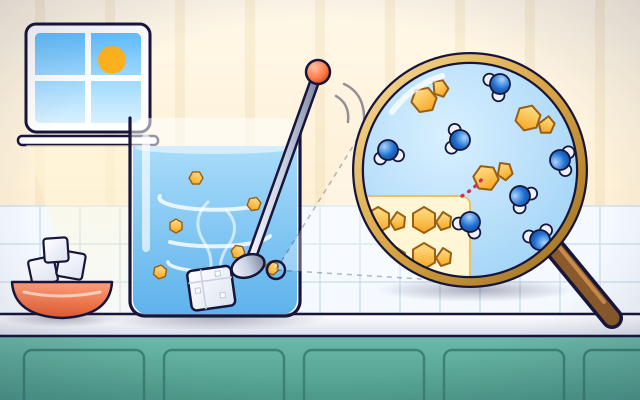
How does sugar dissolve in water?
Follow particles spreading through water and compare stirring and temperature.
#424
Everyday chemistry & materials
How does sugar dissolve in water?
Follow particles spreading through water and compare stirring and temperature.
Keep exploring
Games to play next
- Ratio KitchenScale recipes, fill ratio tables and find the better buy.
- Weather LabPredict the weather in a box, then run a fair test to find out why.
- Science QuizzesOlly's Science Quiz Show: plants, animals, the body, weather, space and more, for every grade.
Guide for grown-ups
- How to start homeschooling: a step-by-step guide for familiesA guide for parents · 7 min read
Science games by grade
Science worksheets by grade
- Preschool Science Worksheets
- Pre-K Science Worksheets
- Kindergarten Science Worksheets
- 1st Grade Science Worksheets
- 2nd Grade Science Worksheets
- 3rd Grade Science Worksheets
- 4th Grade Science Worksheets
- 5th Grade Science Worksheets
- 6th Grade Science Worksheets
- 7th Grade Science Worksheets
- 8th Grade Science Worksheets