How are carpets made?
A row of needles punches loops of yarn through a backing cloth. Leave the loops or cut them open, glue them in place, and you have a carpet.
The big idea: Needles push yarn through a backing cloth to make rows of loops. Loops can be left whole or cut into soft tufts. Glue on the back holds every tuft in.
It's like a sewing machine that never pulls its stitches tight: the needle pushes loops of thread through cloth, and every loop is left standing to make the soft top.
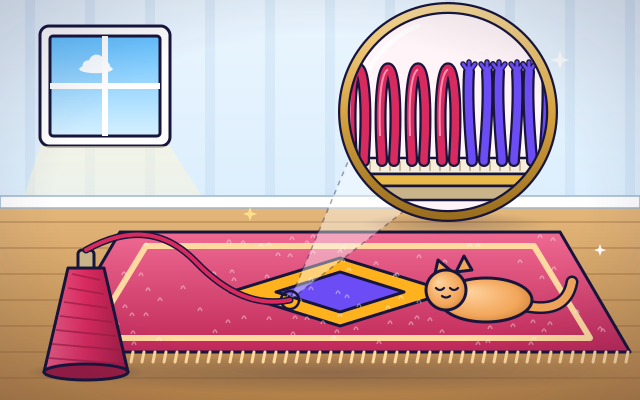
The interactive parts didn't load. The explanations below still work; try reloading the page.
How a carpet is tufted
- A carpet is warm, soft and quiet to walk on. Look closely and you will see why: it is made of thousands of little tufts of yarn, all standing up side by side.
- It starts with yarn, made of wool or of strong plastics such as nylon. Hundreds of cones stand on a rack, and each cone feeds one needle in the machine.
- Each needle pushes yarn down through a backing cloth. Underneath, a hook catches the yarn and holds it while the needle pulls back up. That leaves a loop. The cloth moves on, and the needle punches again.
- The loops can stay as they are. That is loop pile. Or a small knife can slice every loop open as it is made. That is cut pile, and it feels softer and fluffier.
- So far, you could pull the tufts straight out. So the back is coated with a rubbery glue called latex, and a second backing is pressed on. Now every tuft is locked in.
- The carpet is turned pile side up. Spinning blades shave the tips, so the surface is perfectly even. Then it is rolled up, ready to be laid in a room.
Look inside a carpet
This carpet has been sliced so you can see its layers. One half has loops and the other half has cut tufts. Tap each part.
- Loop pile. In loop pile, every tuft is a closed loop. Loops are springy and tough, so this carpet is good for busy places like halls and stairs.
- Cut pile. In cut pile, every loop has been sliced open, so each tuft ends in a soft brush of fibers. It feels cozy, but it squashes flat more easily and shows footprints.
- Primary backing. The primary backing is the cloth that the needles punch the yarn through. It holds the tufts in neat rows.
- Latex glue. A layer of rubbery latex glue soaks around the bottom of every tuft and locks it to the backing. Without it, you could pull the yarn out with your fingers.
- Secondary backing. A second, open-weave cloth is pressed into the glue. It stops the carpet from stretching and wrinkling.
- Underlay. Under the carpet lies a spongy pad called underlay. It makes the floor feel softer and quieter, and it helps the carpet last longer.
Tuft a sample and test it
Choose loops or cut tufts, then tap the needle to tuft a sample. It flips over and a shoe presses on it. Test both kinds. Which one springs back better?
Experiment: Which carpet springs back better after a shoe presses on it?
- Choose loop pile and tuft a whole sample.
- Watch the shoe press down and lift off. Does the pile stand up again?
- Now choose cut pile and test again. Record both.
What we found: The loops spring back almost all the way, because each loop is an arch held at both ends. Cut tufts are softer, but they lean over and stay a little flat, so you can see where the shoe was.
Turn on JavaScript to try it yourself.
Carpet for a hotel hallway
A hotel hallway needs a carpet that springs back at least 90% after it is walked on. Choose the pile, its height and how many tufts, then tuft and test it. Use as little yarn as you can.
How tufts make a carpet
For thousands of years, carpets were made by hand. A weaver tied one tiny knot of wool at a time onto threads stretched on a loom, row after row. A fine rug can have hundreds of thousands of knots and take many months to finish. Some carpets are still made this way, and others are woven on big looms.
Most carpets today are made in a much faster way called tufting. A tufting machine is like a giant sewing machine with hundreds of needles in a row. Each needle is threaded with yarn. All together, the needles punch down through a backing cloth. Under the cloth, little hooks catch the yarn, and when the needles lift, a row of loops is left behind. The cloth moves forward a tiny bit and the needles punch again, many times every second.
If the loops are left alone, the carpet has loop pile. Loops are springy, like little arches, so loop pile is tough and good for busy places. If a small knife cuts every loop open, the carpet has cut pile. The cut ends are soft and fluffy, which is lovely for bedrooms, but they squash flat more easily.
At first the tufts are only held by the cloth squeezing them, and you could pull them out. So the back is covered with rubbery latex glue, and a second cloth is pressed on. After drying, the carpet is flipped over and the tips are trimmed even. Our toothbrush comparison is not perfect: a toothbrush has stiff bristles in a hard handle, but a carpet has to be soft and bendy enough to roll up.
Key words
- Pile
- The soft top surface of a carpet, made of yarn tufts standing on end.
- Tufting
- Making carpet by punching loops of yarn through a backing cloth with needles.
- Loop pile
- Pile made of whole loops of yarn. It is springy and hard-wearing.
- Cut pile
- Pile whose loops have been cut open, leaving soft yarn ends.
- Backing
- The cloth layers at the bottom of a carpet that hold the tufts and keep it flat.
- Density
- How closely the tufts are packed together.
Check your thinking
-
How does a tufting machine make the pile of a carpet?
Show the answer
Needles punch loops of yarn through a backing cloth. Each needle carries yarn through the cloth, and a hook underneath keeps a loop there when the needle lifts.
-
Which carpet is the better choice for a busy school corridor?
Show the answer
Short, dense loop pile. Loops spring back and short, dense pile supports itself, so it stands up to thousands of feet.
-
What would happen to a tufted carpet with no latex glue on the back?
Show the answer
The tufts could be pulled out. Before the glue, the tufts are only pinched by the cloth. The latex locks each one in place.
-
How is cut pile made from loop pile?
Show the answer
A knife slices each loop open. A small knife cuts every loop as it forms, leaving two soft yarn ends.
-
A carpet has 40 tufts along every 10 cm, in both directions. About how many tufts are in one square meter?
Show the answer
160,000. 40 tufts per 10 cm is 400 per meter. 400 × 400 = 160,000 tufts in a square meter.
You're a Making everyday things expert!
You watched, looked inside, tried it, solved the challenge and went deeper. Pick another question below, or switch the age at the top to see this topic another way.
More about making everyday things
 #315
Making everyday things
How are metal objects cast?
Fill a virtual mold, allow cooling, and remove and finish the casting.
#315
Making everyday things
How are metal objects cast?
Fill a virtual mold, allow cooling, and remove and finish the casting.
 #316
Making everyday things
How is sandpaper made?
Coat backing with abrasive grains and compare the resulting surfaces on virtual wood.
#316
Making everyday things
How is sandpaper made?
Coat backing with abrasive grains and compare the resulting surfaces on virtual wood.
 #317
Making everyday things
How does welding join metal?
Watch a simplified joint form and inspect the connection after cooling.
#317
Making everyday things
How does welding join metal?
Watch a simplified joint form and inspect the connection after cooling.
 #318
Making everyday things
How does electroplating coat an object?
Follow preparation and plating as a thin metal layer forms on a surface.
#318
Making everyday things
How does electroplating coat an object?
Follow preparation and plating as a thin metal layer forms on a surface.
Keep exploring
Games to play next
- Machine RepairFix levers, pulleys, gears and ramps so every contraption works.
- Geometry Architect 3DCount, build and fold solids like a real architect.
- Sorting FactoryTurn a work order into if/else rules and watch the conveyor sort every item.
Guide for grown-ups
- How to start homeschooling: a step-by-step guide for familiesA guide for parents · 7 min read
Science games by grade
Science worksheets by grade
- Preschool Science Worksheets
- Pre-K Science Worksheets
- Kindergarten Science Worksheets
- 1st Grade Science Worksheets
- 2nd Grade Science Worksheets
- 3rd Grade Science Worksheets
- 4th Grade Science Worksheets
- 5th Grade Science Worksheets
- 6th Grade Science Worksheets
- 7th Grade Science Worksheets
- 8th Grade Science Worksheets