How does welding join metal?
A welder melts the edges of two metal parts so they flow together and cool into one solid piece.
The big idea: Welding does not stick metal together like glue. It melts the edges of both parts into one little puddle. When the puddle cools and hardens, the two parts have become a single piece of metal.
It's like two ice cubes that melt a little where they touch and then freeze into one block of ice.
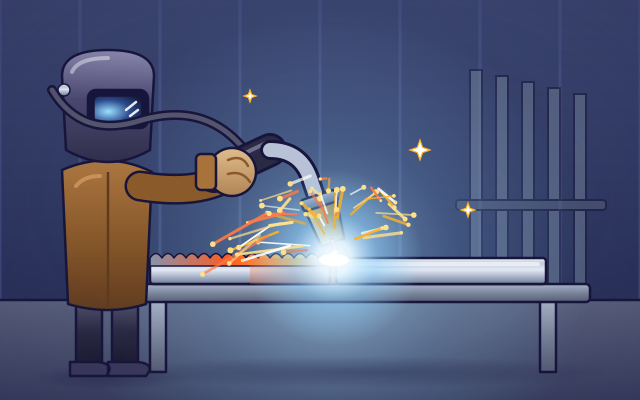
The interactive parts didn't load. The explanations below still work; try reloading the page.
How a weld is made
- Rosa is a welder. She needs to join two steel bars for a gate. Glue would be too weak, and bolts could work loose. She is going to melt the bars together.
- Rosa wears a helmet with a dark window, thick gloves and a heavy jacket. She squeezes the trigger, and electricity leaps from a thin wire to the steel. This bright, hot spark is called an arc.
- The arc melts the edge of each bar, and the tip of the wire too. All three flow together into a small glowing puddle called the weld pool.
- Hot liquid metal soaks up air, and that leaves bubbles and weak spots. So the torch blows a blanket of special gas over the puddle to push the air away.
- Rosa moves the torch steadily along the gap. The puddle follows the arc. Behind it the metal cools and hardens into a rippled line called a bead.
- When it cools, there are no longer two bars with a gap. There is one piece of steel. A good weld is as strong as the metal around it.
Look inside a weld being made
The torch and the steel are cut open so you can see what happens. Tap each part.
- Welding helmet. The arc is far too bright to look at. The helmet's window turns dark the instant the arc starts, and the shell keeps sparks off the welder's face.
- Torch nozzle. The welder holds the torch and points its nozzle at the gap. The wire comes out of the middle and the gas flows out all around it.
- Wire. A motor pushes a thin steel wire out through the torch. The wire carries the electricity, and its tip keeps melting off to add extra metal to the puddle.
- Arc. The arc is electricity jumping through the air from the wire to the steel, like a tiny bolt of lightning that stays on. It is hot enough to melt steel in a blink.
- Shielding gas. Gas from a tall bottle flows out of the nozzle and covers the puddle like a blanket. It keeps air out so no bubbles form in the hot metal.
- Weld pool. Right under the arc is a small puddle of liquid metal. It is made from the melted edges of both bars and the melted wire, all mixed together.
- Weld bead. Behind the torch the puddle cools and hardens into a rippled line called the bead. The ripples show where the puddle froze, a little at a time.
- Base metal. The parts being joined are called the base metal. Their edges must melt, or the new metal will only sit on top like a blob of wax.
Weld three joints and test them
Three pairs of bars are waiting: one set to low heat, one to medium and one to high. Drag the torch along the gaps, then cool them, cut them open and pull.
Experiment: Which heat makes the strongest joint in these bars?
- Drag the torch along all three gaps, or press Weld.
- Press Cool and test. Look at each joint cut open.
- Watch the pull test. Which joints snap, and why?
What we found: With low heat the edges of the bars never melted, so the new metal just sat on top and the joint snapped. With too much heat the puddle fell right through and left holes. With medium heat both edges melted and mixed with the wire, and the joint was as strong as the bar itself.
Turn on JavaScript to try it yourself.
Thin, medium and thick
Weld three joints: thin sheet, a medium bar and a thick plate. Choose the heat for each one. All three must pass the pull test.
Melting two into one
There are many ways to join metal. You can bolt it, glue it or squeeze it together with rivets. In all of those, the two parts stay two parts. Welding is different. It melts the edges of both parts so that they flow together, and when the metal cools there is only one part left.
To melt steel you need a lot of heat in a very small spot. An arc welder makes that heat with electricity. The machine pushes electric current down a thin wire, and the current jumps from the tip of the wire to the steel as a bright, hot arc, like a tiny bolt of lightning that stays switched on.
The arc melts the edges of the two parts and the tip of the wire into a small puddle of liquid metal. Gas blowing out of the torch keeps the air away from it, because air would leave bubbles in the metal. As the welder moves along, the puddle behind the torch cools and hardens into a rippled line called a bead.
Getting the heat right is the skill. With too little heat the parts do not melt, and the new metal only sits on top. With too much, the puddle falls through and leaves a hole. Welding is a job for trained grown-ups in helmets, gloves and jackets, because the arc is hot enough to burn and far too bright to look at.
Key words
- Arc
- Electricity jumping through a gap, making bright light and great heat.
- Weld pool
- The small puddle of melted metal under the arc.
- Bead
- The line of hardened metal left behind as the weld pool cools.
- Base metal
- The metal of the parts that are being joined.
- Shielding gas
- Gas blown over the hot metal to keep air away from it.
- Heat input
- How much heat goes into each little bit of the joint.
Check your thinking
-
How is welding different from gluing?
Show the answer
Welding melts both parts so they become one piece. The melted edges mix and harden into a single piece of metal.
-
Why must nobody look at a welding arc?
Show the answer
Its light is bright enough to hurt your eyes. The arc gives off very bright light. Welders use a dark filter, and everyone else looks away.
-
A welder uses too little heat. What does the joint look like inside?
Show the answer
New metal sits on top, but the bars underneath never melted together. If the edges of the bars do not melt, nothing mixes. The blob on top can snap off.
-
What is the gas from the torch for?
Show the answer
It keeps air away from the melted metal. Air would leave bubbles in the hot metal. The gas pushes the air away.
-
Which needs more heat to weld: thin sheet or a thick plate?
Show the answer
The thick plate. Thick metal carries heat away quickly, so it takes more heat to melt its edges.
-
At 20 volts, which settings give the highest heat input?
Show the answer
200 amperes at 4 millimeters per second. 20 times 200 divided by 4 is 1,000 joules per millimeter. The other two both give 500.
You're a Making everyday things expert!
You watched, looked inside, tried it, solved the challenge and went deeper. Pick another question below, or switch the age at the top to see this topic another way.
More about making everyday things
 #318
Making everyday things
How does electroplating coat an object?
Follow preparation and plating as a thin metal layer forms on a surface.
#318
Making everyday things
How does electroplating coat an object?
Follow preparation and plating as a thin metal layer forms on a surface.
 #319
Making everyday things
How do laser cutters cut shapes?
Draw a pattern and guide a simulated laser along the cutting path.
#319
Making everyday things
How do laser cutters cut shapes?
Draw a pattern and guide a simulated laser along the cutting path.
 #320
Making everyday things
How do waterjet cutters cut tough materials?
Guide a simulated jet through different samples and compare the cuts.
#320
Making everyday things
How do waterjet cutters cut tough materials?
Guide a simulated jet through different samples and compare the cuts.
 #321
Making everyday things
How do computer-controlled machines carve precise parts?
Follow a cutting tool as it removes material along planned paths.
#321
Making everyday things
How do computer-controlled machines carve precise parts?
Follow a cutting tool as it removes material along planned paths.
Keep exploring
Games to play next
- Machine RepairFix levers, pulleys, gears and ramps so every contraption works.
- Geometry Architect 3DCount, build and fold solids like a real architect.
- Sorting FactoryTurn a work order into if/else rules and watch the conveyor sort every item.
Guide for grown-ups
- How to start homeschooling: a step-by-step guide for familiesA guide for parents · 7 min read
Science games by grade
Science worksheets by grade
- Preschool Science Worksheets
- Pre-K Science Worksheets
- Kindergarten Science Worksheets
- 1st Grade Science Worksheets
- 2nd Grade Science Worksheets
- 3rd Grade Science Worksheets
- 4th Grade Science Worksheets
- 5th Grade Science Worksheets
- 6th Grade Science Worksheets
- 7th Grade Science Worksheets
- 8th Grade Science Worksheets