How does electroplating coat an object?
Electricity carries tiny bits of metal through a liquid and lays them on an object as a thin, even coat.
The big idea: In electroplating, an object and a bar of metal hang in a bath. Electricity pulls tiny charged bits of metal, called ions, off the bar, through the liquid and onto the object, where they build a thin metal coat.
It's like a magnet picking up iron filings: the electric pull draws tiny bits of metal to the object until they cover it all over.
The interactive parts didn't load. The explanations below still work; try reloading the page.
How a key gets a copper coat
- A shiny tap, a gold-colored ring, a silvery screw: many metal things wear a very thin coat of another metal. How do you put a coat of metal on a steel key?
- First the key is scrubbed in a cleaning bath and rinsed. Even a greasy fingerprint would stop the new metal from sticking, and the coat would peel off.
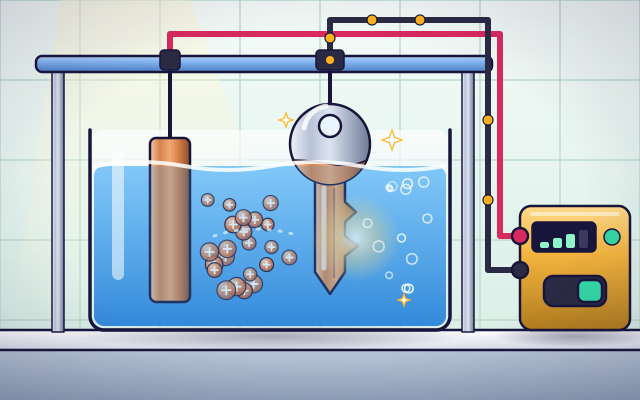
- The clean key hangs in a bath of blue liquid with copper dissolved in it. A bar of solid copper hangs beside it. Wires connect both to a power supply.
- Switch on, and electricity flows. Tiny charged bits of copper, called ions, leave the copper bar and are pulled through the liquid toward the key.
- Look very closely at the key. Each copper ion that touches it is given electricity from the wire and turns into solid copper. Row by row, the coat builds up.
- Lift the key out and rinse it. It is covered all over with shiny copper, in a layer thinner than a hair. The copper bar has shrunk a little: that is where the coat came from.
Look inside a plating tank
This plating tank is running. Tap each part to find out its job.
- Power supply. The power supply pushes electricity around the loop, always in the same direction. Turn it up and the coat grows faster.
- Wires. Wires carry the electricity. Tiny particles called electrons flow through one wire to the key and come back to the power supply through the other.
- Copper bar. The copper bar is where the coat comes from. Little by little its copper goes into the liquid, so the bar slowly gets thinner.
- Plating bath. The bath is water with copper dissolved in it, which is what makes it blue. Bits of metal can travel through the liquid from the bar to the key.
- Copper ions. An ion is a tiny bit of metal with an electric charge. Copper ions have a positive charge, so they are pulled toward the key, which is negative.
- The key. The object being plated hangs on a metal hook, so electricity can reach it. Whatever is wired to the negative side gets the coat.
- New metal layer. Each ion that reaches the key turns into solid copper and stays there. Millions and millions of them build a thin, even layer over the whole key.
Clean, dip, switch on
Two greasy keys are waiting. Clean just one of them, then dip both in the bath and switch on. Lift them out and compare.
Experiment: One key is cleaned and the other is still greasy. What happens when both are plated?
- Press Clean. Only the first key goes into the cleaner.
- Dip both keys in the plating bath and switch the power on.
- When the coat is thick enough, switch off and lift the keys out. Look closely at each one.
What we found: The clean key came out with a smooth, even coat of copper. On the greasy key the copper could not touch the steel wherever there was grease, so the coat was patchy and flaked off. That is why every part is cleaned and rinsed before it is plated.
Turn on JavaScript to try it yourself.
Plate to order
A customer wants a smooth copper coat between 8 and 12 micrometers thick. Clean the key, pick a current, and switch off at the right moment.
Painting with electricity
Lots of metal things are not what they seem. A shiny bathroom tap is usually brass with a very thin coat of chrome on top. Many silvery screws are steel with a coat of zinc to stop them rusting. Putting a thin coat of one metal on top of another is called plating, and the most common way to do it uses electricity.
The object is cleaned until it is spotless, then hung in a bath of liquid that has metal dissolved in it. A bar of the same metal hangs in the bath too. Wires connect the object and the bar to a power supply, making a loop that electricity can flow around.
When the power is switched on, tiny charged bits of metal called ions are pulled through the liquid toward the object. When an ion touches the object it turns back into solid metal and sticks. More and more arrive and build up a layer. At the same time the metal bar slowly dissolves, which keeps the bath topped up.
The longer the power stays on, and the stronger the current, the thicker the coat. Platers have to be patient, though. If they turn the current up too high, the metal piles on too quickly and comes out rough and dull instead of smooth and shiny. Plating baths contain strong chemicals, so the work is done in factories and laboratories by trained people wearing gloves and goggles.
Key words
- Ion
- A tiny bit of matter that carries an electric charge.
- Anode
- The bar of metal that the coat comes from. It is joined to the positive side.
- Cathode
- The object being coated. It is joined to the negative side.
- Electrolyte
- A liquid that conducts electricity because it contains ions.
- Current density
- How much electricity flows onto each bit of the surface.
- Micrometer
- One thousandth of a millimeter. A human hair is about 70 micrometers thick.
Check your thinking
-
Why must an object be cleaned before it is plated?
Show the answer
So the new metal can touch the surface and stick. Grease gets in the way. Where the metal cannot touch the surface, the coat peels off.
-
Where does the metal for the coat come from?
Show the answer
From the bar of metal in the bath, which slowly dissolves. The bar gives up its metal to the bath, and the bath gives it to the object.
-
How can you make the coat thicker?
Show the answer
Leave the power on for longer. The longer the electricity flows, the more metal arrives and the thicker the coat grows.
-
What goes wrong if the current is turned up much too high?
Show the answer
The coat comes out rough and dull. The metal piles on too quickly to settle into a smooth layer.
-
In the bath, what carries the electric charge from the anode to the cathode?
Show the answer
Ions moving through the solution. Electrons flow only in the wires and the metal parts. In the electrolyte, charge is carried by ions.
-
The same charge is passed through a copper bath and a silver bath. Why is far more silver deposited?
Show the answer
Each silver ion needs one electron, each copper ion needs two, and silver atoms are heavier. The number of atoms deposited is the number of electrons divided by the ion's charge. Silver's charge is plus one, and each atom also has more mass.
You're a Making everyday things expert!
You watched, looked inside, tried it, solved the challenge and went deeper. Pick another question below, or switch the age at the top to see this topic another way.
More about making everyday things
 #319
Making everyday things
How do laser cutters cut shapes?
Draw a pattern and guide a simulated laser along the cutting path.
#319
Making everyday things
How do laser cutters cut shapes?
Draw a pattern and guide a simulated laser along the cutting path.
 #320
Making everyday things
How do waterjet cutters cut tough materials?
Guide a simulated jet through different samples and compare the cuts.
#320
Making everyday things
How do waterjet cutters cut tough materials?
Guide a simulated jet through different samples and compare the cuts.
 #321
Making everyday things
How do computer-controlled machines carve precise parts?
Follow a cutting tool as it removes material along planned paths.
#321
Making everyday things
How do computer-controlled machines carve precise parts?
Follow a cutting tool as it removes material along planned paths.
 #322
Making everyday things
How is leather made?
Follow prepared hides through tanning, drying, softening, and finishing.
#322
Making everyday things
How is leather made?
Follow prepared hides through tanning, drying, softening, and finishing.
Keep exploring
Games to play next
- Machine RepairFix levers, pulleys, gears and ramps so every contraption works.
- Geometry Architect 3DCount, build and fold solids like a real architect.
- Sorting FactoryTurn a work order into if/else rules and watch the conveyor sort every item.
Guide for grown-ups
- How to start homeschooling: a step-by-step guide for familiesA guide for parents · 7 min read
Science games by grade
Science worksheets by grade
- Preschool Science Worksheets
- Pre-K Science Worksheets
- Kindergarten Science Worksheets
- 1st Grade Science Worksheets
- 2nd Grade Science Worksheets
- 3rd Grade Science Worksheets
- 4th Grade Science Worksheets
- 5th Grade Science Worksheets
- 6th Grade Science Worksheets
- 7th Grade Science Worksheets
- 8th Grade Science Worksheets