How are metal objects cast?
Hot liquid metal is poured into a hollow sand mold. It cools into a solid copy of the shape, which is then broken out, trimmed and polished.
The big idea: A liquid takes the shape of whatever holds it. Casting uses that: melted metal fills a shaped hollow in a mold, then cools and hardens into exactly that shape.
It's like making ice pops or jelly in a mold: the liquid takes the shape of the hollow it is poured into, and keeps that shape when it turns solid.
The interactive parts didn't load. The explanations below still work; try reloading the page.
How a bell is cast
- This bronze bell is one solid piece of metal, with no joins at all. Metal is far too hard to squeeze into a shape like this. So how is it made? It is poured!
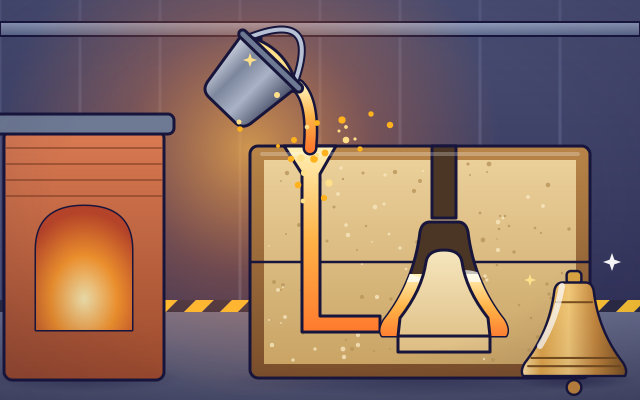
- First comes a wooden copy of the bell, called a pattern. Damp, sticky sand is packed tightly around it. When the pattern is lifted out, it leaves a hollow in exactly its shape. That hollow is the mold.
- Next, lumps of bronze are heated in a furnace. At about 950 degrees Celsius they melt into a glowing liquid. Foundry workers wear special clothes, gloves and face shields to stay safe.
- The liquid metal is poured into a hole in the top of the mold. It runs through a channel and fills the hollow from the bottom up, pushing the air out through a second hole.
- Now the metal cools. The sand soaks up its heat, and the glowing liquid slowly turns back into hard, solid bronze. It shrinks a little as it hardens, so extra metal waits in a pocket on top to fill the gap.
- When the bell is cool, the sand mold is broken away. The extra metal from the pouring channels is sawn off, and the rough bell is ground and polished until it shines.
Look inside a sand mold
Here is a sand mold sliced open, ready for pouring. Tap each part to see what it is for.
- Flask. The flask is the box that holds the sand. It comes in two halves, so the mold can be opened to take the pattern out and then closed again.
- Molding sand. Molding sand is damp and mixed with clay, so it holds its shape like good sandcastle sand. It does not melt or burn when the hot metal touches it.
- Cavity. The cavity is the empty space left by the pattern. Whatever shape the cavity is, the metal will become.
- Core. A bell is hollow. To make the hollow, a shaped lump of hard sand called a core sits inside the cavity. The metal flows around it, and afterwards the core is knocked out.
- Sprue. The sprue is the channel the metal is poured into. A funnel at the top catches the stream, and a tunnel carries it down and into the bottom of the cavity.
- Riser. The riser is a pocket of extra metal on top of the cavity. Metal shrinks as it hardens, and the riser feeds in more liquid so no hole is left inside the bell.
- Vent. As metal fills the mold, the air inside has to get out. A thin vent lets it escape. Trapped air would leave bubbles in the bell.
Pour and cool
Set how hot the metal is, then pour it and watch the mold fill and cool. Try a cooler pour and a hotter one. What changes?
Experiment: What happens if the metal is only just melted when you pour it?
- Set the heat so the metal is only just melted. Pour and wait for it to cool.
- Look at what comes out of the mold.
- Now heat the metal more and pour again. Compare the two bells.
What we found: Metal that is only just melted cools and hardens on its way through the cold mold, so it stops before the bell is complete. Hotter metal stays runny long enough to fill every corner. But far too hot is not good either: it leaves the surface rough.
Turn on JavaScript to try it yourself.
Cast and finish a bell
Cast a perfect bell: choose the heat, pour, wait for it to cool, open the mold, cut off the extra metal and polish it.
Why liquid metal copies a shape
Metal seems like the hardest stuff there is. But heat it enough and it melts into a liquid that pours like water. Aluminum melts at about 660 degrees Celsius, bronze at about 950 and iron at about 1,200. That is far hotter than any kitchen oven, so it is done in special furnaces by trained workers in protective gear.
A liquid has no shape of its own. It takes the shape of whatever holds it. Casting uses this simple idea. First a model of the object, called a pattern, is pressed into damp sand. When the pattern is lifted out, it leaves a hollow in exactly its shape. Liquid metal is poured into the hollow. When the metal cools, it becomes solid again, and it keeps the shape of the hollow.
A few things can go wrong. If the metal is not hot enough, it hardens before it reaches every corner, and the casting comes out with a piece missing. If the air cannot get out, it leaves bubbles. And because metal shrinks a little as it hardens, a pocket of spare metal is left on top to keep the shape full. Then the mold has to stay closed until the metal is solid all the way through.
People have been casting metal for more than five thousand years. Today engine parts, frying pans, taps, statues, manhole covers and bells are all cast. Our ice pop comparison is not perfect: water gets bigger when it freezes, but metal gets smaller, and you can use an ice pop mold again while a sand mold is broken to get the casting out.
Key words
- Casting
- Making an object by pouring a liquid into a mold and letting it turn solid. The object itself is also called a casting.
- Mold
- A block with a hollow in the shape of the object to be made.
- Pattern
- A model of the object, used to make the hollow in the sand.
- Melting point
- The temperature at which a solid turns into a liquid.
- Riser
- A pocket of extra liquid metal that tops up the casting as it shrinks.
- Superheat
- How much hotter the liquid metal is than its melting point when it is poured.
Check your thinking
-
Why does the metal come out shaped like a bell?
Show the answer
A liquid takes the shape of the hollow that holds it, and keeps it when it hardens. The metal flows into every part of the hollow, and when it cools it stays that way.
-
What happens if the metal is poured when it is only just melted?
Show the answer
It hardens before the mold is full. The cold mold takes heat out of the metal as it flows. Metal that starts barely melted freezes on the way.
-
What is the riser for?
Show the answer
It holds extra metal to fill the gap as the casting shrinks. Metal shrinks as it hardens. The riser tops the casting up, so no hole is left inside.
-
Why does a mold need a vent or a second opening?
Show the answer
To let the air out as the metal comes in. The hollow starts out full of air. If the air cannot escape, it gets trapped as bubbles in the metal.
-
Bronze melts at about 950 °C and is poured at 1,080 °C. What is its superheat?
Show the answer
130 °C. Superheat is the pouring temperature minus the melting point: 1,080 − 950 = 130 °C.
You're a Making everyday things expert!
You watched, looked inside, tried it, solved the challenge and went deeper. Pick another question below, or switch the age at the top to see this topic another way.
More about making everyday things
 #316
Making everyday things
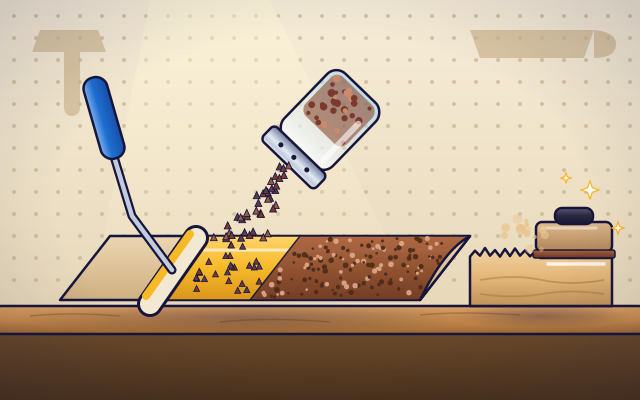
How is sandpaper made?
Coat backing with abrasive grains and compare the resulting surfaces on virtual wood.
#316
Making everyday things
How is sandpaper made?
Coat backing with abrasive grains and compare the resulting surfaces on virtual wood.
 #317
Making everyday things
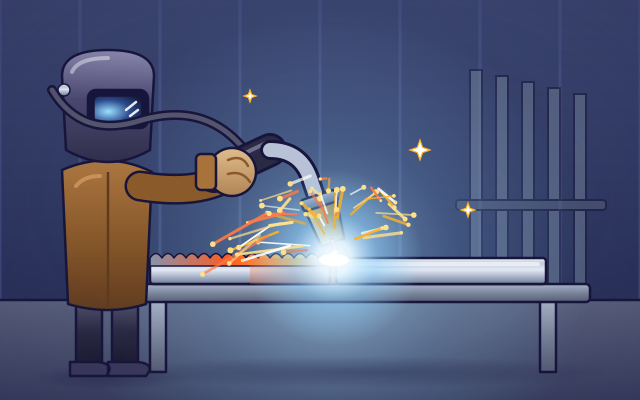
How does welding join metal?
Watch a simplified joint form and inspect the connection after cooling.
#317
Making everyday things
How does welding join metal?
Watch a simplified joint form and inspect the connection after cooling.
 #318
Making everyday things
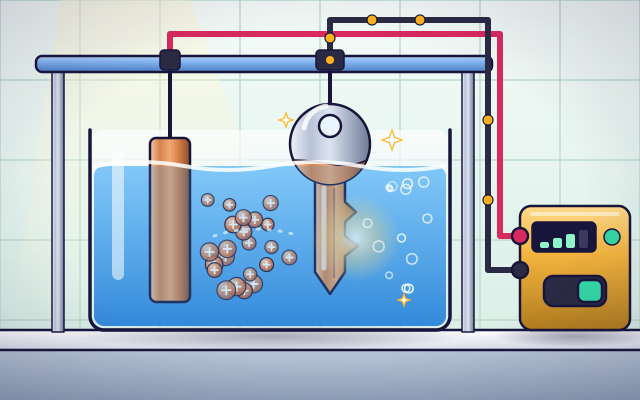
How does electroplating coat an object?
Follow preparation and plating as a thin metal layer forms on a surface.
#318
Making everyday things
How does electroplating coat an object?
Follow preparation and plating as a thin metal layer forms on a surface.
 #319
Making everyday things
How do laser cutters cut shapes?
Draw a pattern and guide a simulated laser along the cutting path.
#319
Making everyday things
How do laser cutters cut shapes?
Draw a pattern and guide a simulated laser along the cutting path.
Keep exploring
Games to play next
- Machine RepairFix levers, pulleys, gears and ramps so every contraption works.
- Geometry Architect 3DCount, build and fold solids like a real architect.
- Sorting FactoryTurn a work order into if/else rules and watch the conveyor sort every item.
Guide for grown-ups
- How to start homeschooling: a step-by-step guide for familiesA guide for parents · 7 min read
Science games by grade
Science worksheets by grade
- Preschool Science Worksheets
- Pre-K Science Worksheets
- Kindergarten Science Worksheets
- 1st Grade Science Worksheets
- 2nd Grade Science Worksheets
- 3rd Grade Science Worksheets
- 4th Grade Science Worksheets
- 5th Grade Science Worksheets
- 6th Grade Science Worksheets
- 7th Grade Science Worksheets
- 8th Grade Science Worksheets