How do pulleys make lifting easier?
Loop a rope around more pulleys and more pieces of rope share the weight. The pull gets easier, but you have to pull the rope farther.
The big idea: One pulley only changes the direction of your pull. But when the rope loops around a pulley on the load, two pieces of rope hold it up and each carries half. More loops mean a lighter pull and a longer pull.
It's like carrying a heavy box with friends: four friends each lift a quarter of the weight. In a pulley system, the pieces of rope are the friends.
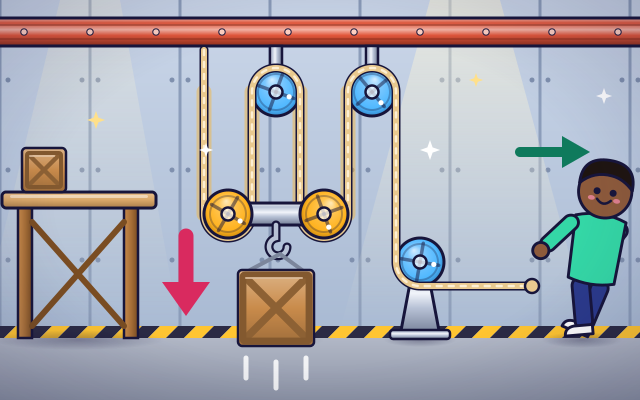
The interactive parts didn't load. The explanations below still work; try reloading the page.
Sharing the weight with rope
- Sam needs to get a heavy crate up onto the platform. He tries to lift it with his arms, but it is far too heavy. Time for a rope and some pulleys!
- A pulley is a wheel with a groove for a rope. With one pulley fixed to the beam, Sam can pull along the floor to lift the crate up. That is handy, but the pull is just as hard as lifting, because one piece of rope holds all the weight.
- Now Sam loops the rope around a second pulley fixed to the crate. Count the pieces of rope holding the crate: two! Each one carries half of the weight, so Sam only has to pull half as hard.
- Sam threads the rope through even more pulleys. Now four pieces of rope hold the crate, and each one carries a quarter of the weight. The pull is four times easier.
- There is a catch. To lift the crate a little, every one of the four ropes has to get shorter. So Sam must pull four times as much rope. Easier pull, longer pull.
- Up it goes, onto the platform! Cranes, elevators, flagpoles and sailboats all use pulleys. A big crane's hook hangs from many loops of steel cable, so its motor can lift many tons.
Look closely at a pulley system
Tap each part of the pulley system to see what it does.
- Beam. A strong support that holds everything up. It carries the weight of the load and the pull of the rope.
- Fixed pulley. A grooved wheel fixed to the beam. It does not make the pull any easier. It turns the pull around, so pulling one way lifts the load up.
- Movable pulley. A pulley fixed to the load, so it moves up with it. The rope loops under it, so two pieces of rope share the weight it carries.
- Rope. A single rope threaded around all the pulleys. It pulls just as hard at every point along its length.
- Supporting strands. The pieces of rope that hold up the load. Count them: with four, each one carries a quarter of the weight.
- Load. The thing being lifted. Gravity pulls it down with a force called its weight.
- Pull. Your pull on the free end of the rope, called the effort. It only has to match what one piece of rope carries.
Pulley lab: count the ropes
Thread the rope through more pulleys, then pull. Compare how hard Sam pulls with how far he has to walk.
Experiment: You thread the rope so that four pieces hold the crate instead of two. What changes?
- Thread one more pulley so two ropes hold the box. Pull until the box reaches the top.
- Look at how far Sam walked.
- Thread two more pulleys so four ropes hold it, and pull again.
What we found: More ropes holding the load means each one carries less, so the pull gets easier. But every one of those ropes has to get shorter for the load to rise, so Sam must pull more rope. Four ropes: a quarter of the pull, four times the rope.
Turn on JavaScript to try it yourself.
Just enough rope
Lift the 40 kg crate onto the platform. Sam can pull with 150 N, and he has room to walk only 2.5 m. Choose how many ropes hold the crate.
Why more pulleys make lifting easier
A pulley is a wheel with a groove around its edge for a rope. The simplest way to use one is to fix it up high and run a rope over it. Then you can pull down, or along the ground, to lift something up. That is useful, because pulling down lets you use your own weight. But the pull is just as big as the load, because one piece of rope is holding everything.
The clever part comes when you fix a pulley to the load itself. Now the rope goes down to the load, around the pulley and back up again, so two pieces of rope hold the load. A rope pulls equally hard all along its length, so each piece carries half the weight. Your pull only has to match one of them. Add more loops, and three, four or more pieces of rope share the weight.
The price is distance. For the load to go up by one hand-width, every piece of rope holding it must get one hand-width shorter. With four pieces, that is four hand-widths of rope that you have to pull. It is the same trade a lever makes: a gentle pull over a long way instead of a hard pull over a short way.
Our comparison with friends carrying a box is not perfect. Friends each use their own muscles, but the rope's pieces are all one rope, pulled by one person. And real pulleys rub a little as they turn, so a real pull is always a bit harder than the simple sum says. Cranes, elevators, flagpoles, window blinds and sailboats all use pulleys.
Key words
- Pulley
- A wheel with a groove for a rope, used to redirect or share a pull.
- Fixed pulley
- A pulley attached to a support. It changes the direction of the pull, not its size.
- Movable pulley
- A pulley attached to the load, so that two pieces of rope hold it up.
- Block and tackle
- Several pulleys and one rope arranged to share a load among many strands.
- Tension
- How hard a rope is pulling.
- Efficiency
- How much of your effort does useful work instead of being wasted by rubbing.
Check your thinking
-
Why is it easier to lift a load when the rope loops through more pulleys?
Show the answer
More pieces of rope share the weight, so each carries less. The load weighs the same, but it is shared among more pieces of rope, and you pull with the force of just one.
-
Four ropes hold a crate. To lift it 1 m, how much rope must you pull?
Show the answer
4 m. All four pieces of rope must get 1 m shorter, so 4 m of rope comes through your hands.
-
What does a single pulley fixed to the ceiling do?
Show the answer
It changes the direction of your pull, but not how hard you pull. Only one piece of rope holds the load, so you pull with the full weight. But you can pull down instead of lifting up.
-
A 600 N load is raised 2 m with a three-strand system. The effort is 250 N. What is the efficiency?
Show the answer
80%. Work out = 600 N × 2 m = 1,200 J. Rope pulled = 3 × 2 m = 6 m, so work in = 250 N × 6 m = 1,500 J. 1,200 ÷ 1,500 = 0.8.
-
Which of these uses pulleys?
Show the answer
A flagpole. A pulley at the top of a flagpole lets you pull the rope down to send the flag up.
-
Why is a real pulley system a little harder to pull than the simple sum says?
Show the answer
The pulleys rub as they turn, which wastes some of your pull. Friction at each pulley uses up a little of your effort, so you have to pull a bit harder.
You're a Forces & mechanisms expert!
You watched, looked inside, tried it, solved the challenge and went deeper. Pick another question below, or switch the age at the top to see this topic another way.
More about forces & mechanisms
 #105
Forces & mechanisms
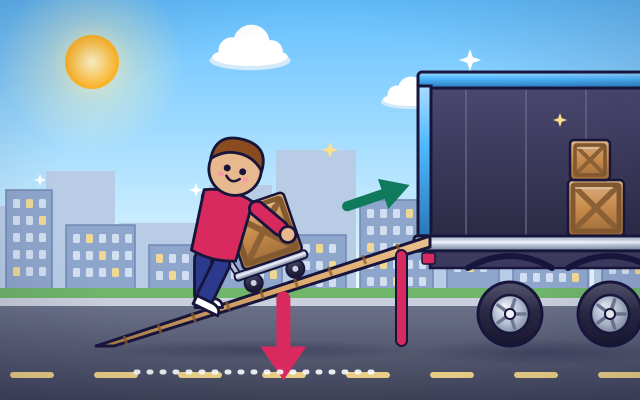
How do ramps reduce lifting effort?
Change a ramp's slope and compare pushing force, travel distance, and height gained.
#105
Forces & mechanisms
How do ramps reduce lifting effort?
Change a ramp's slope and compare pushing force, travel distance, and height gained.
 #106
Forces & mechanisms
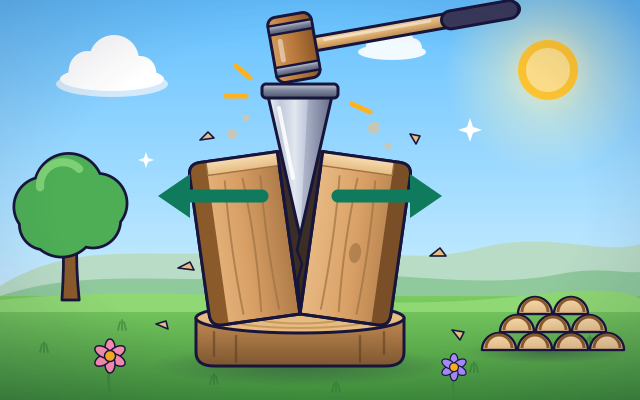
How do wedges split or separate materials?
Push different wedge shapes into model materials and watch forces move the sides apart.
#106
Forces & mechanisms
How do wedges split or separate materials?
Push different wedge shapes into model materials and watch forces move the sides apart.
 #107
Forces & mechanisms
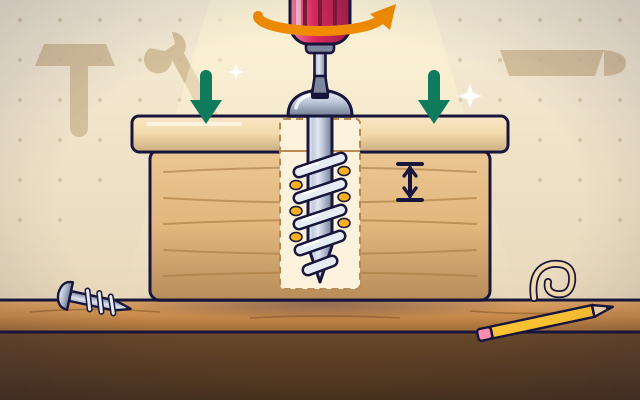
How do screw threads hold things together?
Turn screws with different thread spacing and compare forward movement and fastening action.
#107
Forces & mechanisms
How do screw threads hold things together?
Turn screws with different thread spacing and compare forward movement and fastening action.
 #108
Forces & mechanisms
How do gears change speed and direction?
Connect different-sized gears and observe rotation speed, direction, and turning force.
#108
Forces & mechanisms
How do gears change speed and direction?
Connect different-sized gears and observe rotation speed, direction, and turning force.
Keep exploring
Games to play next
- Machine RepairFix levers, pulleys, gears and ramps so every contraption works.
- Marble MountainLay straights, curves, drops and splitters to roll marbles down the mountain.
- Bridge LabBuild a bridge from beams, brace it with triangles, and stay on budget.
Guide for grown-ups
- How to start homeschooling: a step-by-step guide for familiesA guide for parents · 7 min read
Science games by grade
Science worksheets by grade
- Preschool Science Worksheets
- Pre-K Science Worksheets
- Kindergarten Science Worksheets
- 1st Grade Science Worksheets
- 2nd Grade Science Worksheets
- 3rd Grade Science Worksheets
- 4th Grade Science Worksheets
- 5th Grade Science Worksheets
- 6th Grade Science Worksheets
- 7th Grade Science Worksheets
- 8th Grade Science Worksheets