How do ramps reduce lifting effort?
Too heavy to lift? Roll it up a ramp! A long, gentle slope needs only a small push, but you have to push a longer way.
The big idea: A ramp lets you raise a heavy load with a small push, because the ramp itself holds up most of the weight. The gentler the slope, the smaller the push, but the longer the way to the top.
It's like climbing a hill: the zigzag path is longer, but each step is easy. Going straight up is short, but very hard work.
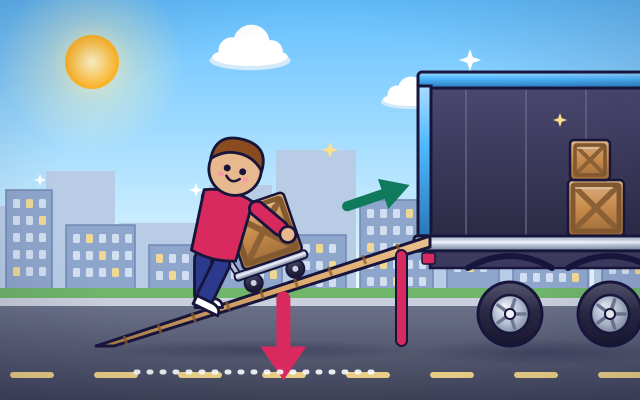
The interactive parts didn't load. The explanations below still work; try reloading the page.
A small push up a long slope
- Zoe has to get a heavy crate up into the truck. She tries to lift it straight up, but it is far too heavy. Lifting means holding all of its weight.
- So she leans a long, strong board from the ground up to the truck. Now there is a slope to roll the crate up. A ramp is one of the simplest machines of all. It has no moving parts!
- Zoe puts the crate on a cart and pushes it up the ramp. Now a small, steady push is enough to move the same heavy crate, all the way up to the truck.
- Why is it easier? The ramp pushes up on the cart and carries most of its weight. Only a small part of the weight tries to roll the cart back down, and that small part is all Zoe has to beat.
- A steeper ramp is shorter, but more of the weight pulls back, so the push must be bigger. A gentler ramp needs a smaller push, but it is longer, so Zoe has to push farther.
- Into the truck it rolls! Look around and you will see ramps everywhere: wheelchair ramps, moving-truck ramps, roads that zigzag up mountains, and even playground slides.
Look closely at a ramp
Tap each part of the picture to see what it does.
- Ramp. The sloping surface. It must be strong and firmly fixed at the top so it cannot slip.
- Height. How high the load has to be raised. However you get there, the load ends up this much higher.
- Length. How far you travel along the slope. A longer ramp to the same height is gentler.
- Load. The thing being moved. Wheels help a lot, because rolling rubs much less than sliding.
- Push. Your push along the slope, called the effort. On a gentle ramp it is much smaller than the load's weight.
- Weight. Gravity pulls the load straight down. On a slope, only part of that pull tries to roll the load backward.
- Support from the ramp. The ramp pushes back on the cart, straight out from its surface. This push carries most of the weight, so you do not have to.
Ramp lab: steep or gentle?
Drag the foot of the ramp to change its slope, then press Push! Compare the push needed with the distance Zoe has to go.
Experiment: Which ramp lets Zoe push the cart up with the smallest force?
- Make the ramp short and steep. Look at the push arrow, then press Push!
- Make the ramp long and gentle and try again.
- Compare the push needed with how far Zoe walked each time.
What we found: The long, gentle ramp needs the smallest push, because the ramp holds up more of the load's weight. But Zoe has to push much farther. The steep ramp is short, but the push is so big that she may not manage it at all.
Turn on JavaScript to try it yourself.
The shortest ramp that works
Get the 60 kg crate into the truck. Zoe can push with 200 N. For 3 stars, use the shortest ramp she can still push it up.
Why a ramp makes lifting easier
Lifting something straight up means holding all of its weight. A ramp gives you another way to get it up high: along a slope. When a load rests on a slope, the slope pushes back on it and carries most of the weight. Only a small part of the weight tries to roll the load back down, and that is the only part you have to push against.
How small? It depends on how gentle the ramp is. If the ramp is three times as long as it is high, you need about a third of the push. If it is six times as long, you need about a sixth. That is why ramps for wheelchairs are made long and gentle.
But you never get something for nothing. The gentle ramp is longer, so you have to push the load a longer way. A small push for a long way, or a big push for a short way: either way, the load ends up just as high. Our hill comparison fits well here: the zigzag path and the straight path both reach the top.
Real ramps also have friction, which is the rubbing between the load and the ramp. Wheels make friction small, which is why movers use carts. Dragging a box without wheels up a long ramp can be harder than you expect, because friction pulls back the whole way. Ramps are not only for loading trucks. Slides, mountain roads, and even the spiral ridge on a screw are all slopes at work.
Key words
- Ramp (inclined plane)
- A flat, sloping surface used to raise or lower a load with less force.
- Slope
- How steep something is.
- Friction
- A force that resists rubbing or rolling between two surfaces.
- Work
- What you do when you push something along: a bigger push or a longer distance means more work.
- Normal force
- The push of a surface on something resting on it, straight out from the surface.
- Mechanical advantage
- How many times a machine multiplies your push.
Check your thinking
-
Which ramp needs the smallest push to raise the same crate to the same height?
Show the answer
A long, gentle ramp. The gentler the slope, the more of the weight the ramp carries, so the smaller the push you need.
-
What do you give up when you use a long, gentle ramp?
Show the answer
You have to push the load a longer distance. A smaller push over a longer distance does the same job as a bigger push over a shorter distance.
-
Why is pushing a cart up a ramp easier than lifting the load straight up?
Show the answer
The ramp holds up most of the weight, so you only push against a small part of it. The load weighs the same, but the ramp's surface pushes back and carries most of it.
-
With friction, which ramp wastes the most energy when raising the same load to the same height?
Show the answer
The longest ramp, because friction acts over a greater distance. Friction work is about μ × W × run, and a longer ramp has a longer run. The useful work, W × h, is the same for all of them.
-
Why are wheelchair ramps long and gentle?
Show the answer
So the push needed to go up is small. A gentle slope means only a small part of the weight pulls back, so it takes little force to roll up.
-
Why do movers put heavy boxes on carts with wheels before using a ramp?
Show the answer
Rolling rubs much less than sliding, so less push is wasted. Friction pulls back all the way up a ramp. Wheels make that friction small.
You're a Forces & mechanisms expert!
You watched, looked inside, tried it, solved the challenge and went deeper. Pick another question below, or switch the age at the top to see this topic another way.
More about forces & mechanisms
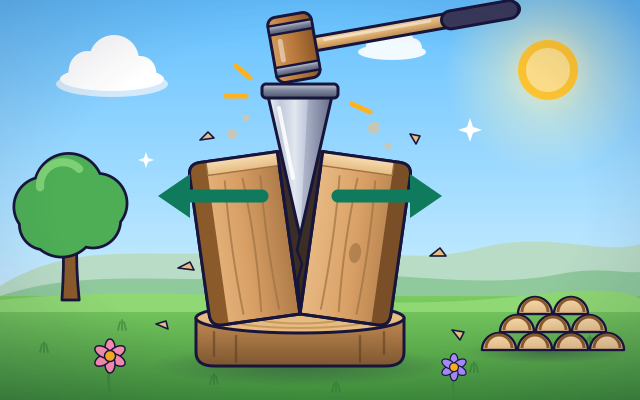 #106
Forces & mechanisms
How do wedges split or separate materials?
Push different wedge shapes into model materials and watch forces move the sides apart.
#106
Forces & mechanisms
How do wedges split or separate materials?
Push different wedge shapes into model materials and watch forces move the sides apart.
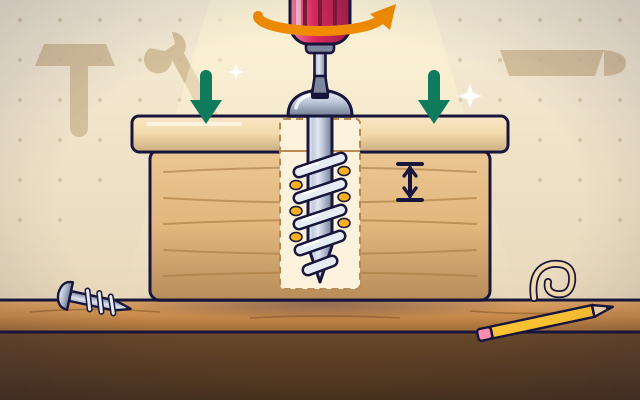 #107
Forces & mechanisms
How do screw threads hold things together?
Turn screws with different thread spacing and compare forward movement and fastening action.
#107
Forces & mechanisms
How do screw threads hold things together?
Turn screws with different thread spacing and compare forward movement and fastening action.
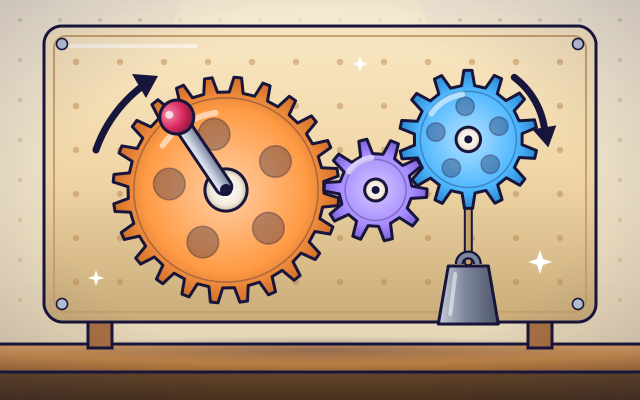 #108
Forces & mechanisms
How do gears change speed and direction?
Connect different-sized gears and observe rotation speed, direction, and turning force.
#108
Forces & mechanisms
How do gears change speed and direction?
Connect different-sized gears and observe rotation speed, direction, and turning force.
 #109
Forces & mechanisms
How do cams create repeating movements?
Rotate differently shaped cams and watch connected parts rise, pause, and fall.
#109
Forces & mechanisms
How do cams create repeating movements?
Rotate differently shaped cams and watch connected parts rise, pause, and fall.
Keep exploring
Games to play next
- Machine RepairFix levers, pulleys, gears and ramps so every contraption works.
- Marble MountainLay straights, curves, drops and splitters to roll marbles down the mountain.
- Bridge LabBuild a bridge from beams, brace it with triangles, and stay on budget.
Guide for grown-ups
- How to start homeschooling: a step-by-step guide for familiesA guide for parents · 7 min read
Science games by grade
Science worksheets by grade
- Preschool Science Worksheets
- Pre-K Science Worksheets
- Kindergarten Science Worksheets
- 1st Grade Science Worksheets
- 2nd Grade Science Worksheets
- 3rd Grade Science Worksheets
- 4th Grade Science Worksheets
- 5th Grade Science Worksheets
- 6th Grade Science Worksheets
- 7th Grade Science Worksheets
- 8th Grade Science Worksheets